
Russia picks off Ukraine's substations to freeze it into submission


Russia is knocking out Ukraine's substations that carry power from Ukraine's nuclear plants to its cities, leaving parts of Kyiv with one hour of power a day.
"Russia is methodically freezing Ukraine one substation at a time," Iuliia Mendel, a former press secretary to President Volodymyr Zelenskiy, said on X on November 1. Power is available for roughly one hour a day in parts of Kyiv, and some districts of Dnipro have gone several days in a row without electricity, she said, as Russian strikes hit facilities that crews had almost restored and force them to start again. Russian strikes on October 29 left up to 350,000 people in and around Dnipro without power, Governor Oleksandr Hanzha said, the Kyiv Independent reported.
The latest tactic is part of Russian President Vladimir Putin’s “Pandora’s box” strategy of systematically destroying Ukraine’s economy, in retaliation to Kyiv decision to target Wildberries warehouse in July. Since then Russia has destroyed 90% of Ukraine’s modern warehouses as it attempts to systematically destroy Ukraine’s retail infrastructure, then moved on to petrol stations and more recently has started attacking the railway. At least two thirds of power generation capacity has already been destroyed and the Odesa port cut off from the rest of country, bottling up Ukraine’s large agricultural sector so grain can’t be exported, and the metallurgical sector has been brought to a standstill for the first time in a century.
The campaign targets the weakest link in a system Russia has already gutted. Strikes since early 2024 have damaged or destroyed nearly all of Ukraine's thermal and hydro capacity, leaving the three nuclear plants under Kyiv's control, Rivne, Khmelnytskyi and South Ukraine, as the backbone of supply. Russia has not hit the reactors, but it does not need to. A nuclear plant that cannot send its output onto the grid has to throttle back or shut down, so Moscow is going after the 750 kV substations and switchyards that connect them, in its fifth winter attempt to freeze Ukraine into submission.
The backbone
Ukrenergo, the state grid operator, runs 103 substations of 220-750 kV, according to its website, not counting another 32 in occupied Donbas and Crimea. At the top sits the 750 kV ultra-high-voltage tier. Open-source grid maps list eight 750 kV substations, from Zakhidnoukrainska near Lviv through Vinnytska, Kyivska, Pivnichnoukrainska and Dniprovska to Zaporizka, Kakhovska and Prymorska in the south.
Voltages that high are rare in Europe, where most networks run at 400 kV or less, so spares are scarce, and a large 750 kV transformer is custom-built and can take six to 18 months to replace. Kyivska takes the output of the Rivne and Khmelnytskyi plants to the capital and central Ukraine, including over a 346 km line from Rivne commissioned in December 2015. Zakhidnoukrainska supplies the west and ties Ukraine to the European grid, on which it now depends for imports.
Nineteen substations are critical to the safe running of Ukraine's nuclear plants, and the International Atomic Energy Agency (IAEA) will send monitoring missions to all of them, Foreign Minister Andrii Sybiha said after meeting IAEA Director General Rafael Grossi in Warsaw on October 13. Sybiha called it "the largest deployment of IAEA missions of this type to date".
How many have been hit
Ukraine does not publish damage reports for its grid, so there is no official count. IntelliNews' Missile War Monitor that tracks the destruction (including ledger detailing the missile and drone strikes since the summer), counts at least four of the eight 750 kV nodes struck since December. Missiles hit a 750 kV substation outside Odesa on December 7, 2025, blacking out the city for nearly two days. On February 7 Russia struck Kyivska and Zakhidnoukrainska together with the Burshtyn, Dobrotvir and Trypillia thermal plants, Ukrainian media reported, and the monitoring account Defence Index said Vinnytska was hit by two Zircon missiles. Kyivska came under attack again on October 1, with the extent of the damage undisclosed.
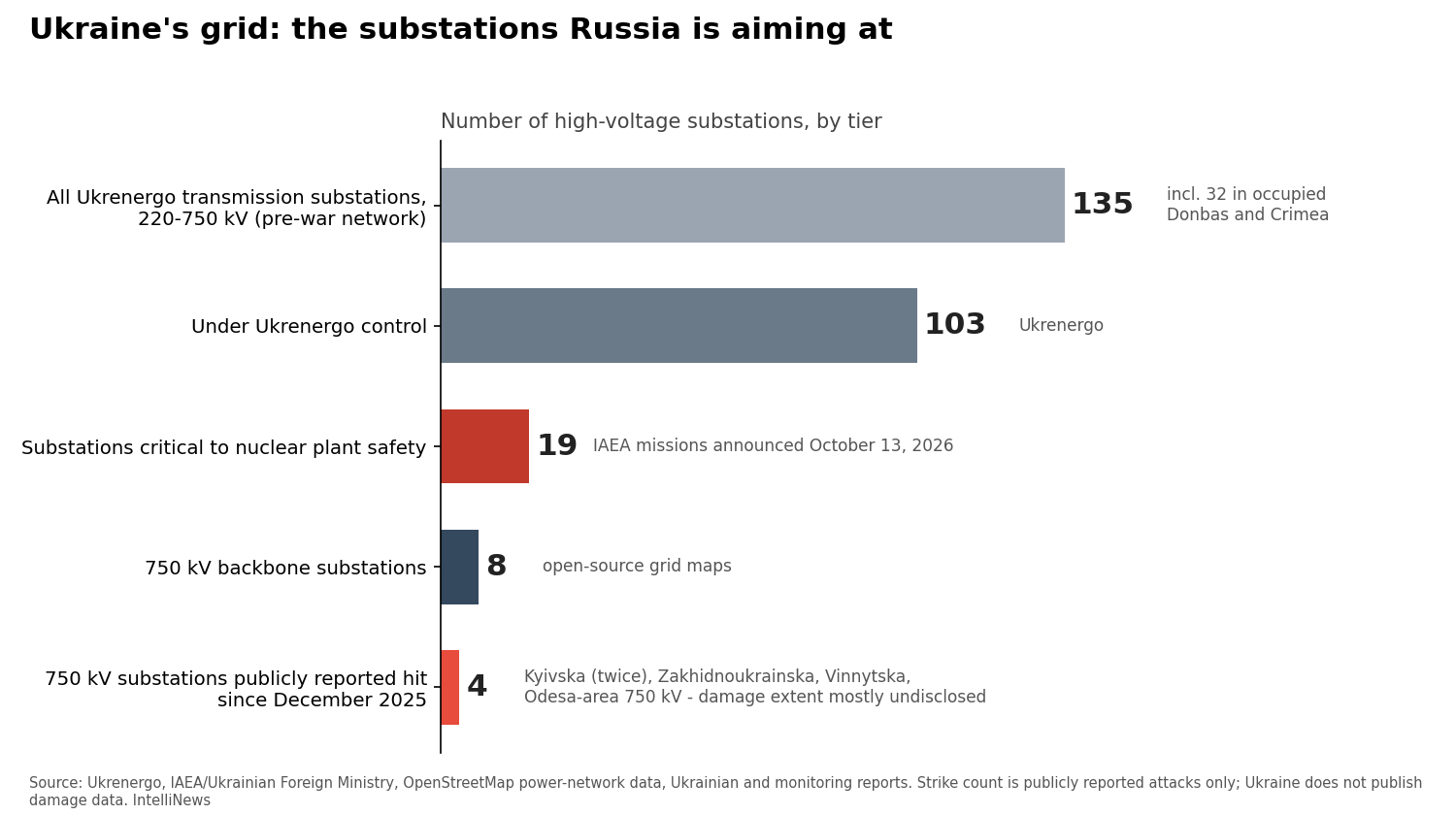
Ukraine's high-voltage substations by tier, and the 750 kV nodes publicly reported hit since December 2025. Source: Ukrenergo, IAEA, OpenStreetMap, Ukrainian and monitoring reports. IntelliNews
Below that tier the strikes are near nightly. Drones hit the 330 kV substation serving Zhytomyr on October 17, blacking out the regional centre, according to a Russian monitoring channel, and Russia's defence ministry claimed a strike on a Zhytomyr substation that moves power from western to central Ukraine. The 330 kV Artsyz substation in the Odesa region was hit two days later, the monitoring account AMK Mapping said, and the Zalyutyne substation on the western edge of Kharkiv on October 26. Overnight strikes on October 18 hit substations in the Vinnytsia, Zhytomyr, Khmelnytskyi and Odesa regions, leaving tens of thousands of families without power.
The October 14 assault on Ukrenergo's facilities was among the largest since the full-scale invasion, its chairman Vitalii Zaichenko said, and ballistic missiles damaged equipment. Hryhorii Plachkov, a former head of Ukraine's nuclear regulator, warned that grid damage could stop nuclear electricity reaching homes and businesses even with the plants running.
The plants have already felt it. Strikes on October 30, 2025 cost the South Ukraine and Khmelnytskyi plants one off-site power line each, and the grid operator had to cut output at two of Rivne's four units to keep the system stable, the IAEA said at the time. "The threats to nuclear safety remain very real and constant," Grossi said.
Nowhere to send the power
A Russian plan reported by the New York Times envisages up to 1,000 missiles, drones and bombs to disable as much as 15 GW of capacity and gut essential services in Kyiv, Kharkiv and Odesa, and attacks on switchyards could force the Rivne, Khmelnytskyi and South Ukraine plants offline. Strikes on substations near the western border would also choke off imports from the EU - Ukraine's main fall back as its own capacity is hampered.
Kyiv went dark on October 8 after an attack on what Energy Minister Denys Shmyhal called "one of the energy facilities important for the city of Kyiv", halting the metro and cutting water pressure, and Ukrenergo blamed later emergency cuts on "falling voltage in the high-voltage network".
Ukraine is hitting back at Russia's energy system. A drone attack overnight on November 1 caused "significant damage" to an industrial enterprise in the Kstovo district, home to Lukoil's largest refinery, Nizhny Novgorod Governor Gleb Nikitin said, Interfax reported. The refinery processes about 17mn tonnes of oil a year, according to Mendel.
The substation war is the latest stage of a campaign that has already pushed Ukraine to rebuild its power system from the bottom up. Businesses have built 4 GW of their own generation in 18 months because the centralised grid can no longer guarantee supply, and the government's winter targets assume capacity that Russian strikes have broken every previous winter. With the 750 kV nodes now in the firing line, the question this winter is less how much power Ukraine can generate than whether it can move it.
Unlock premium news, Start your free trial today.


