
Halloween youth protests spread from France to Germany as Europe's economic model cracks


Youth-led protests swept Europe on Halloween as 320,000 people marched in France, according to the interior ministry, for a third straight weekend, while the unrest spread to dozens of German cities.
The French interior ministry put turnout on October 31 at 320,000, including 70,000 in Paris, while a coalition of youth groups and student unions claimed nearly half a million. The marches started peacefully but ended in clashes on the eastern edge of Paris, where masked protesters prised up paving stones and threw them at police, who answered with tear gas and baton charges. Police also fired tear gas in Lyon, and the ministry counted around 290 arrests nationwide by the evening.
In Germany the Gen Z regelt ("Gen Z handles it") alliance of school and university students said 120,000 people took to the streets against social spending cuts, crumbling schools, the cost of living and the return of conscription. Police used water cannon in Frankfurt, Cologne and Hamburg. Frankfurt police described "violent riots", with looting and Molotov cocktails thrown at emergency services, and in Hamburg officers said they were "repeatedly pelted with stones, fireworks and other objects" before organisers called the march off early, Al Jazeera reported.
The triggers differ from country to country but the protests share a common root: a generation that no longer believes it will live better than its parents, squeezed by a cost-of-living crisis that started with an energy shock and is now being made worse as governments divert scarce money to rearmament and the war in Ukraine. That makes this a structural crisis rather than a cyclical one, and the anger is already being harvested by the populist right.
The French movement began in the lycees on September 17 over dilapidated school buildings, teacher shortages and the Parcoursup university admissions system, and grew into the country's worst rioting in years. On October 17 the government estimated turnout at more than 500,000 and shops were looted in Paris. The wave has since reached Belgium, Italy, where there were clashes in Milan, Turin and Bologna, and Spain, where Catalan police raised their alert to the highest level after rioting in Barcelona on October 24 led to about 130 arrests, most of them minors. In Germany, school students had already walked out in more than 100 cities in September against the step-by-step return of military service.
In Albania, where students have been on the streets since October 13 demanding Prime Minister Edi Rama's resignation, Halloween brought placards reading "The real monsters wear suits!" that cast Rama and opposition leader Sali Berisha as blood-soaked vampires above a crate marked "Korrupsion". Berisha's Democratic Party had called a national rally for October 31 in support of the students, who have refused Rama's offers of talks, but the demand on the streets is increasingly for both men to go, according to the Tirana Report news account on X. The government has answered with fines for anyone who stays in a crowd that turns violent.
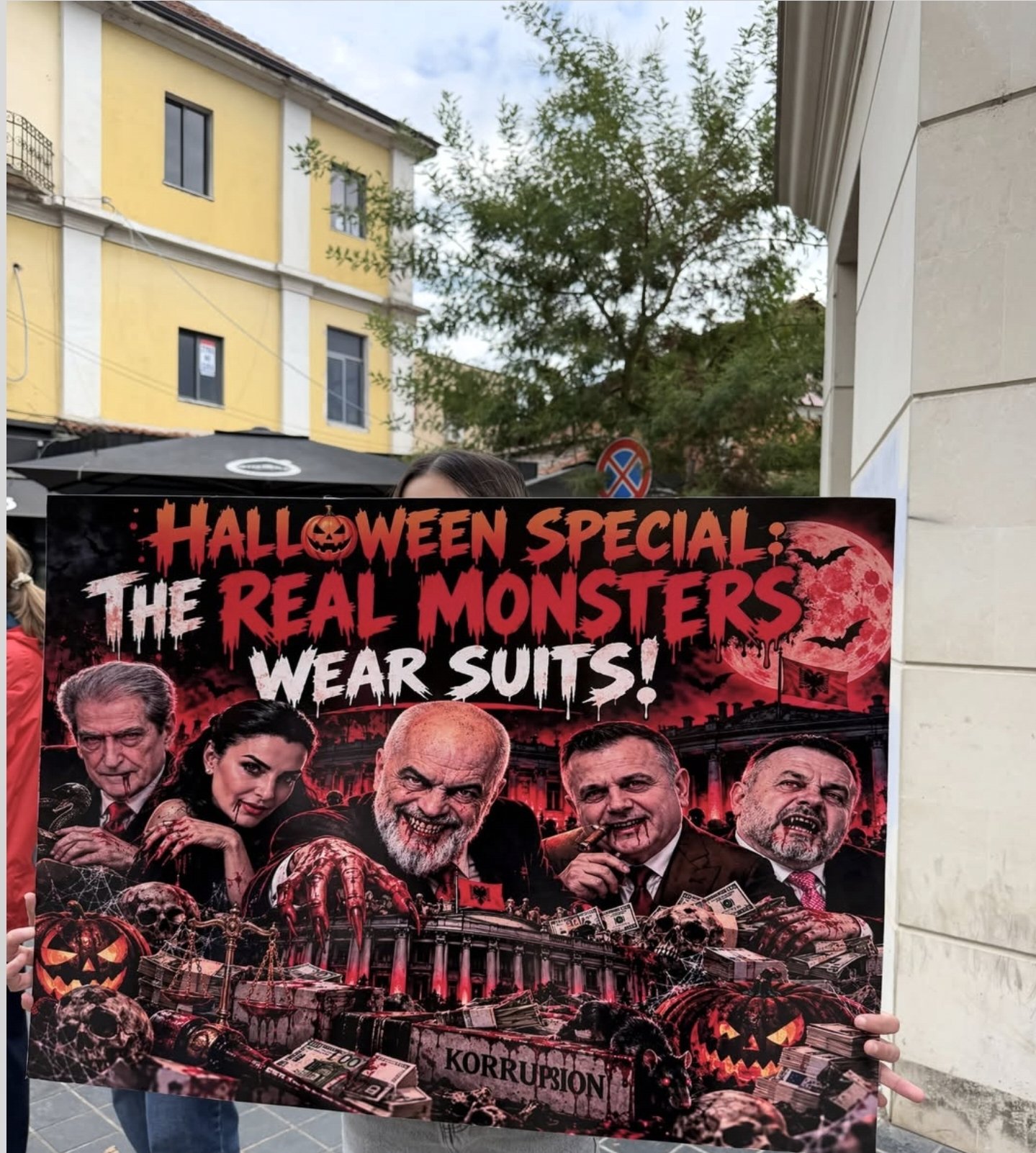
A Halloween placard at an anti-government protest in Albania on October 31. Source: X
Robbed of a future
"These are the protests of a generation that believes it has been robbed of its future," Thomas Fazi wrote in UnHerd on November 1. The triggers are schools in France and Belgium, housing in Spain and Portugal, the cost of living in Italy and corruption in Serbia, but the social contract their parents knew - work hard and you will own a home, support a family and do better than the generation before - has collapsed, according to Fazi.
A decade of quantitative easing inflated the property and financial assets held by the old while wages stagnated, locking the young out of home ownership. Labour market reforms such as Germany's Hartz laws, Italy's Jobs Act and France's El Khomri law protected those already in work and pushed newcomers into a revolving door of temporary contracts, and after 2010 austerity fell hardest on education, youth services and public investment. Then came the pandemic, an inflation surge and an energy shock "that Europe's leaders largely inflicted on themselves", according to Fazi. Now the young are being asked to accept further cuts "to make room for rearmament and an open-ended war".
In France the over-60s, about a quarter of the population, hold around 60% of national wealth, according to Fazi, and the political consequences are already visible: a third of French under-25s backed the far-right Rassemblement National in 2024, and more than a quarter of young German men voted for the Alternative for Germany (AfD).
Playing with fire
The AfD, which tops national opinion polls, is the main beneficiary of that anger, but a leak of more than 420,000 internal party emails published online on October 20 shows how uneasy its own leader once was about the radicals in its ranks. In messages from 2015-2017 reviewed by Welt, co-leader Alice Weidel warned the party leadership that its closeness to the Pegida street movement and the neo-Nazi National Democratic Party was scaring off conservative voters, and that radicals were blurring the line between the AfD and neo-Nazi politics.
Weidel called a speech by Thuringian AfD leader Bjoern Hoecke contrasting African and European "types" deeply problematic and in 2017 backed a move to expel him from the party. When the party's then press spokesman Christian Lueth circulated a New York Times commentary critical of Hoecke, Weidel replied two minutes later: "Ich muss es jetzt so sagen: Ich koennte kotzen" ("I have to say it now: I could puke"), according to the leaked emails reported by Tagesspiegel. In 2025 she said she got on well with Hoecke and that he was fit for a federal cabinet post.
"The German extreme Left and Right are terrified of their own supporters who propel them in elections," Wall Street Journal correspondent Bojan Pancevski said in a post on X on October 31. The AfD has not confirmed whether the emails are genuine and has urged the media not to spread material obtained by data theft.
The emails are a decade old, but the dilemma is current. The AfD is feeding on the frustration that put tens of thousands of young Germans on the streets on Halloween, while its leader knows from experience how quickly the radical fringe can take over. A population that feels its living standards slipping away is radicalising, and the parties riding that mood are playing with fire.
France in the worst shape
The protests are erupting in a dysfunctional European economy, and France is in the worst shape of the big three. Fitch Ratings cut the outlook on France's 'A+' rating to negative from stable on October 30, citing "weaker growth, renewed fiscal deterioration and higher yields". Fitch, which had already cut France to 'A+' in September 2025, now expects public debt to rise from 115.7% of GDP in 2025 to 124% in 2028, and warned that divisions ahead of the 2027 presidential election could make it hard to agree "a credible fiscal strategy". The economy contracted by 0.1% q/q in 3Q26, according to statistics office INSEE.
"France is in a debt crisis. The problem is that the ECB has a track record of bailing countries out when things get tough. So politicians don't have an incentive to fix stuff, because they know the ECB will be there," economist Robin Brooks, a former chief economist of the Institute of International Finance, said in a post on X on October 4, before the Fitch decision. In an outlook published in mid-October he put the chance of a French debt crisis by the end of the year at 30%, and he expects the ECB to step in to cap yields if the sell-off deepens.
The energy shock that undid the model
The cost-of-living crisis is rotting European societies, and its root is the price of energy. Cheap Russian pipeline gas was the foundation of the European, and above all the German, economic model. Germany lost that gas after 2022, having already shut its last three nuclear power stations in April 2023, and its power prices are now among the highest in Europe. German industry is deindustrialising and inflation-adjusted output is still stuck at 2019 levels.
The sanctions boomerang has hit Germany, France and Italy hardest, while Russia keeps selling its oil. Russia has earned more than €1 trillion from fossil fuel exports since the full-scale invasion of February 2022, passing that mark in early January, according to a report by the Centre for Research on Energy and Clean Air (CREA). Its revenue in the fourth year of the war was €193bn, including €85.5bn from crude oil. Sanctioned tankers carried more than 60% of Russia's seaborne crude by 4Q25, and Western sanctions "have failed to cut supplies, even while forcing deeper price discounts", according to CREA.
The sanctions bite on the margin: Russia's oil and gas budget revenue fell 22.7% y/y in 1H26. Yet Brussels keeps adding packages that leave the main income stream intact. The 22nd sanctions package, adopted on October 12, listed a record 826 companies and 743 individuals, but the EU has switched to adding names because sector-wide curbs need a unanimity that Greece withheld from the 21st sanctions package in July. Athens only let that package through after winning an exemption for its shipowners, whose tankers make up about a fifth of Russia's shadow fleet.
Interregnum
Europe's malaise is part of something bigger. The Pax Americana has passed its peak and the world has entered an Interregnum as it moves from a unipolar to a multipolar order. The old "rules-based order" has been smashed, and the transition brings chaos, tension, war, protest and protectionism. Empires tend to last about a hundred years, and what follows is usually several decades of instability and lower growth as the leading powers vie to fill the void.
The West is in relative decline and has so far failed to come to terms with the rise of the Global South. The youth protests are one symptom of that decline: a generation inheriting a shrinking share of global wealth, a stagnant economy and a state that has less and less to offer it.
Guns, not growth
Europe knows what it needs to do. Former ECB president Mario Draghi's report on EU competitiveness, published in September 2024, called for an extra €750bn-800bn a year of investment, or 4.4%-4.7% of GDP, to close the innovation gap with the US and China. It is not happening. The Commission's proposal for the 2028-2034 Multiannual Financial Framework (MFF), the EU's seven-year budget, comes to almost €2 trillion in total, a fraction of what Draghi asked for each year.
The €800bn figure has instead reappeared in the Commission's ReArm Europe plan for defence, and Nato members have committed to lift defence spending to 5% of GDP. Ukraine fatigue is rising as a result. "We have a problem, namely Ukraine: we are there largely on our own, and we are the biggest supporters there," EU foreign policy chief Kaja Kallas told reporters in April.
The young protesters connect two themes. The first is conscription: Germany's new military service law, passed in December 2025, is bringing compulsory service back step by step, and many teenagers do not want to be trained to fight for Ukraine, which is a member of neither the EU nor Nato. The second is spending cuts to schools and public services, which they link to the money flowing to Kyiv. Europe was already losing competitiveness before 2022, and the war has made every one of these problems worse.
Chancellor Friedrich Merz rejects the link. "Not a single euro that flows to Ukraine is being diverted from social spending and education spending in our country," he told the Bundestag on October 14. The streets of Frankfurt, Hamburg and Cologne on Halloween suggest few young Germans believe him. Merz's support for Ukraine at almost any cost has left his government out of touch with a large part of the electorate, and the AfD and the populist right, in Germany and across the continent, are the ones gaining from it.
None of this will be fixed by a better budget round or a rate cut. Expensive energy, an ageing society, a war on the EU's border and a shrinking place in a multipolar world are structural problems, and the generation now on the streets will be living with them for decades.
Unlock premium news, Start your free trial today.


