
India's IPO queue grows, the rupee sags and a Super El Niño looms


Indian companies are still queuing up to list their shares, despite a rupee near record lows, record foreign selling and a Super El Niño threatening the harvest.
About 15 companies are lined up to open initial public offerings (IPOs) in the coming week, seeking roughly INR280bn ($2.95bn) between them, according to the October 30 daily market report from Delhi-based listing adviser India IPO. Five issues opened on October 30 alone, one on the main board and four on the small-company platforms, chasing just over INR4.6bn.
The visible calendar is thinner than that headline count. Listings tracked by IPO Watch show only one main-board offer running into the new week, Bombay Coated and Special Steels, which wants INR1.83bn, alongside a handful of small-company deals. The bigger names said to be preparing, such as brewer Carlsberg India with an estimated INR67bn sale and hotel platform OYO with about INR33.5bn, have no confirmed dates, according to Upstox.
Whichever count proves right, the primary market is doing something the secondary market is not: drawing money in. In the April-September half of the 2026-27 financial year, 78 companies raised INR942bn through IPOs, 35.4% more than a year earlier. Jio Platforms, the telecoms and digital arm of Reliance Industries (NSE: RELIANCE), raised INR302bn in the largest IPO India has seen, overtaking Hyundai Motor India's INR278.7bn offer of 2024, after oversubscribing more than five times with a day of bidding to spare. It began trading on October 28 at a valuation of about $137bn, Reuters reported.
Rahul Saraf, head of investment banking for India at Citi (NYSE: C), told Reuters on October 29 that dealmaking was holding up because buyers were acting on long-term business logic rather than financial engineering. When an acquisition is about building a business, a currency move of 1-2% barely changes the calculation, in his view.
The numbers only half back him. Mergers and acquisitions involving Indian companies were worth $95.5bn so far this year, down more than 19% from $118.5bn a year earlier on LSEG data, although the number of deals barely changed. Saraf expects more partnerships between Chinese groups and Indian conglomerates, after New Delhi eased rules on minority Chinese stakes in March, and argues that about $700bn of shares held by domestic mutual funds and insurers, plus promoters' 45% ownership, will eventually lure global investors back.
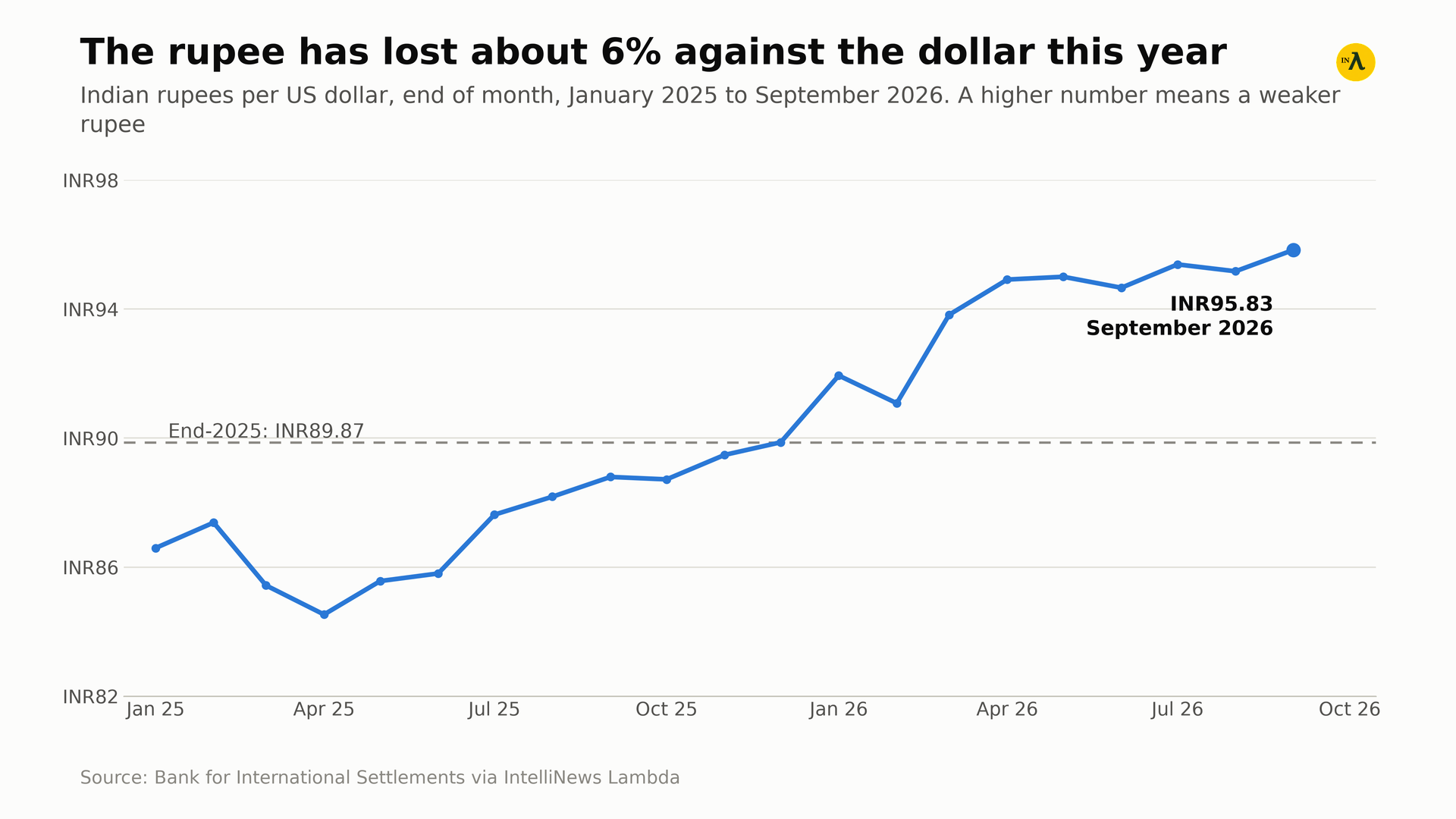
Indian rupees per US dollar, end of month, January 2025 to September 2026. Source: Bank for International Settlements via IntelliNews Lambda
They have yet to return. The rupee has lost about 6% against the dollar this year and traded around INR95 on October 30, with the European Central Bank's reference rates implying INR94.96. It ended September at INR95.83. The Reserve Bank of India (RBI) has tightened scrutiny of large overseas investments by Indian companies and lifted its repo rate by 25 basis points to 5.5% on October 9, its first increase in almost four years. The IMF's weaker exchange-rate assumptions have already pushed India's $5 trillion milestone back to 2029.
Foreign portfolio investors had sold a record $32.56bn of Indian shares this year by October 26, according to Reuters. The outflow has prompted State Bank of India's economists to call for scrapping capital gains tax on equities, and the pension regulator is weighing whether to let the $184bn National Pension System buy a wider range of listed stocks.
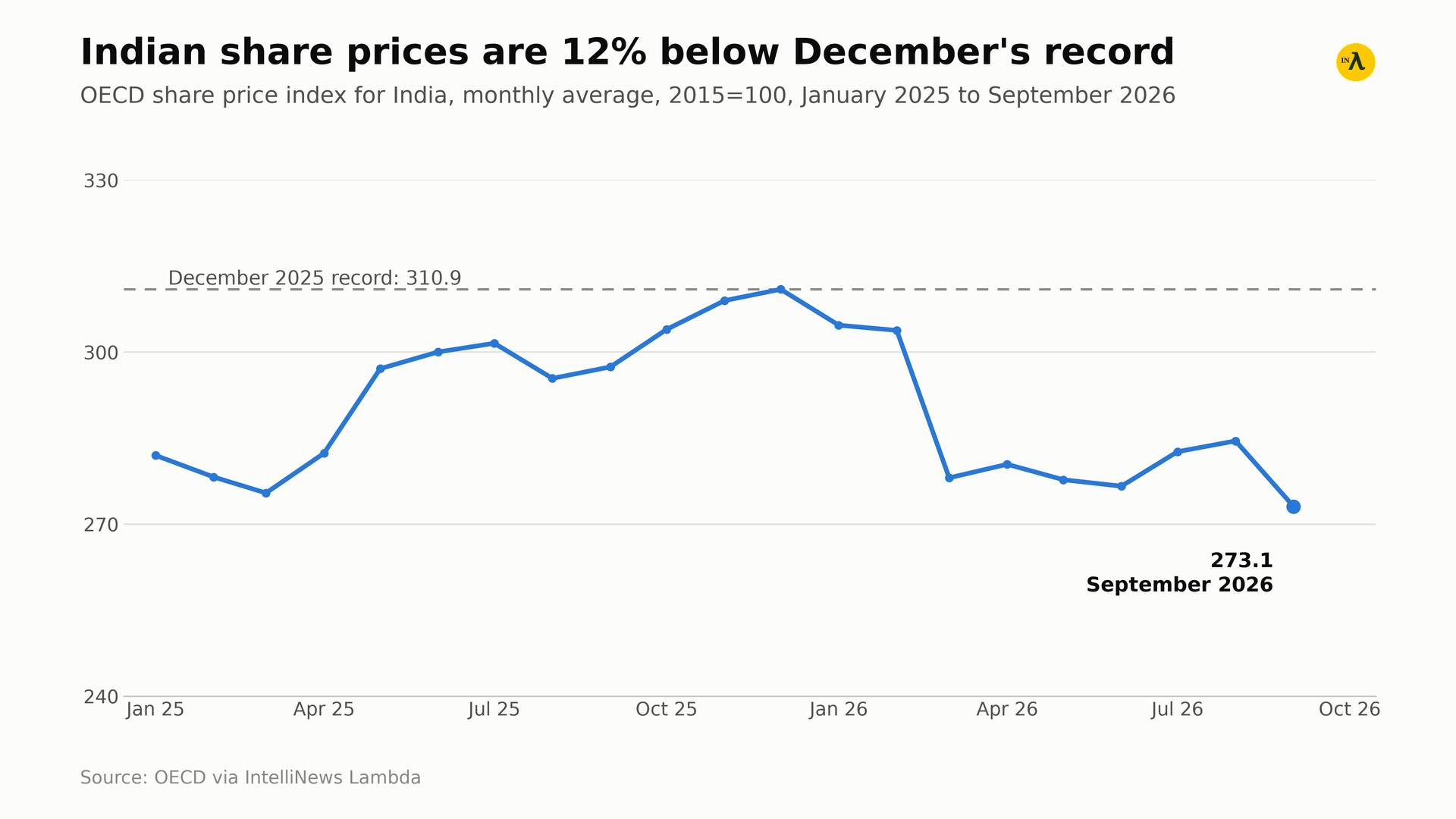
OECD share price index for India, monthly average, 2015=100, January 2025 to September 2026. Source: OECD via IntelliNews Lambda
Share prices show the damage. The OECD's monthly gauge of Indian equities averaged 12% below its December 2025 record in September. A relief rally on October 29 lifted the BSE Sensex 1.24% to 74,151.04 and the Nifty 50 1.05% to 22,936.75, yet even on that day foreign investors were net sellers of INR9.44bn of shares in the cash market, while domestic institutions bought INR19.24bn.
The risks are not only financial. At a press briefing reported on October 29, IMF communications director Julie Kozack said the weather was the threat to watch.
“So these are risks that we see that India faces, but right now those risks have not materialised,” she said, adding that “we will reassess our growth projections for India the next time in our January WEO update.”
For now the fund sees “quite strong growth momentum in India.” Its October World Economic Outlook lifted growth forecasts for both the 2026-27 and 2027-28 financial years to 7%, from 6.4% and 6.7% in July. The World Bank and RBI opted to raise forecasts for 2026 to 7.1%.
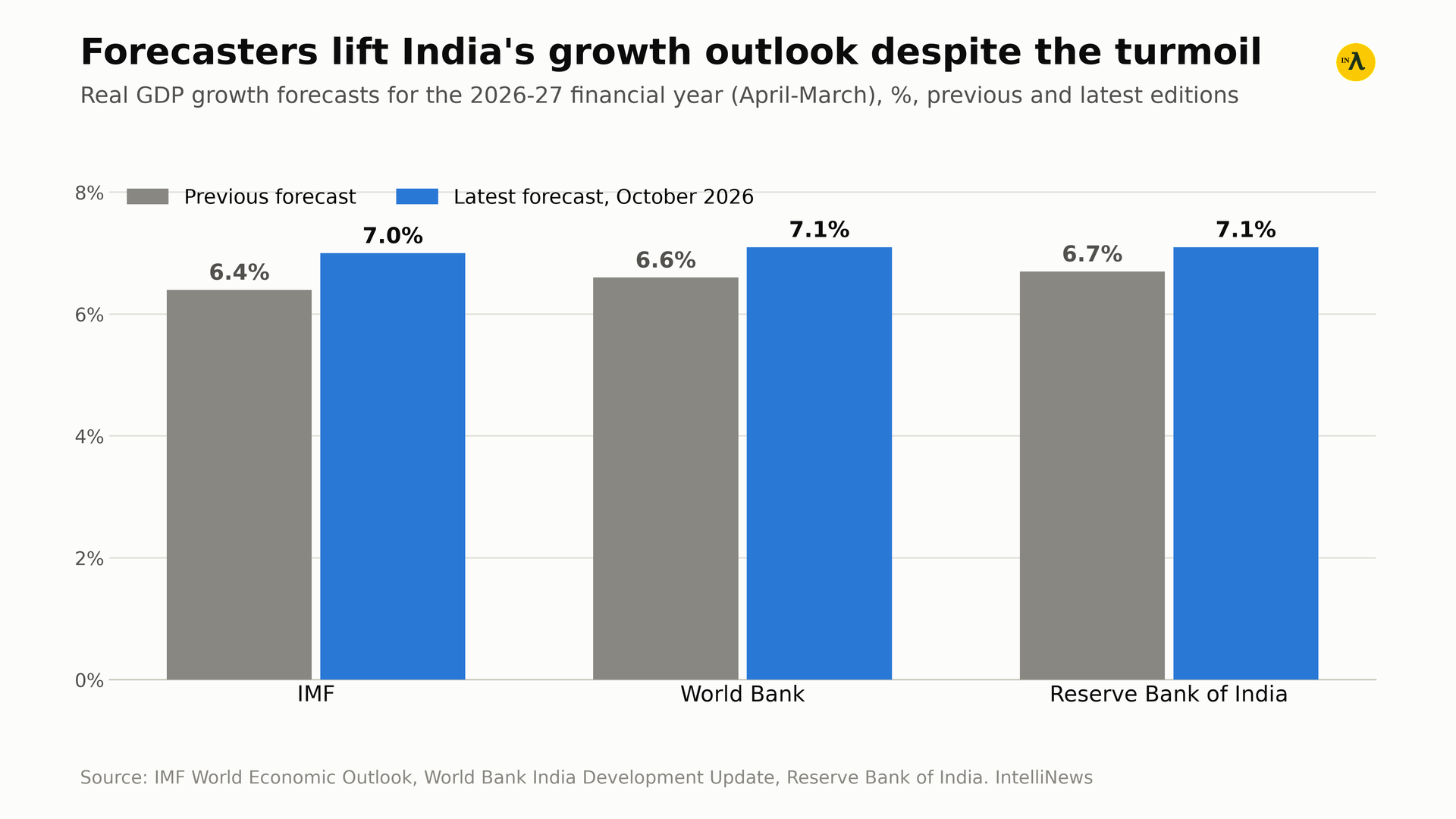
Real GDP growth forecasts for the 2026-27 financial year, previous and latest editions, %. Source: IMF World Economic Outlook, World Bank India Development Update, Reserve Bank of India. IntelliNews
Those upgrades leave little room for a bad harvest. The southwest monsoon ended 13% below its long-period average, already putting rice output under pressure, and retail inflation reached 5.54% in September, close to the RBI's 6% upper limit. A strong El Niño would mean dearer food, smaller rural budgets and more pressure on the central bank to keep raising rates. Traders were already pricing in slightly more than 100 basis points of increases over the coming year, Reuters reported on October 21.
That is the bind for the dealmakers. Citi's equity capital markets team reckoned in May that 60-70% of India's issuance over the past two years landed in the final quarter, The Economic Times reported. This year's final quarter has arrived with the rupee weak, foreign funds selling and the weather report on the IMF's agenda.
This article was produced with the help of IntelliNews Lambda analytical tool
Unlock premium news, Start your free trial today.


