
Western oil majors, Europe's arms makers win the money war as Saudi Arabia, Qatar lose out


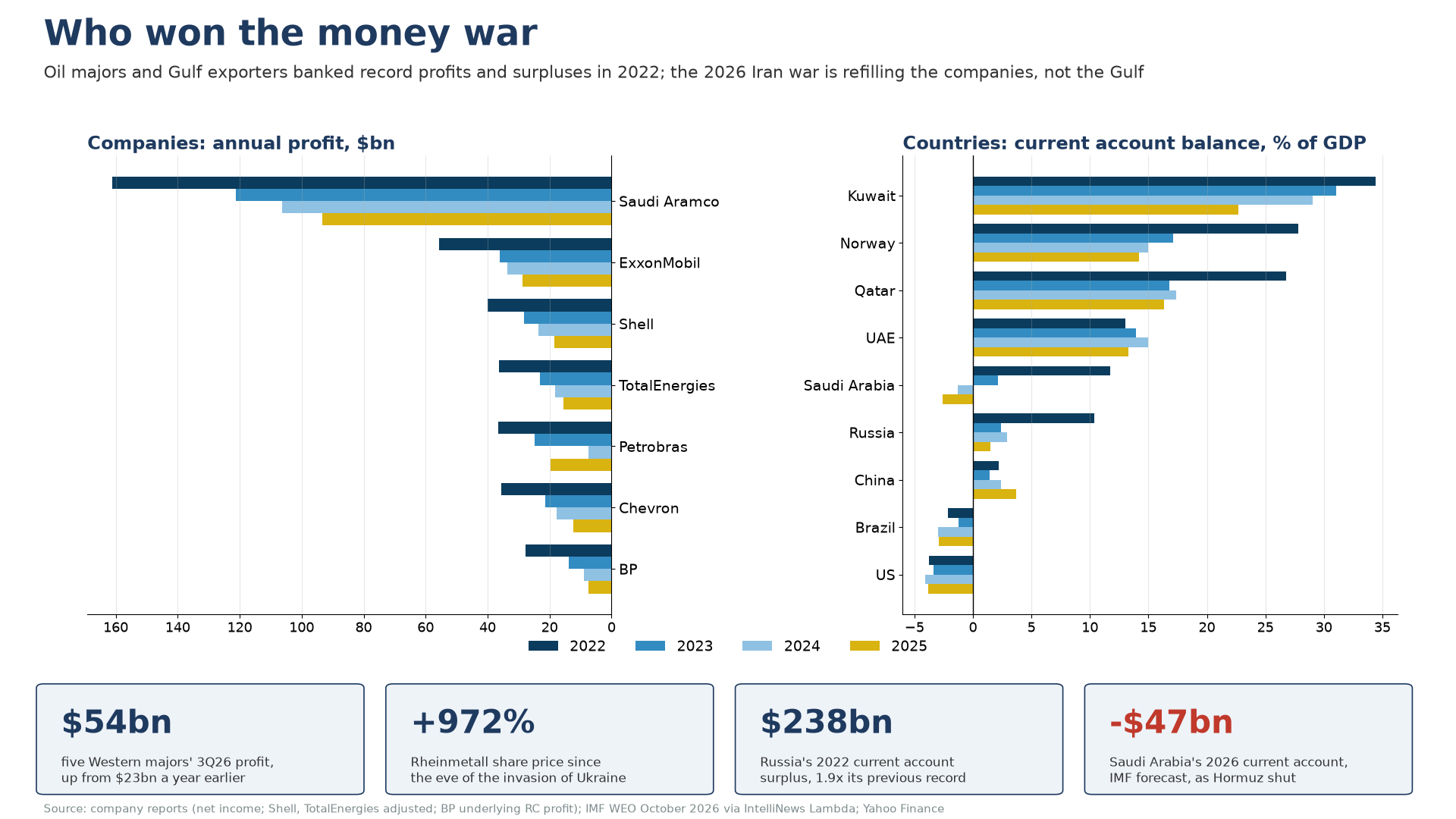
Who won the money war. Source: company reports; IMF WEO October 2026 via IntelliNews Lambda; Yahoo Finance
Western oil majors and European arms makers are making the most money from the wars in Ukraine and Iran, while Gulf producers cashed in during 2022 energy crisis.
BP's underlying replacement cost profit hit an 18-year high of $8.46bn in the third quarter, almost four times the $2.2bn of a year earlier, the company said on October 30. Campaign group Global Witness called the result "obscene", The Guardian reported the same day. ExxonMobil, Chevron, Shell and TotalEnergies posted similar jumps, and the five Western majors together earned about $54bn in 3Q26, against roughly $23bn in 3Q25.
The windfall is the second biggest of this decade. Russia's invasion of Ukraine in February 2022 sent the same five companies to a combined record of about $195bn in annual profit, and handed oil exporters from Moscow to Riyadh record or near-record current account surpluses.
This time round the distribution of money is different. Producers outside the Strait of Hormuz, and the refiners that turn crude into scarce diesel, are capturing the gains, while Saudi Arabia, Qatar and the other Gulf exporters whose barrels are trapped behind the chokepoint have seen their surpluses shrink or turn into deficits. Europe's defence companies have grown profits faster than their American rivals and carry the biggest share-price gains of the war years.
US households had spent more than $100bn extra on gasoline and diesel by September 7, or over $750 each, since the war began on February 28, according to Brown University's Iran War Energy Cost Tracker. Oil and gas companies have made more than $130bn in the past six months, almost three times as much as a year earlier, the New York Times reported, days before US voters go to the polls in the November 3 midterm elections.
Europe out-earns the US on arms
Europe's arms makers have grown profits faster than the big US contractors since 2020, a period spanning the full-scale invasion of Ukraine, according to an analyst comparison published by Ukraine Business News on October 29. Sweden's Saab and Italy's Leonardo did best, each lifting profit more than fivefold. Lockheed Martin, the world's largest defence company, earned less in 2025 than in 2020.
| Company | Country | Profit 2020, $bn | Profit 2025, $bn | Change | Share price since Feb 23, 2022 |
| Saab | Sweden | 0.12 | 0.64 | +433% | +1,175% |
| Leonardo | Italy | 0.27 | 1.38 | +411% | +709% |
| Airbus | EU | 1.29 | 5.91 | +358% | +69% |
| Rheinmetall | Germany | 0.31 | 0.79 | +155% | +972% |
| BAE Systems | UK | 1.67 | 2.72 | +63% | +245% |
| RTX | US | 3.52 | 6.73 | +91% | +117% |
| General Dynamics | US | n/a | c.4.2 | n/a | +72% |
| Northrop Grumman | US | n/a | c.4.2 | n/a | +44% |
| Lockheed Martin | US | 6.83 | 5.02 | -27% | +64% |
Defence company profits 2020-2025. Source: analyst comparison via Ukraine Business News (profits); Yahoo Finance closing prices to October 30, 2026 (shares). IntelliNews
Saab's revenue rose 109.6% over the five years, Rheinmetall's 76.3% and BAE Systems' 51%, against 14.8% at Lockheed Martin and 14% at Northrop Grumman. The comparison does not show how much of the growth came from the war in Ukraine itself rather than from the wider rearmament drive that followed, as governments across the continent asked whether they could afford to rearm.
Rheinmetall has become the emblem of that boom. The Duesseldorf-based maker of tanks, guns and ammunition reported record sales of €9.9bn for 2025, up 29%, and an operating result of €1.84bn, a margin of 18.5%, according to its annual report. Its backlog stood at €63.8bn at the end of 2025 and reached €80.5bn by the end of June, against €56bn a year earlier. It has spent part of the money expanding east, buying Romania's Mangalia shipyard for €138mn in October.
Rheinmetall shares closed at €96.78 on February 23, 2022, the eve of the invasion, and peaked at €1,988.50 on September 29, 2025 - a twentyfold gain. They have since lost almost half their value, closing at €1,037.60 on October 30, after the company trimmed its 2026 sales guidance and hopes of a ceasefire in Ukraine knocked 36.5% off the stock in the first half. Even so, a shareholder who bought before the invasion is still up 972%. The company publishes third-quarter results on November 5.
Big Oil is back at 2022 levels
The five Western oil majors earned a combined $195bn in 2022, when Brent crude averaged about $99 a barrel. Profits then fell for three years in a row, to about $83bn in 2025 as Brent averaged $68/b, before the Iran war reversed the slide.
| Company | 2021 | 2022 | 2023 | 2024 | 2025 | 3Q25 | 3Q26 |
| ExxonMobil (US) | 23.0 | 55.7 | 36.0 | 33.7 | 28.8 | 7.5 | 15.4 |
| Chevron (US) | 15.6 | 35.5 | 21.4 | 17.7 | 12.3 | 3.6 | 10.4 |
| Shell (UK) | 19.3 | 39.9 | 28.3 | 23.7 | 18.5 | 5.4 | 10.8 |
| TotalEnergies (France) | 18.1 | 36.2 | 23.2 | 18.3 | 15.6 | 4.0 | 9.1 |
| BP (UK) | 12.8 | 27.7 | 13.8 | 8.9 | 7.5 | 2.2 | 8.5 |
| Total | 88.8 | 195.0 | 122.7 | 102.3 | 82.7 | 22.7 | 54.2 |
Western oil majors' profits, $bn. ExxonMobil net income; Chevron net income (quarters adjusted); Shell and TotalEnergies adjusted earnings; BP underlying replacement cost profit. Source: company reports. IntelliNews
Brent closed at $72.48 a barrel on February 27, the last trading day before US and Israeli strikes on Iran, and hit a closing high of $118.35/b on March 31 as traffic through Hormuz collapsed. The big profits came first from crude, with ExxonMobil and Chevron reporting multi-year highs in the second quarter, and then from refining. ExxonMobil's refineries earned about $7.2bn in the third quarter, more than its oil and gas fields, as the US Gulf Coast crack spread hit an all-time high of $72.64 on September 22, CNBC reported. Chevron's adjusted earnings of $10.4bn compared with $3.6bn a year earlier, according to its results statement.
"It really was a banner quarter for the refining business," BP chief executive Meg O'Neill told Bloomberg TV. Shell's adjusted earnings doubled to $10.8bn, its quarterly results show, and TotalEnergies' rose to $9.1bn from $4.0bn. ExxonMobil and Chevron shares both closed at all-time highs on October 30.
The EU has paid an extra €100bn for fossil fuels since the war began without receiving a single extra barrel, and seven member states back a windfall tax on energy companies. Poland's president has already signed a fuel windfall tax into law. In the UK diesel costs 198.79p ($2.66) a litre, according to motoring group RAC.
Outside the West the national oil companies have had a mixed war. Saudi Aramco saw its net income fall from $161.1bn in 2022 to $93.4bn in 2025, and its shares are down 23% since February 2022, even though it booked adjusted net income of $67.2bn in the first half of 2026 as it rerouted crude through its Petroline pipeline to the Red Sea. Brazil's Petrobras, pumping far from the Gulf, posted a second-quarter profit of BRL52.4bn ($10.3bn), its best since 2022, and Guyana has more than doubled its 2026 oil revenue forecast to $6.5bn. Venezuelan-owned US refiner Citgo has raised its 2026 profit outlook to as much as $8bn.
In Asia the gains have gone to whoever can export fuel. India's Reliance Industries shipped an estimated 541,000 barrels a day of diesel in October, its highest in 18 months, although its shares are only 6% higher than before the invasion of Ukraine. Other Asian refiners have earned exceptional margins while struggling to source crude. China's state producers PetroChina and CNOOC have more than doubled in value since February 2022.
Guns beat oil on the stock market
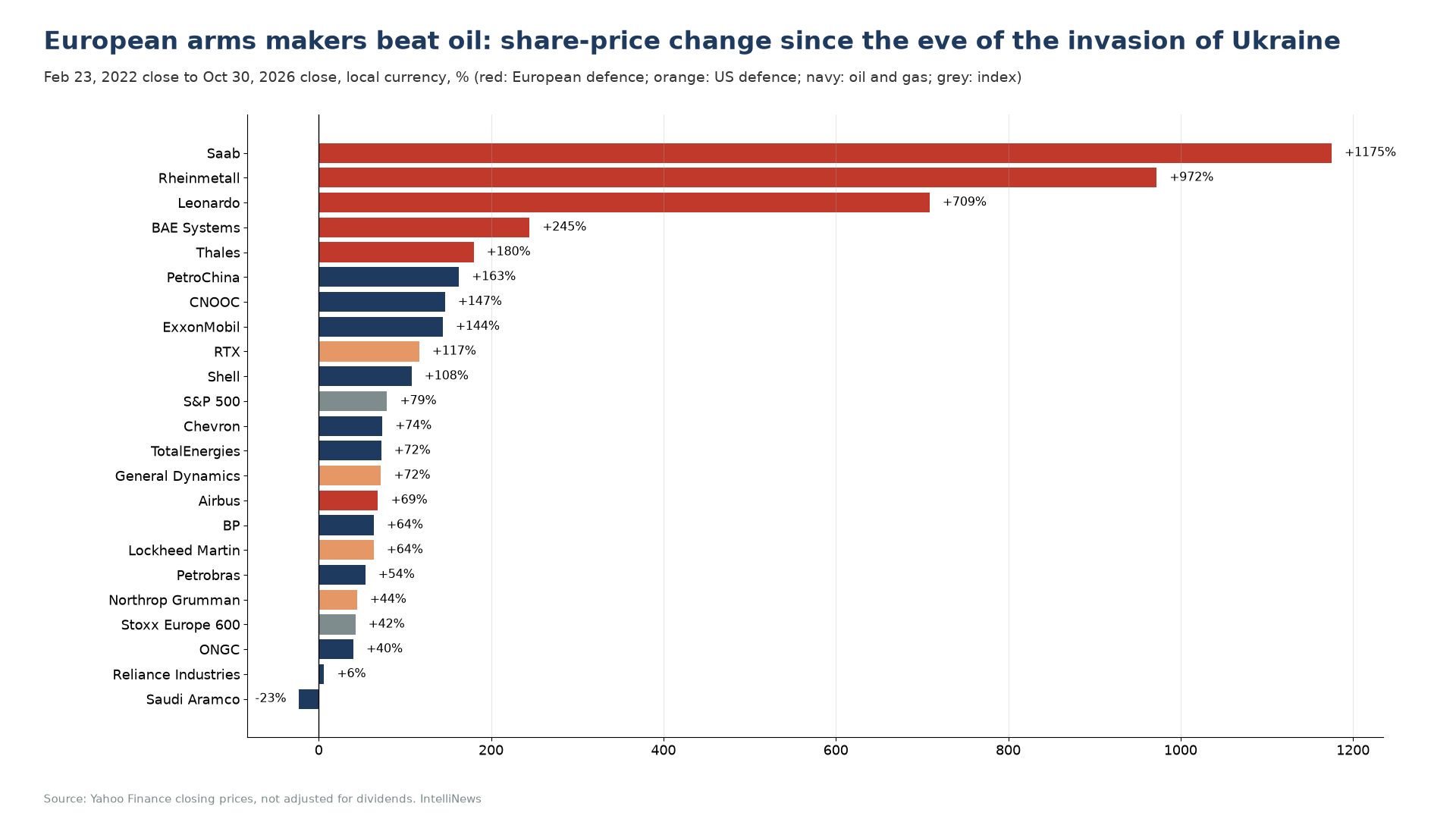
Share-price change since the eve of the invasion of Ukraine. Source: Yahoo Finance. IntelliNews
Investors have rewarded guns over oil. Saab's shares are up 1,175% since the close on February 23, 2022, Rheinmetall's 972% and Leonardo's 709%, while BAE Systems has more than tripled. The best-performing oil major, ExxonMobil, is up 144%, ahead of Shell at 108%, while TotalEnergies, Chevron and BP have gained between 64% and 74%, less than the S&P 500's 79% rise over the same period. The US defence contractors have trailed their European peers, with Lockheed Martin up 64% and Northrop Grumman 44%, barely more than the Stoxx Europe 600 index.
Over the past four years the gap is starker still. From the end of October 2022 Saab has risen 592%, Rheinmetall 531% and Leonardo 536%, against 69% for ExxonMobil, 31% for Lockheed Martin and 2% for Northrop Grumman.
The petrostates win once
Sanctions were meant to stop Russia profiting from its oil, and in the year of the invasion they failed. Russia's federal budget took in RUB11.6 trillion ($169bn) of oil and gas revenue in 2022, 41.6% of all its revenue, according to Finance Ministry data, and its current account surplus hit $237.7bn, 1.9 times the previous record of $125bn set in 2021, the IMF's October 2026 World Economic Outlook shows. That was the peak of the economic war for Moscow's finances.
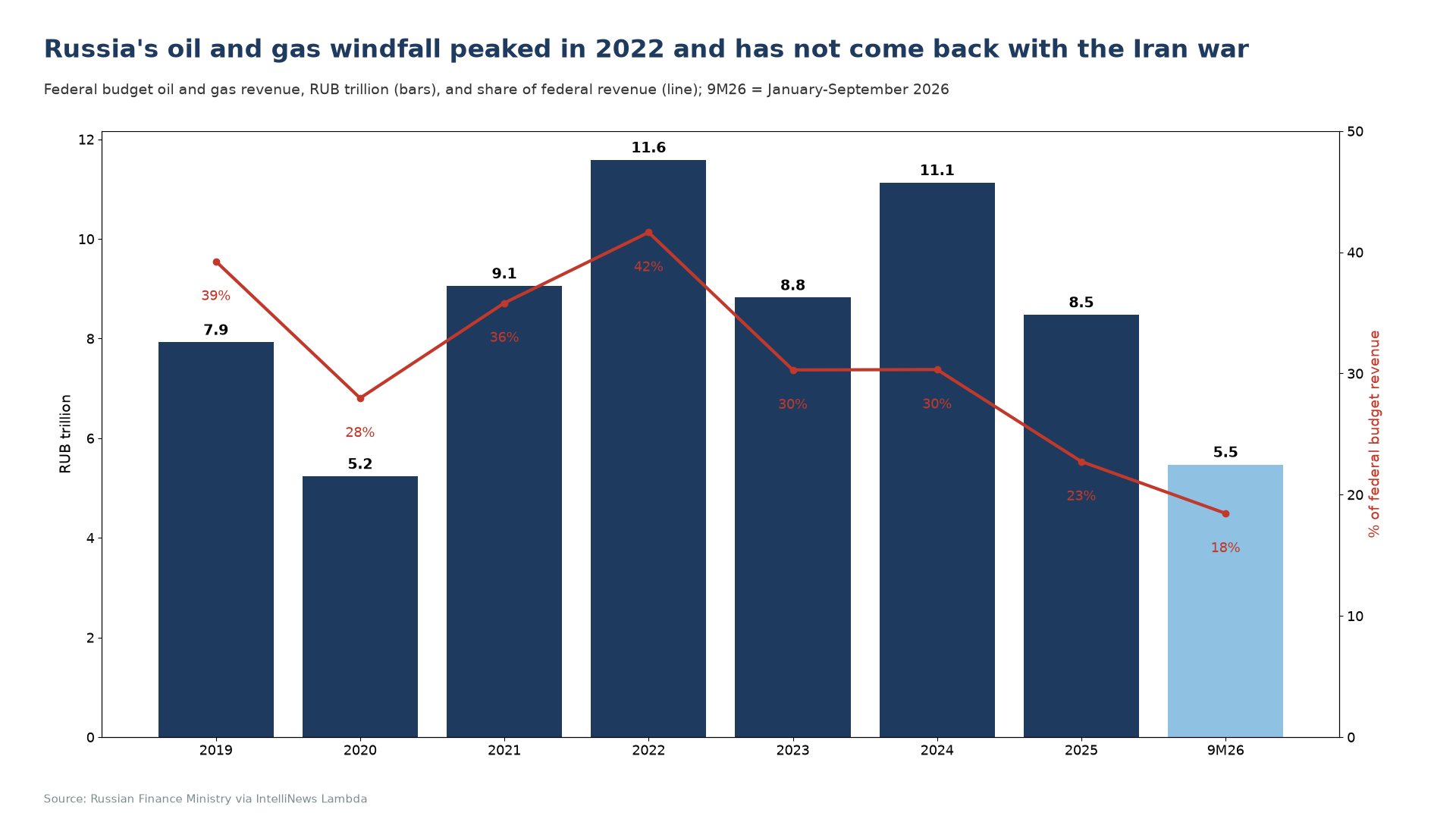
Russia federal budget oil and gas revenue. Source: Russian Finance Ministry via IntelliNews Lambda
Moscow's oil and gas revenue fell 17.2% y/y to RUB5.47 trillion ($67.9bn) in January-September, just 18.5% of federal revenue, even though Urals crude climbed above $92 a barrel by the end of September. A strong ruble, lower output and soaring damper payments to refiners, which hold down domestic fuel prices, ate the gain. The IMF still expects Russia's current account surplus to almost treble to $108bn in 2026, from $38.8bn in 2025, as export prices rise. Sanctions have not cut the Kremlin off from its petrodollar income.
Saudi Arabia's current account surplus of $145.3bn in 2022, 11.7% of GDP, has turned into deficits, and the IMF forecasts a shortfall of $46.6bn this year. The closure of Hormuz collapsed export volumes in the first quarter and produced a record budget deficit of SAR125.7bn ($33.5bn), before Red Sea exports lifted oil income 22% to SAR185bn ($49.3bn) in the second. The finance ministry now expects the economy to shrink 3.6% in 2026, with oil activities down 21.8%, and a full-year deficit of SAR245bn ($65.3bn).
Qatar, whose 2022 surplus reached 26.8% of GDP, is expected by the IMF to run a surplus of just 7.1% this year. QatarEnergy has extended force majeure on LNG deliveries to the end of December, covering 38 cargoes since April for one European buyer alone. Kuwait's surplus is forecast to shrink to 18.3% of GDP from 34.4% in 2022, and the UAE's to 4.8%.
The petrostates outside the Gulf are the new winners. Norway's surplus is forecast to rise to $134.7bn, 20.7% of GDP, from $75.4bn in 2025. US LNG has swung towards Europe to replace lost Qatari supply, but the gains accrue to US companies rather than the federal budget, and the US current account deficit is still forecast to widen to $1.26 trillion. China's surplus is heading for a record $863bn, as an AI-driven export boom offsets its bigger oil import bill.
| Country | 2021 | 2022 | 2023 | 2024 | 2025 | 2026 (IMF forecast) |
| Russia | 125.0 | 237.7 | 49.4 | 63.3 | 38.8 | 108.0 |
| Saudi Arabia | 44.9 | 145.3 | 25.9 | -16.3 | -32.7 | -46.6 |
| Qatar | 26.3 | 63.1 | 36.5 | 37.9 | 35.3 | 14.4 |
| UAE | 48.0 | 66.5 | 72.8 | 86.9 | 81.7 | 31.7 |
| Kuwait | 37.4 | 63.1 | 51.4 | 46.7 | 35.7 | 26.8 |
| Norway | 75.3 | 171.8 | 86.0 | 75.1 | 75.4 | 134.7 |
| China | 297.4 | 404.1 | 257.0 | 458.5 | 724.4 | 863.2 |
| Brazil | -39.4 | -42.0 | -27.0 | -65.3 | -66.7 | -63.5 |
| US | -855.2 | -972.4 | -931.4 | -1,198.6 | -1,177.1 | -1,262.6 |
Current account balance, $bn. Source: IMF World Economic Outlook, October 2026, via IntelliNews Lambda
Wars on two fronts have twice made fortunes for the arms makers and the oil companies. The states that sit on the oil have done less well: Russia's 2022 bonanza is long gone from a budget that has set aside $203bn for defence in 2027, and the Gulf monarchies that won the last oil shock are losing this one.
Unlock premium news, Start your free trial today.


