
Ukraine's debt interest bill is $11bn a year, not $33bn


Ukraine plans to spend UAH513bn ($11.3bn) on interest on its state debt this year, about a third of the $33bn a year claimed in posts circulating on social media.
The state budget had paid UAH275.7bn ($6.1bn) of that by the end of September, Finance Ministry execution data show. In Ukraine's budget, "debt service" means interest only. Principal is a separate line: the draft 2026 budget set repayments at UAH656.8bn ($14.5bn), so even interest and principal together come to about UAH1.17 trillion ($25.8bn), and about 80% of the principal falls due on domestic debt, which the treasury refinances with new bond issues. The 2027 budget, passed in first reading on October 28, cuts debt service to UAH474.1bn ($10.4bn), Interfax-Ukraine reported.
The bill is real and rising fast: annual interest payments have more than tripled from UAH159.7bn ($4.4bn) in 2022, the first year of the full-scale invasion, and are about 20 times their 2011 level. They are still a fraction of what the war costs. Defence and security took UAH2.01 trillion ($44.3bn) of state general-fund spending in January-September, more than seven times the interest bill.
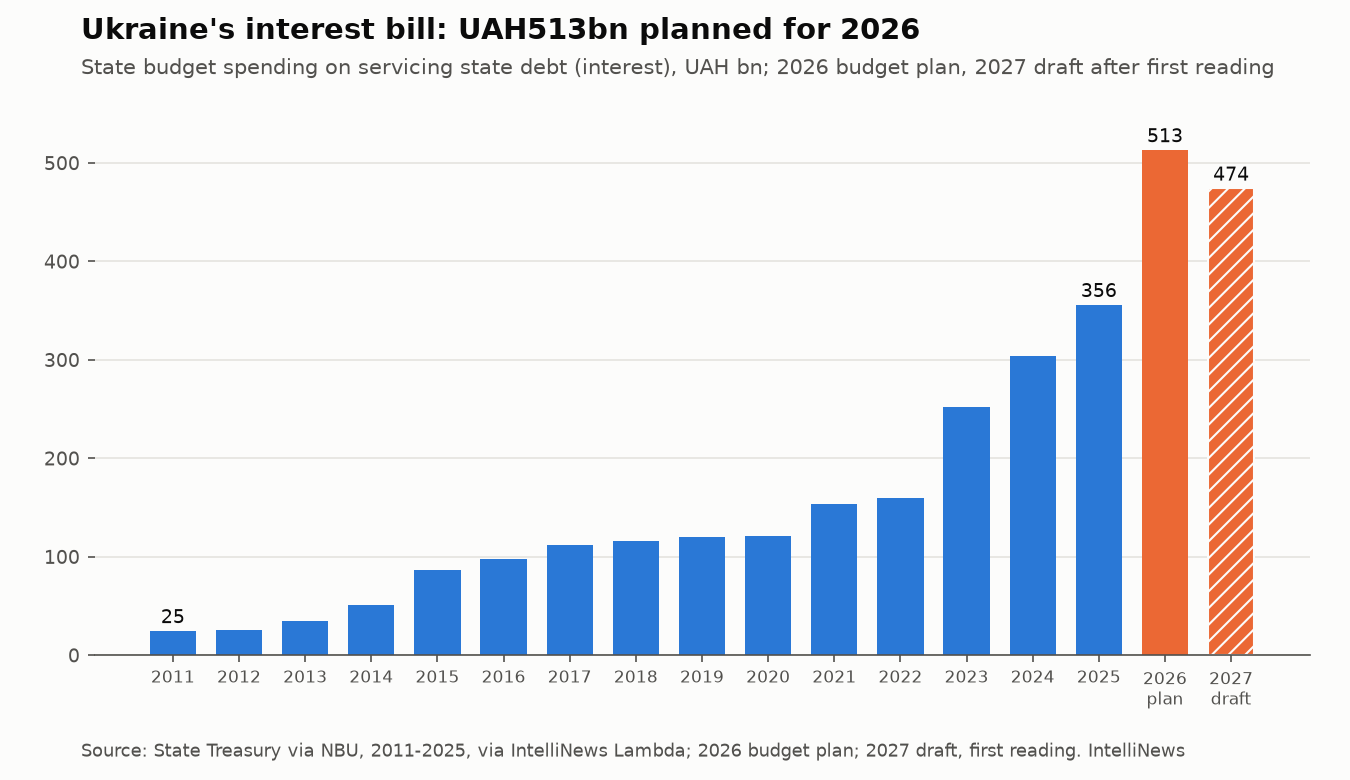
Ukraine's state budget spending on debt service (interest), UAH bn, 2011-2025 actual, 2026 plan and 2027 draft. Source: State Treasury via NBU, IntelliNews Lambda; Ukraine 2026 and 2027 budgets
Most of the money does not leave the country. Of the UAH513bn planned for 2026, UAH190.4bn ($4.2bn) is interest on external debt and the rest is owed on domestic borrowing. Adding external principal of UAH132.4bn ($2.9bn) puts this year's payments to foreign creditors at about UAH323bn ($7.1bn). The UAH1.99 trillion ($43.9bn) stock of hryvnia government bonds is held mainly by Ukrainian banks, with UAH922bn ($20.3bn), and the National Bank of Ukraine (NBU), with UAH656bn ($14.5bn), while non-residents held just UAH16.8bn ($370mn) in June, according to NBU data. The NBU hands its profit back to the budget: UAH146.1bn ($3.2bn) in January-September.
Foreign creditors are mostly governments and institutions lending on soft terms. Concessional loans make up about 66% of the debt portfolio and the EU is the largest single creditor with a 38% share, the Finance Ministry said on October 27, and the weighted average cost of the whole state debt was 4.44% at the end of September. Repayments on the G7's Extraordinary Revenue Acceleration loans are to be covered by income from immobilised Russian sovereign assets, and principal on the restructured Eurobonds is not due until 2029.
The other half of the claim, that Ukraine's hryvnia debt has risen 130-fold since 2006, is close to the mark. General government debt rose from UAH80.5bn ($15.9bn) at the end of 2006 to UAH9.57 trillion ($225.7bn) at the end of 2025, a 119-fold increase, according to the IMF's World Economic Outlook database, and the ministry put state and state-guaranteed debt at UAH9.54 trillion ($212.6bn) at the end of September. That is a doubling roughly every two and three-quarter years, not every two.
Much of the rise is the currency. The hryvnia traded at about UAH5.05/$ in 2006 and is now above UAH45/$, having lost nearly 90% of its value against the dollar, and almost four-fifths of the debt is in foreign currency. Measured in dollars, the debt grew about 14-fold, doubling roughly every five years. As a share of the economy it climbed from 14% of GDP to 107%, in three jumps: the 2008-2009 financial crisis, the 2014-2015 war in Donbas and devaluation, and the full-scale invasion in 2022.
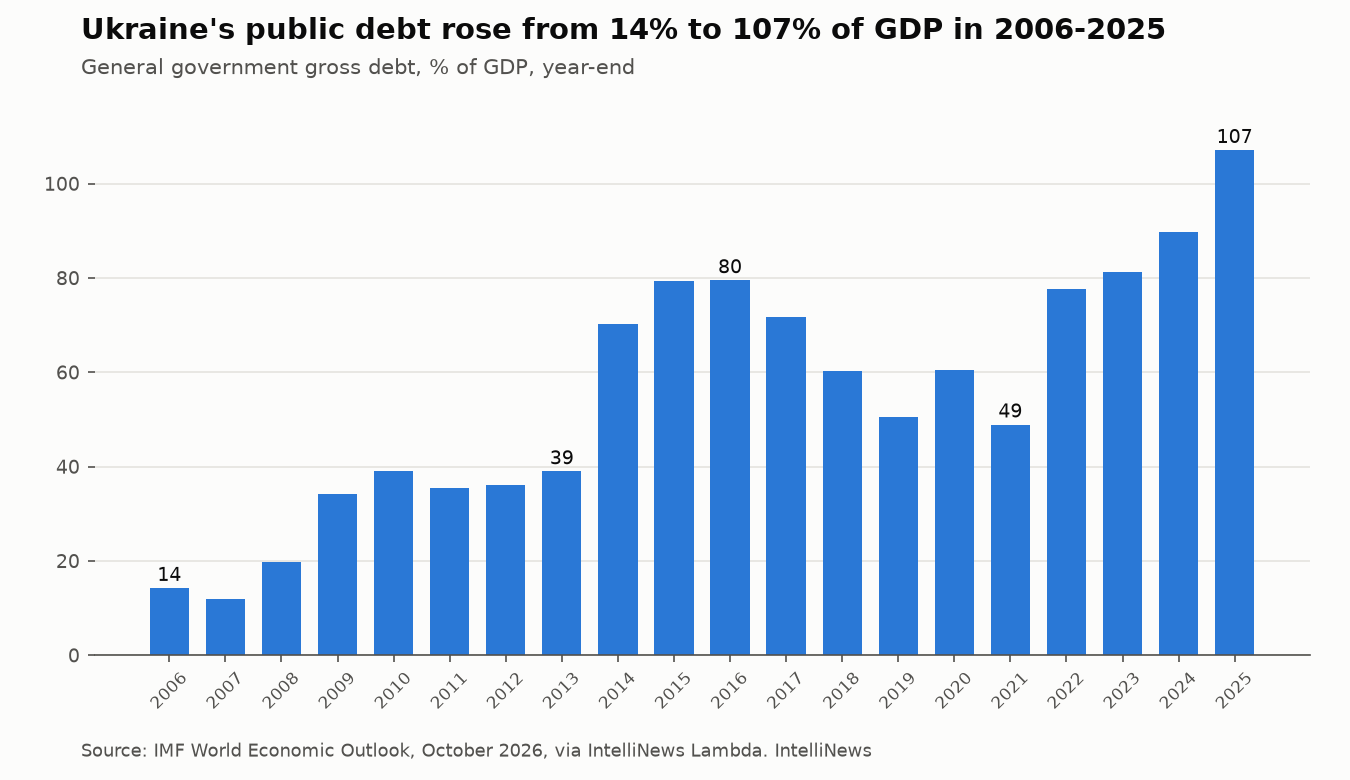
Ukraine's general government gross debt, % of GDP, 2006-2025. Source: IMF World Economic Outlook, October 2026, via IntelliNews Lambda
That puts Ukraine 38th in the world by the size of its public debt. The $33bn figure does appear in Ukraine's public finances, but as a funding gap rather than an interest bill: Fitch Ratings, which affirmed Ukraine at 'CCC' on October 23, puts the country's additional external financing need in 2027 at $33bn, and the IMF sees an uncovered gap of $30bn-35bn next year. It is money Ukraine needs to raise from its allies, much of it as new loans that will add to the debt.
This article was produced with the help of IntelliNews Lambda analytical tool
Unlock premium news, Start your free trial today.


