
Philippines, Indonesia face more rate hikes as peso, rupiah lead Asia's slide


The Philippine peso and Indonesian rupiah are among emerging Asia's weakest currencies this year, putting pressure on both central banks to raise rates even as the US Federal Reserve pauses.
Measured against the dollar, the rupiah has shed 7.9% since the end of 2025 and the peso 7.7%, on European Central Bank reference rates for October 29. The peso touched a record low of PHP64.18 per dollar on October 28.
Philippine government bonds have hurt too. Foreign investors who count their returns in dollars were nursing losses of more than 11% for the year by October 29, while a regional Asian bond gauge was up 3.1%, according to Bloomberg index data.
Across the Fed's last two tightening cycles, which began in 2017 and 2022, Philippine 10-year yields climbed by an average of 152 basis points, close to four times the rise in India, the region's next most sensitive market, a Bloomberg analysis found. That makes Philippine debt the most exposed in emerging Asia to US rate rises. Costly oil, an expensive dollar and a war around Iran that keeps energy prices high bear hardest on importers such as the Philippines.
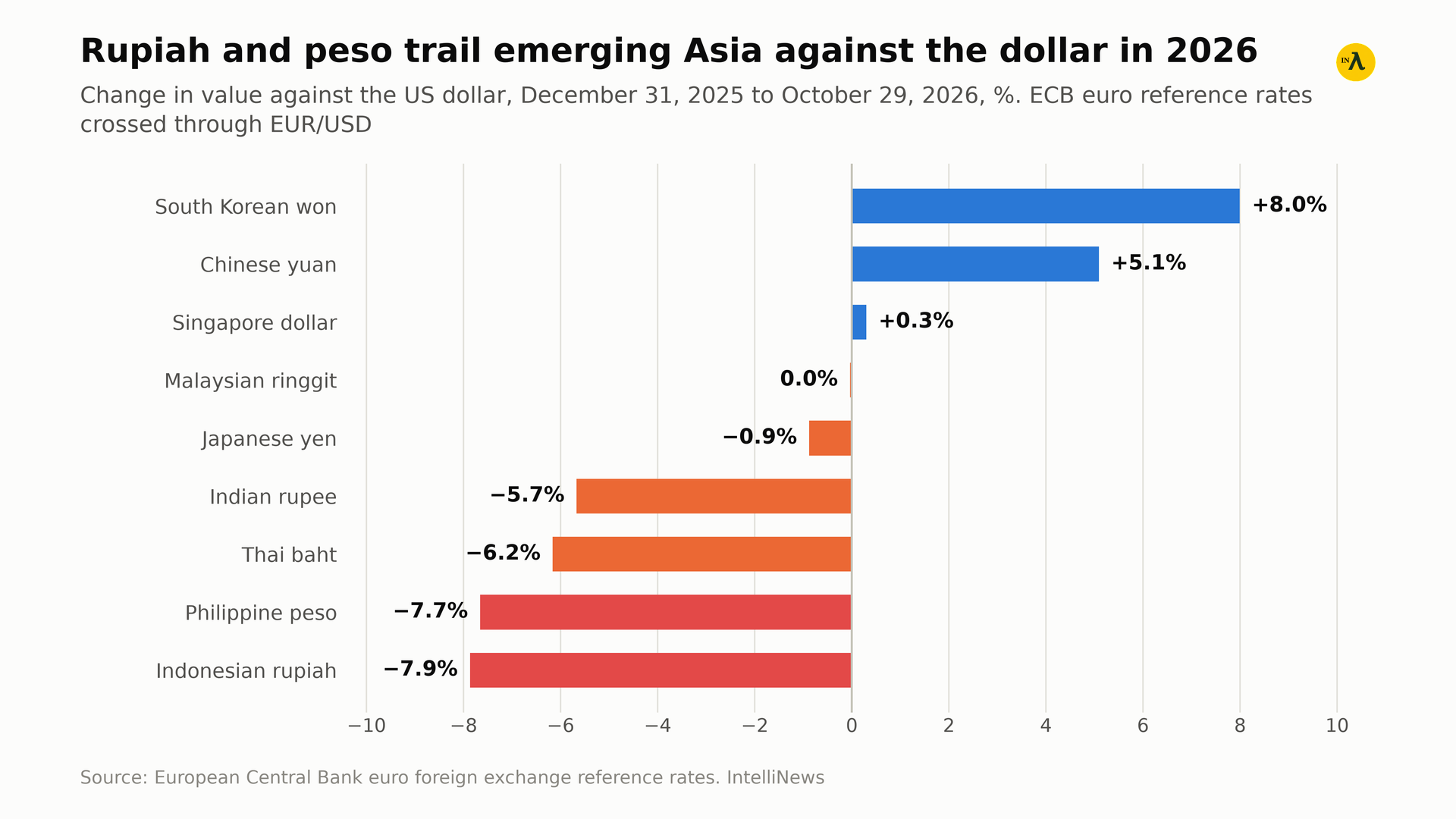
Change in value against the US dollar, December 31, 2025 to October 29, 2026, %. Source: European Central Bank euro foreign exchange reference rates. IntelliNews
The Fed itself stood still. Its Federal Open Market Committee kept the target range at 3.75-4% on October 28 by a 10-2 vote, a month after its first increase since July 2023. Two members, Lisa Cook and Beth Hammack, wanted a further quarter-point rise. "Inflation remains elevated," the committee said, adding: "The Committee will deliver price stability."
Fed Chairman Kevin Warsh refused to say whether another increase would follow before the end of the year. Asked at his press conference whether there was still broad support for one, he replied: "I don't believe in forward guidance absent exigent circumstances, absent a crisis," adding: "I also don't believe in prejudging meetings. A lot of things can happen."
Raiffeisen Research described the decision as a pause rather than the end of the cycle and, in a note on October 29, said a December rise looked well supported.
Bangko Sentral ng Pilipinas (BSP) had already moved. It lifted its policy rate by 50 basis points to 5.5% on October 22, its fourth straight increase and a cumulative 125 basis points since April. Only two of 22 economists polled by BusinessWorld saw a half-point move coming. Inflation hit 7.2% in September, more than double the 3% target, while second-quarter growth slowed to 2.3%.
"Such a decisive response will make monetary policy appropriately restrictive," the BSP said. Governor Eli Remolona has said the bank has its own estimates of how far the peso can fall before the slide feeds inflation, which is when it tends to step in.
"Currency stability has become an important consideration in the policy reaction function," Peerampa Janjumratsang, a fixed-income portfolio manager at M&G Investments in Singapore, told Bloomberg.
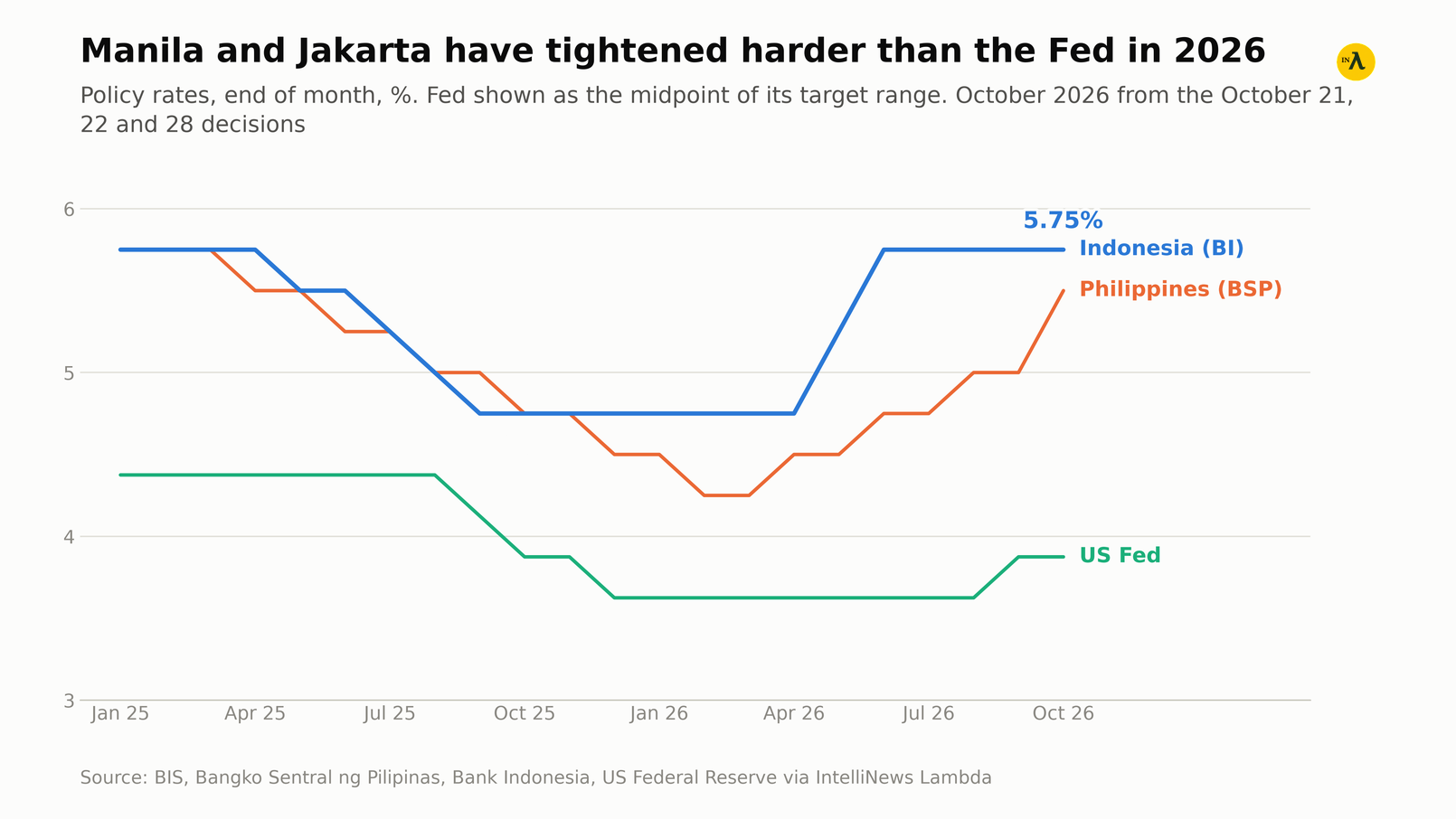
Policy rates, end of month, %; Fed shown as the midpoint of its target range. Source: BIS, Bangko Sentral ng Pilipinas, Bank Indonesia, US Federal Reserve via IntelliNews Lambda
Bank Indonesia faces the same trade-off with a weaker hand. It left the BI-Rate at 5.75% on October 21, having added 100 basis points since January, but raised its deposit facility rate by 25 basis points to 5% and cut banks' reserve requirement by 200 basis points to 7%. One measure props up the rupiah, the other frees bank lending. Economists polled by Bloomberg had been split 19-19 on whether it would hike.
Some of Jakarta's strain is home-made. Index provider MSCI's proposal to move Indonesia to standalone status sent stocks down 11% in a single session on October 16 and pushed the rupiah through IDR18,000 to the dollar. Capital Economics has likened the central bank's balancing act to Turkey's, warning that it risks losing its grip on inflation and exposing the rupiah to larger, more disorderly falls.
Indonesia's bond market has one cushion Manila lacks. Bank Indonesia's purchases of government bonds since 2020 lifted its share of the outstanding stock from about 10% to a peak of around 27% in January 2023, blunting the effect of US tightening on yields, by Bloomberg's count.
The rest of the region is not following them down. The South Korean won has gained 8% against the dollar this year and the Chinese yuan 5.1%, which points to weaknesses particular to Manila and Jakarta rather than a blanket retreat from Asia.
For those two, more tightening looks likelier than relief. Citigroup strategists wrote in a recent note that risks are "skewed heavily towards a more hawkish BSP", while University of Asia and the Pacific economist Marco Antonio Agonia told BusinessWorld he expects quarter-point rises in December and February that would take the rate to 6%. A Fed rise in December would only strengthen the case for both to follow.
This article was produced with the help of IntelliNews Lambda analytical tool
Unlock premium news, Start your free trial today.


