
Vietnam's trillion-dollar trade boom puts Chinese supply chains in Trump's crosshairs


Vietnam's goods trade has crossed $1 trillion in a single year for the first time, built on Chinese parts coming in and finished goods heading out to America.
Preliminary customs figures put two-way merchandise trade at just over $1 trillion between January 1 and October 29. Imports outran exports, climbing 37.6% year on year to $507.66bn against a 27.2% gain in shipments abroad to $493.64bn, so the period closed with a gap of about $14bn.
Vietnam first passed $100bn of goods trade in 2007, the year it joined the World Trade Organisation, and the whole of 2025 came to $929.92bn. The pace is not the only thing that has changed: the make-up of the trade now reads like a schematic of the supply chains that the US says it wants to break up.
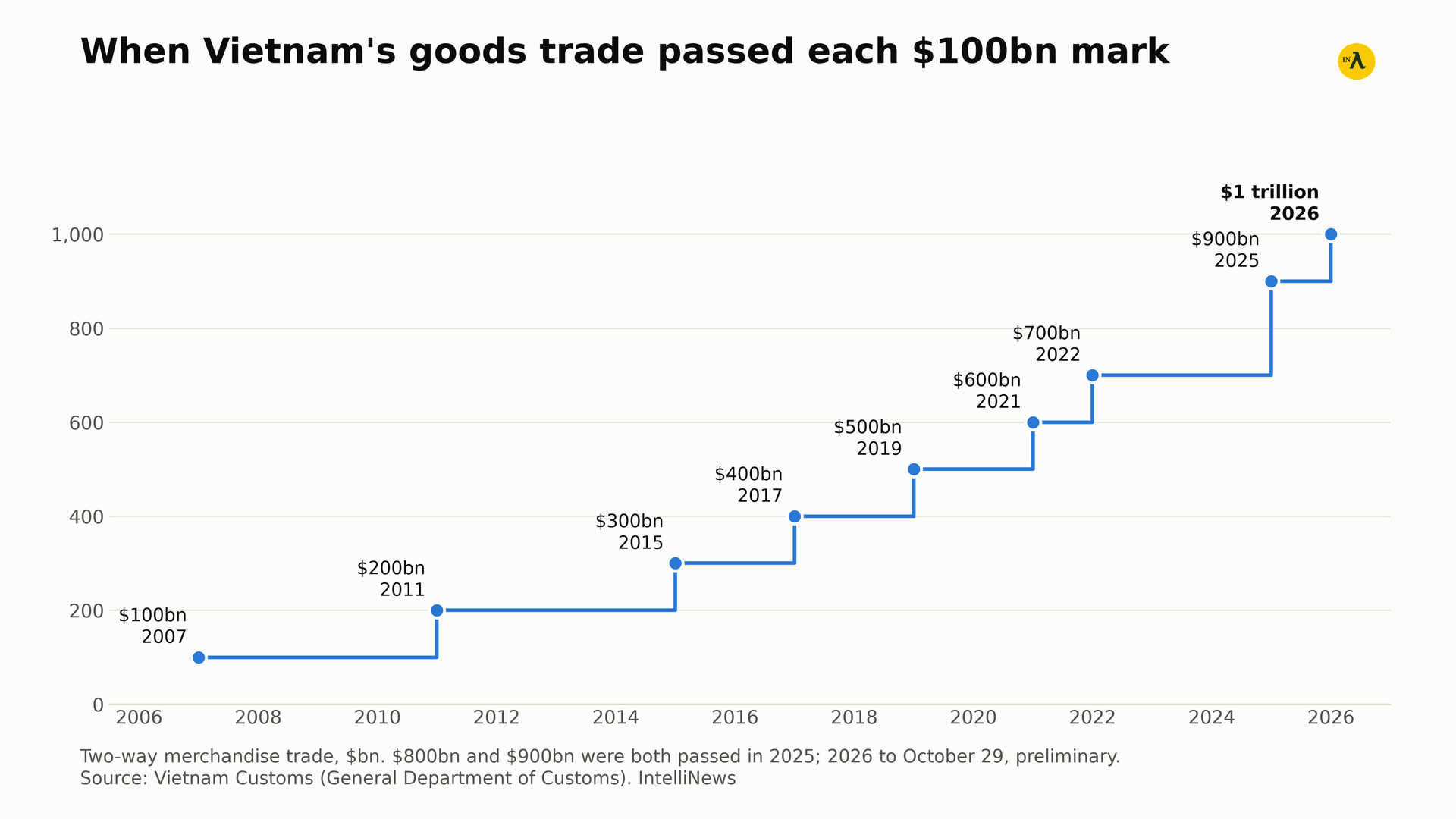
Two-way goods trade, $bn, by the year each $100bn mark was first passed; 2026 to October 29, preliminary. Source: Vietnam Customs. IntelliNews
Foreign-invested companies handled roughly $778bn of the total, close to four-fifths, with trade by domestic firms growing at less than half their pace. Computers and electronics, phones and machinery together accounted for about $532bn, more than half of all trade. On the import side, capital goods made up 94.1% of purchases in the first nine months, machinery and parts alone 58.3%. Vietnam is buying in components and equipment and shipping out finished products, which is what an assembly economy does.
By partner, China and the US still sit at the top. Between January and September the US took $140bn of Vietnamese goods and Vietnam's surplus with it climbed 23.8% to $122.62bn. China supplied $187.34bn of imports over the same months, and the deficit with China widened by 43% to $121.48bn. The two balances almost cancel each other out.
The deficit with South Korea nearly doubled to $43.75bn. Mexico meanwhile was the fastest-growing of the larger destinations in the period to October 29, up 42.5%, while sales to South Korea rose 19.1%, to Japan 18.6% and to Canada 14.4%.
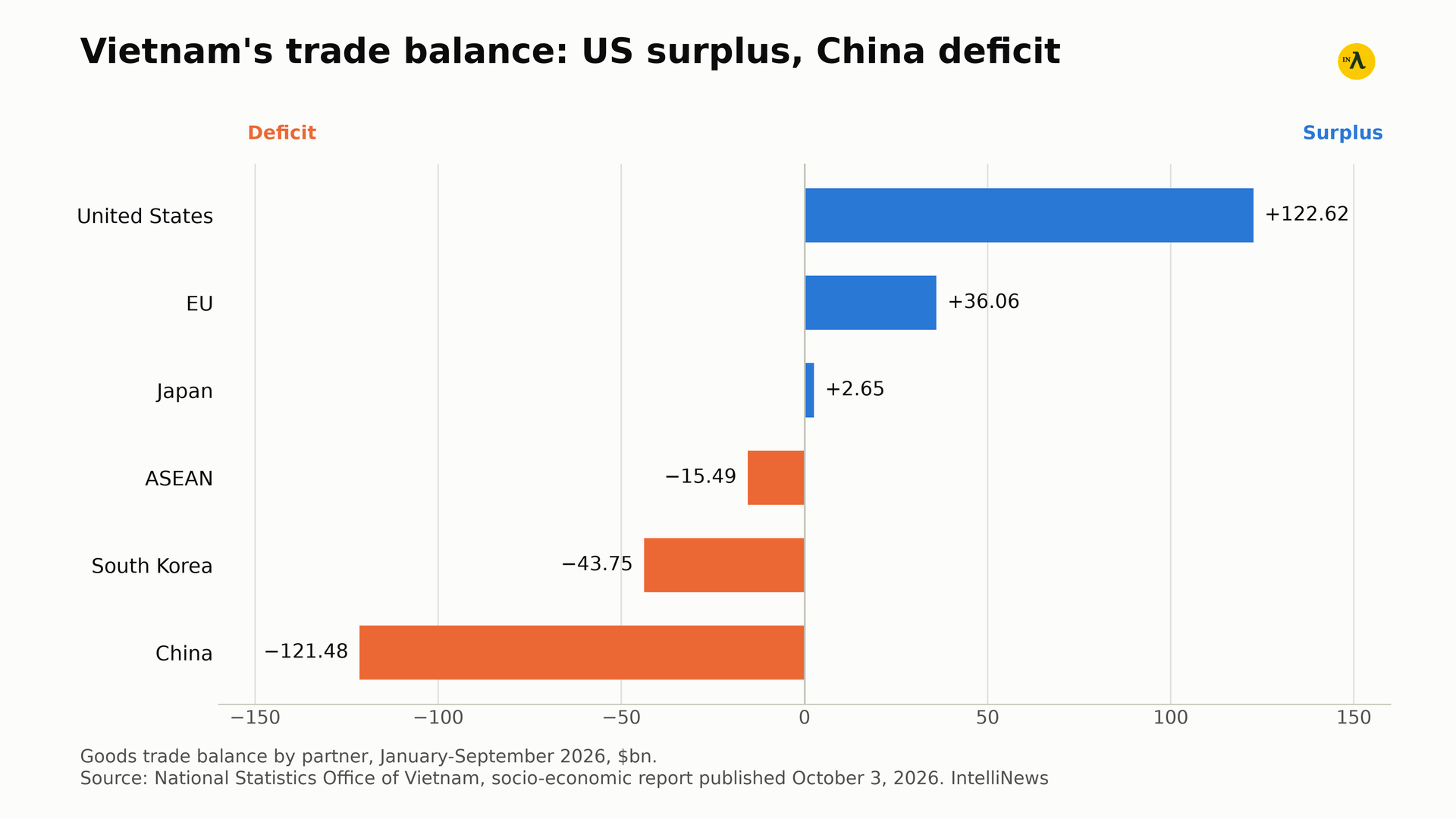
Goods trade balance by partner, January-September 2026, $bn. Source: National Statistics Office of Vietnam. IntelliNews
A White House report titled The Great Transshipment Scam, published on August 13 to document that pattern, ranks Vietnam alongside Brazil, Indonesia, Malaysia, Thailand and Turkey in a second tier of countries combining large flows with deep integration into China-linked supply chains. It cites a Commerce Department estimate that around $67bn of US-bound goods were transshipped from China through Mexico, India and Vietnam in 2025, costing about $28bn in tariff revenue, and singles out the Ho Chi Minh City corridor for electrical switching and circuit-protection equipment.
“Effective enforcement therefore requires distinguishing legitimate manufacturing and substantial transformation from pass-through trade and origin shifting,” the report says.
Rules of origin are where that distinction gets made, and the report concedes that the US version rests on “customs case law, rather than a precise statute”. It asks Congress to codify the standards and describes an AI screening system at the border that checks declared origin, routing and component content against expected patterns. A Vietnamese factory that adds real value to Chinese parts passes that test; one that relabels them does not, and the grey zone between the two covers a lot of electronics.
The 40% penalty on transshipped goods that the US wrote into Executive Order 14326 in July 2025 rested on the International Emergency Economic Powers Act, which the Supreme Court ruled in February cannot be used to levy tariffs. The 20% baseline Hanoi accepted in last October's outline trade deal fell with it. Since July Vietnamese goods have instead paid 12.5% under a Section 301 action over forced-labour import bans, the higher of its two bands, IntelliNews reported. A separate Section 301 probe into overcapacity and intellectual property is still running.
Hanoi says the bilateral deal is nearly done. Deputy Prime Minister Pham Gia Tuc said on October 14 that Vietnam had sent Washington the final text, Reuters reported, while US officials were more guarded and pointed to the size of the American deficit. Washington's top trade negotiator Jamieson Greer was warning as early as last December that neighbours must not become gateways for Chinese manufacturing, and any final text is likely to carry content tests that bite hardest on exactly the electronics now driving Vietnam's numbers.
Vietnam's planners see the concentration risk too. A draft trade strategy to 2030 would cap any single market at 25% of exports and 35% of imports, Nhan Dan reported on October 30. On the nine-month figures the US took about 32% of Vietnam's exports and China supplied about 41% of its imports, so both caps are already breached. Hanoi has been trying to broaden its export markets since the US tariff shock of 2025, and the faster sales to Japan, South Korea and Mexico show some of that working.
A trillion dollars of trade gives Vietnam scale and bargaining weight. It does not settle the question US customs officers will keep asking about each container: where the goods inside were really made.
This article was produced with the help of IntelliNews Lambda analytical tool
Unlock premium news, Start your free trial today.


