
Indonesia squeezes Singapore as gas nationalism crosses a new line


Indonesia has started using its gas as a political lever against Singapore, first cutting pipeline deliveries and then questioning what the city state does with Indonesian LNG.
Upstream regulator SKK Migas began trimming pipeline exports on October 24, diverting about 31mn standard cubic feet a day (cf/d) from the Natuna and Sumatra fields to power plants in Batam, Bintan and Sumatra. Singapore's Energy Market Authority (EMA) said importers had reported a shortfall of 17bn British thermal units a day over 18 days, under 2% of national demand, and that its central buyer GasCo could bring in extra LNG at any time.
Five days later, after talks with President Prabowo Subianto on October 29, Energy Minister Bahlil Lahadalia raised the stakes.
“I believe that not all of the 148 cargoes we send are used for Singapore's own needs, but some are traded and subsequently exported to other countries,” he told reporters, The Straits Times reported.
He produced no evidence and gave no period for the 148 shipments. No public reply from Singapore to the charge had been reported by October 30. Jakarta had no immediate plan to curb LNG exports, Bahlil said, though home demand would come first and cargoes would go abroad only once it was met.
The row carries Indonesia's resource nationalism, long aimed at nickel ore and coal through export bans and windfall taxes, into gas, a commodity sold to neighbours under binding cross-border contracts. The first target is the country that has been Indonesia's largest foreign investor since 2014 and depends on imported gas for roughly 95% of its electricity.
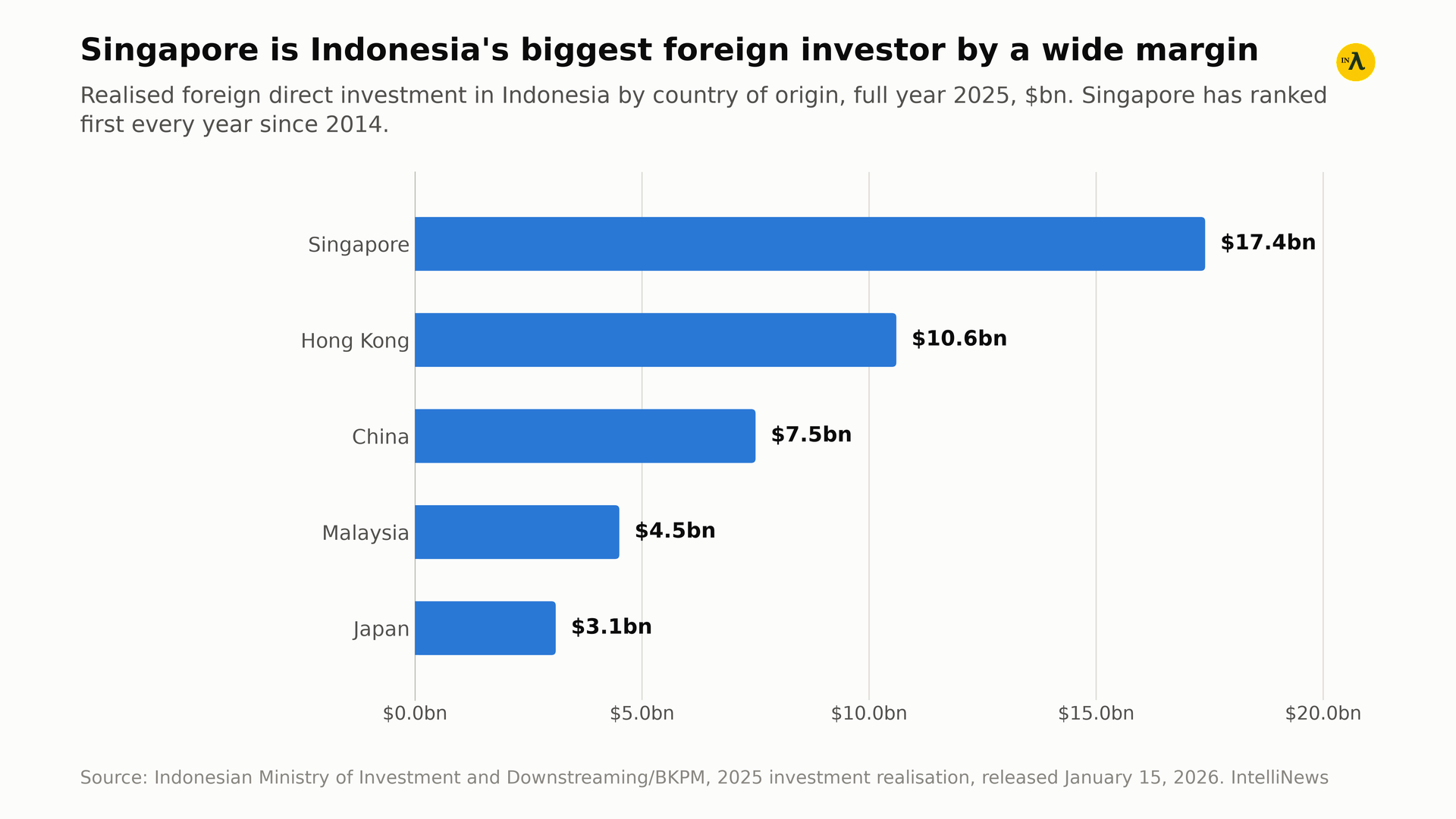
Realised foreign direct investment in Indonesia by country of origin, 2025, $bn. Source: Indonesian Ministry of Investment and Downstreaming/BKPM. IntelliNews
Singapore put $17.4bn into Indonesia in 2025, well ahead of Hong Kong's $10.6bn and China's $7.5bn, Investment Minister Rosan Roeslani said in January when presenting the ministry's annual figures. Over 2010-2025 the city state supplied 28.6% of all foreign direct investment, the ministry's data show.
Politics first, contracts second
On October 21 Bahlil said Indonesia might stop renewing gas exports to neighbours. “Because we have to survive, we must first meet our domestic needs,” he said, hours after Prabowo told his cabinet that only strong nations would come through the current geopolitical turmoil.
Prime Minister Lawrence Wong answered that commercial agreements must be honoured and that Singaporean importers would protect their rights. Bahlil shot back on October 26: “Do not lecture Indonesia about its commitment to honouring and respecting contracts.” He insists deliveries remain above contractual minimums.
A supply problem at home
Indonesian gas output averaged 6,455mn cf/d in January-July, below the 6,837mn cf/d state target, while ceramics makers on Java say they receive only about 40% of their needs at the regulated gas price.
Home users already took 69% of the country's gas in 2025, according to Abra Talattov, an energy economist at the Institute for Development of Economics and Finance (Indef). LNG has been touched before: in April 2025 SKK Migas switched five export cargoes to domestic buyers and announced a 30mn cf/d cut in Sumatra pipeline flows to Singapore, Reuters reported at the time.
Reselling cuts both ways
The reselling charge sits awkwardly with Jakarta's own business. Re-exporting LNG breaks no rule unless a supply contract bars it, and Indonesia is the world's biggest market for LNG re-export loadings: the Arun terminal in Aceh reloaded 0.85mn tonnes in 2025, a 17.3% global share, according to the International Gas Union's World LNG Report 2026, with the terminal's operator pitching it as a regional hub.
Asked in parliament in September 2025 about Jakarta's plans to buy more US LNG, Deputy Prime Minister Gan Kim Yong, then trade minister, said this would not affect Singapore “as we are not a gas exporter”, in a parliamentary reply that also put LNG at close to 60% of Singapore's gas supply.
If the squeeze reaches LNG
Singapore's contracts for Indonesian pipeline supply expire at the end of 2028, and a floating import terminal due by 2030 will lift LNG capacity enough to cover all power-sector gas by sea if needed. A curb on seaborne cargoes would be a different matter, because LNG supply deals across the region assume the seller treats them as commercial rather than diplomatic instruments.
Abra warned that Singapore could retaliate through investment and trade, and that global investors would read any breach of contract as a sign of uncertainty spreading beyond energy, at a time when the rupiah and Jakarta's capital markets are already under pressure.
Other ministers have tried to cool things: Rosan said Singapore's investment pledges were intact, and National Economic Council chairman Luhut Binsar Pandjaitan asked reporters on October 27: “Why would we fight with Singapore? There's no reason to.” Singaporean Foreign Minister Vivian Balakrishnan's October 27-29 visit to Jakarta ended with a joint task force, though on haze rather than gas.
The volumes at stake are small and Singapore has absorbed the pipeline cut without strain. But a supplier that warns it may not renew exports, trims flows within contractual limits and then questions where its cargoes go has told every regional buyer of Indonesian gas that, from Jakarta's side, the 2028 renegotiation has already begun.
Unlock premium news, Start your free trial today.


