
Ukraine raises key rate to 16.5% as central bank forecasts contraction


Ukraine's central bank raised its key policy rate by half a percentage point to 16.5% on October 29 and now expects the economy to shrink this year.
The rate takes effect on October 30 and is the third hike since July, when the National Bank of Ukraine (NBU) lifted it to 15.5%, followed by a rise to 16% in September. In its rate statement, the NBU said price pressures had increased "markedly" and inflation expectations had deteriorated. Its new forecast keeps the rate at 16.5% through 2Q27.
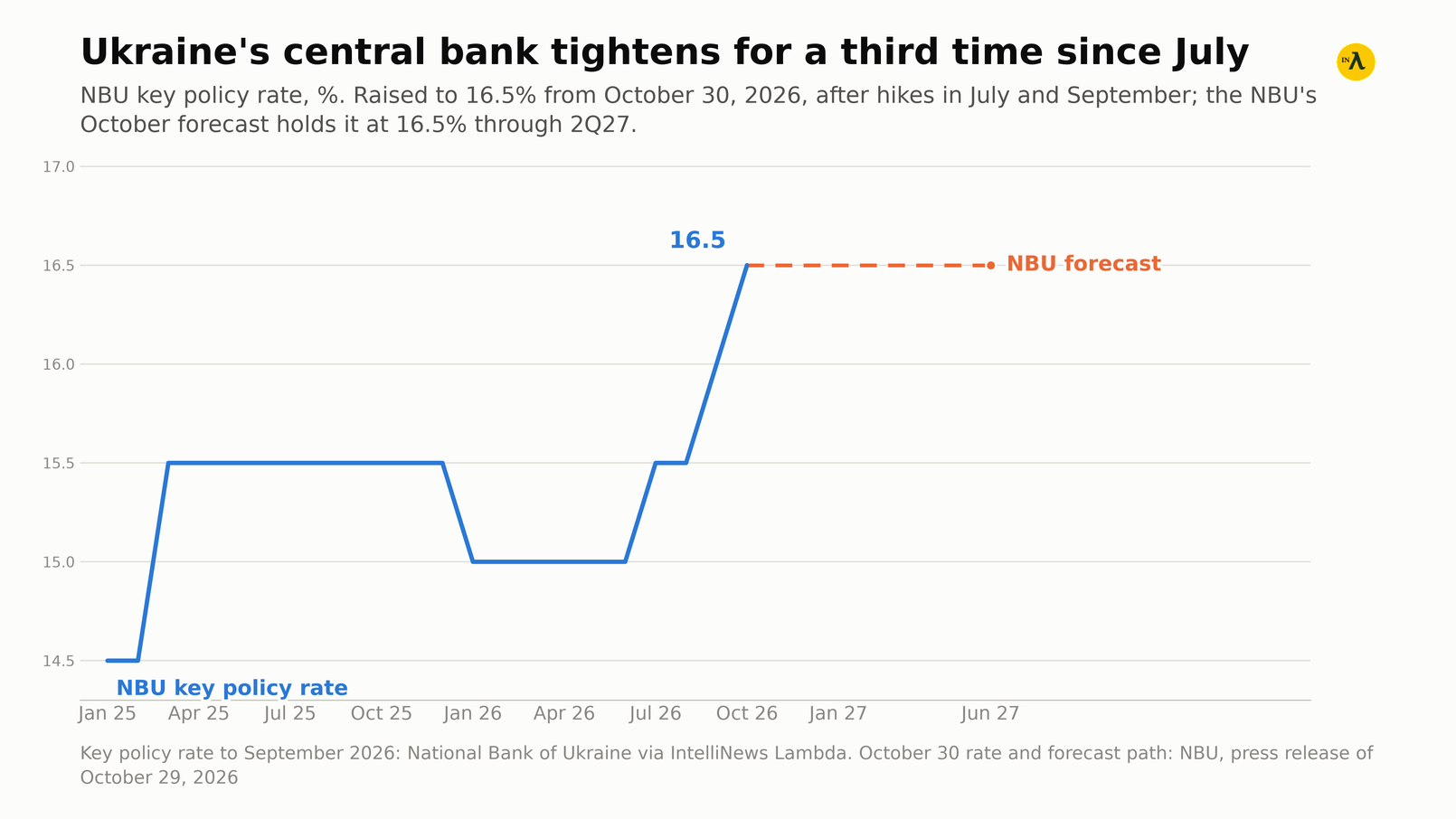
NBU key policy rate, %, with the NBU's October forecast path. Source: National Bank of Ukraine via IntelliNews Lambda
The decision comes with a sharp reversal of the outlook. Only three months ago the NBU raised its 2026 growth forecast to 1.8% on defence spending and a better harvest. It now forecasts a 0.4% contraction, after the NBU estimated that real GDP fell by 0.5% y/y in 3Q26 as the blockade of the Black Sea ports since July and Russian missile strikes that idled 90% of steel output hit industry, trade and agriculture.
"This downward trend has been driven primarily by the effects of the blockade of seaports and Russian attacks on production facilities and logistics. Metallurgical and ore-mining companies suffered the greatest losses," NBU Governor Andriy Pyshnyi told a monetary policy briefing, Ukrainska Pravda reported.
The intensified attacks alone cut 1.9 percentage points off this year's growth, the central bank estimates. It expects a slow recovery, with GDP growing 0.4% in 2027 if its technical assumption of better logistics from mid-2027 holds, and 2.2% in 2028 as security risks ease. Investment in the defence industry, weapons production financed by the Ukraine Support Loan and reconstruction of critical infrastructure should drive it. Nominal GDP for 2026 was trimmed to UAH10.01 trillion ($219.9bn) from UAH10.065 trillion.
Inflation reached 10% in September, with core inflation at 8.8%, and the NBU estimates both kept rising in October. Higher fuel prices caused by the war in the Middle East and Russian strikes on warehouses and logistics hubs did most of the damage. The bank raised its 2026 inflation forecast to 12.5% from 10%, of which about 0.7 percentage points is the effect of the air attacks, and its 2027 forecast to 7.3% from 6.9%. It still expects inflation to return to its 5% target in 2028.
| NBU forecast | October 2026 | July 2026 |
| Real GDP 2026, % | -0.4 | 1.8 |
| Real GDP 2027, % | 0.4 | 2.8 |
| CPI end-2026, % | 12.5 | 10.0 |
| CPI end-2027, % | 7.3 | 6.9 |
| Reserves end-2026, $bn | 62.8 | 69.7 |
| Reserves end-2027, $bn | 62.1 | 73.7 |
| Reserves end-2028, $bn | 57.0 | 70.0 |
| Nominal GDP 2026, UAH trillion | 10.01 | 10.065 |
Source: National Bank of Ukraine, October 29, 2026 forecast and July 2026 forecast
Slower aid inflows weighed on the reserves forecast. The NBU now sees international reserves at $62.8bn at the end of 2026, down from $69.7bn in July, and $62.1bn at the end of 2027 instead of $73.7bn. Assistance in 3Q26 came in below expectations, "primarily due to Ukraine delaying the implementation of reforms", although parliament passed laws in October to unblock EU and IMF money. Reserves fell by $1.6bn in September to $47.1bn.
The forecast assumes about $50bn of direct budget support and more than $32bn under the defence component of the Ukraine Support Loan this year, rising to $52bn and $37bn in 2027. Such volumes would keep reserves at "a comfortable level" above $62bn, the NBU said.
Part of the hike is aimed at the hryvnia. Large banks have started raising rates on hryvnia deposits after the earlier hikes, and the NBU said the latest move would also curb pressure on the currency market, which has grown as exports fall. Lending is still expanding fast, with net hryvnia corporate loans up more than 32% y/y in September and retail loans up more than 38%. Minutes of the decision will be published on November 9.
Private forecasters moved first. Investment group ICU expects two years of contraction, with GDP down 0.6% this year and 1.9% in 2027, while Dragon Capital forecasts declines of 0.5% and 1%, Interfax-Ukraine reported.
Ukraine's economy is probably under more strain than at any time since spring 2022, according to a commentary published on October 23 by Poland's Centre for Eastern Studies (OSW). Grain exports fell from 3.6mn tonnes in June to just under 1mn tonnes in August and recovered to only 1.5mn tonnes in September, around 40% of the pre-blockade level, as farmers face a shortage of storage. Average purchase prices for wheat and maize fell by about 40% between June and October to UAH5,500 ($121) a tonne, leaving most farms selling below cost.
The government's own estimate is that Russian attacks on businesses could cost UAH70bn ($1.5bn) in tax revenue this year, a figure OSW considers too low; opposition MP Yaroslav Zheleznyak puts the shortfall at UAH120bn-UAH150bn ($2.6bn-$3.3bn).
This article was produced with the help of IntelliNews Lambda analytical tool
Unlock premium news, Start your free trial today.


