
Russia settles up to 85% of Africa trade in rubles, Putin says - IntelliNews Lambda

The ruble now accounts for up to 85% of commercial payments between Russia and Africa, President Vladimir Putin told the third Russia-Africa summit in Moscow on October 29 [2], as he pressed partners to settle trade outside Western financial infrastructure.
"This allows us to protect our economic exchanges from external influence," Putin said at the summit's plenary session, Vedomosti reported. A day earlier he had called for wider use of national currencies, independent national payment systems "protected from interference by unfriendly countries" and offered African states access to a cross-border payment system using digital currencies that would convert currencies instantly and, he said, could not be blocked.
The pitch revives the BRICS Pay idea that Russia floated when it hosted the BRICS summit in Kazan in October 2024: a common platform for settling trade between members in their own currencies, outside the dollar-based correspondent banking network and the SWIFT messaging system. Two years on, no BRICS-wide system is running. Russia has instead built a patchwork of bilateral arrangements, its own messaging system and, most recently, the A7 payment network and its ruble-pegged stablecoin, which the US Treasury designated a transnational criminal organisation on October 1.
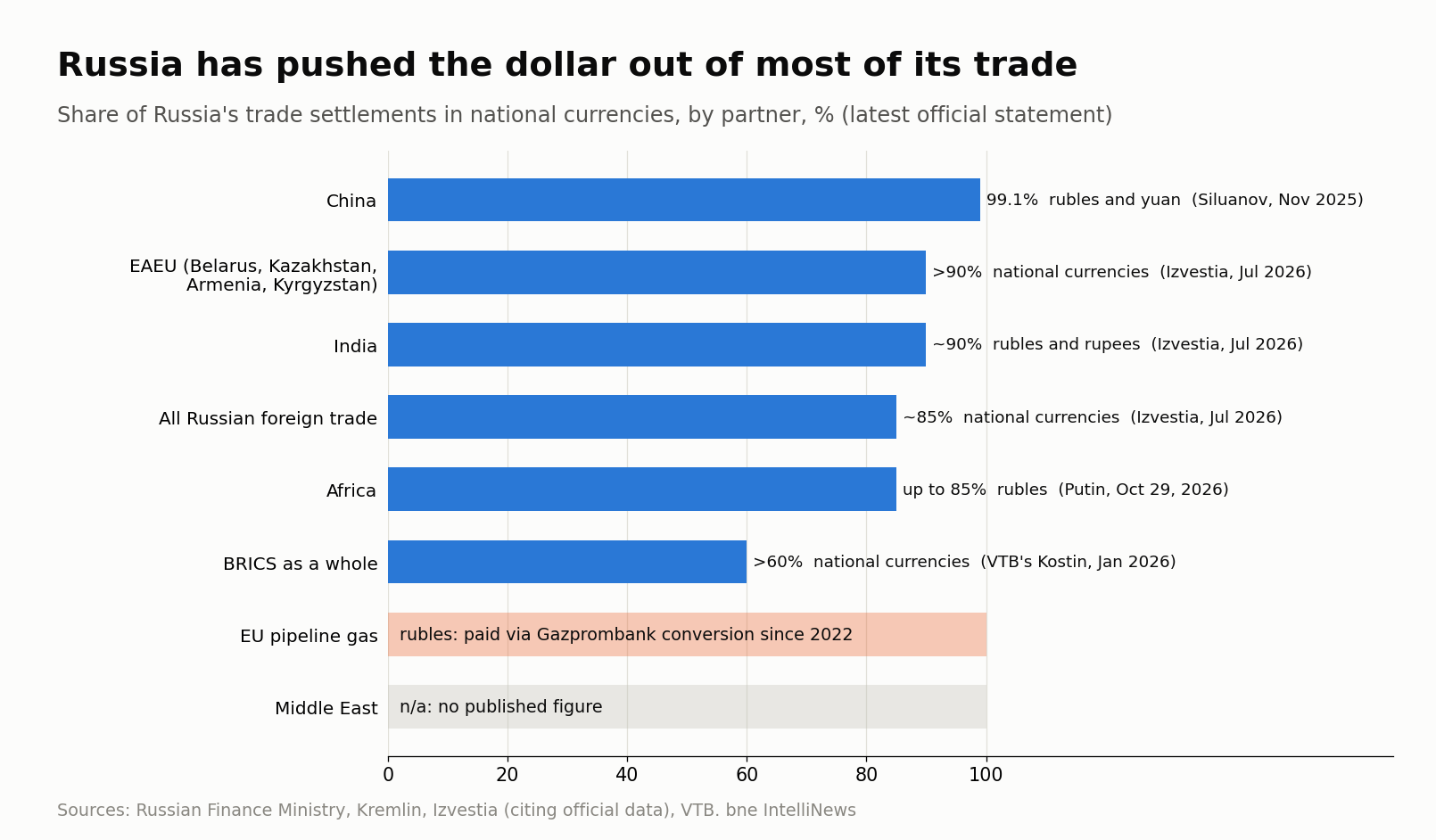
Share of Russia's trade settlements made in national currencies, by partner, %, latest official statements. The Middle East has no published figure; EU pipeline gas is paid for in rubles under the 2022 conversion scheme. Sources: Russian Finance Ministry, Kremlin, Izvestia, VTB.
Almost dollar-free with Asia and the neighbours
Russia's trade with China is now settled almost entirely in rubles and yuan: 99.1% of payments, Finance Minister Anton Siluanov said in November 2025 [1]. About 90% of payments with India are made in rubles and rupees, and the share of national currencies in trade within the Eurasian Economic Union of Russia, Belarus, Kazakhstan, Armenia and Kyrgyzstan exceeds 90%, Izvestia reported in July [3], putting the share for Russia's foreign trade as a whole at about 85% [3].
Across the wider Commonwealth of Independent States, national currencies have passed 90% of commercial settlements, Putin told CIS leaders in Turkmenbashi on October 9, as Russian trade with the bloc topped $110bn in 2025. Across BRICS as a whole the share is lower: national currencies account for more than 60% of Russia's settlements with the group, VTB chief executive Andrey Kostin said in January [4].
Africa is the newest front. Russian trade with the continent topped $27bn in 2025, Kremlin aide Yuri Ushakov said before the summit, and Putin said on October 29 [2] that it had grown by half. Moscow is pushing Russian and African banks to open more correspondent accounts, to adopt the Bank of Russia's financial messaging system and to link it to the Pan-African Payment and Settlement System.
Official statements give no comparable figure for the Gulf and the wider Middle East, where much of Russia's oil trade runs through intermediaries and is often settled in UAE dirhams, yuan or other third currencies.
Europe pays for its gas in rubles
The one large Western market where Russia gets paid in rubles is gas in the gas-for-rubles scheme. Since a decree Putin signed on March 31, 2022, European buyers of Gazprom's pipeline gas have had to open accounts at Gazprombank, which converts their euro or dollar payments into rubles before the gas is deemed paid for. Buyers that refused, including Poland, Bulgaria and Finland, were cut off within weeks.
The remaining EU customers, chiefly Hungary and Slovakia, which still take Russian gas through the last branch of TurkStream, pay under the scheme. The bloc is phasing the trade out: it will stop buying Russian LNG from the start of 2027 and Russian pipeline gas from October 2027.
The shift has costs for Russia too. Settling in yuan and rupees leaves exporters holding currencies that are hard to use outside the partner country, and converting between several currencies is slow and expensive, with no way to hedge many of the currency pairs, according to a Russia-Africa report prepared by Vedomosti and the New Generation club of young economists for the summit.
Sources
[1] Ministry of Finance of the Russian Federation, statement by Anton Siluanov on Russia-China settlements, November 4, 2025
[2] President of Russia, address to the plenary session of the third Russia-Africa summit, October 29, 2026
This article was produced with the help of IntelliNews Lambda analytical tool

