
Ukraine faces €70bn 2027 funding gap as EU support remains unresolved - IntelliNews Lambda


Ukraine depends on the EU for most of the money it needs to keep fighting, but Brussels has paid out less than half of this year's €45bn loan tranche and is still arguing over who covers a €70bn hole in the 2027 budget.
The bloc's €90bn Ukraine Support Loan, agreed in December 2025 and unlocked in April after Hungary and Slovakia dropped their vetoes, is split into €45bn for 2026 and €45bn for 2027. Of the 2026 money, €28.3bn is earmarked for weapons made by Ukraine's own defence industry and €16.7bn for the budget, divided equally between the Ukraine Facility and macro-financial assistance, according to the European Commission.
By October 14 Ukraine had received about €19.8bn of this year's tranche, roughly €15.8bn for defence and €4bn in budget support, leaving €25.2bn to come before the end of the year, on figures in the Commission's latest disbursement notice. The remaining budget money depends on reforms that the Rada has been slow to pass, and Kyiv has already asked to draw part of the 2027 tranche early to pay for drones.
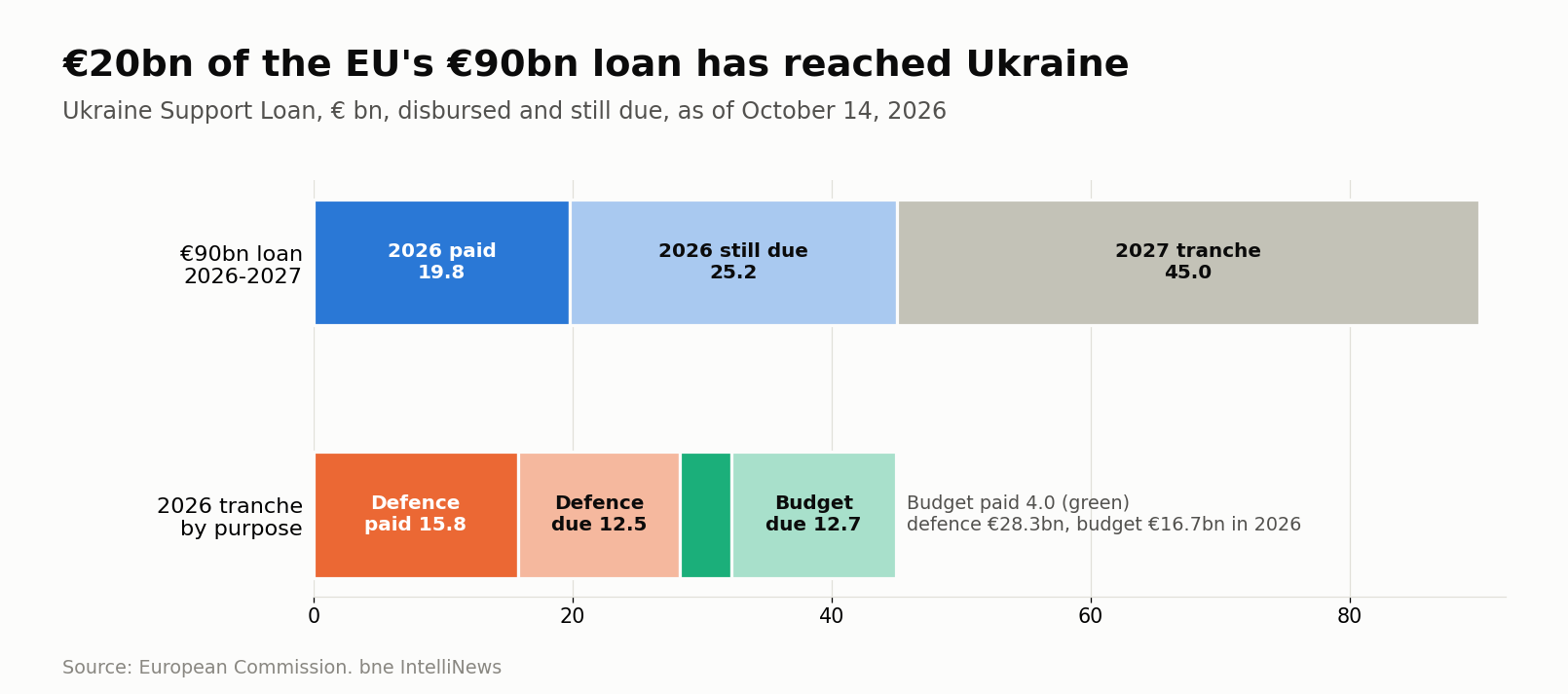
The EU's €90bn Ukraine Support Loan: money paid and still due in 2026, and the 2027 tranche, € bn, as of October 14, 2026. Source: European Commission.
A budget built on foreign money
Ukraine's 2026 budget, adopted in December 2025, planned revenue of UAH2.90 trillion ($63.7bn) against spending and lending of UAH4.82 trillion ($105.8bn), leaving UAH2.08 trillion ($45.6bn) to be raised from foreign partners [1]. A June amendment lifted the deficit target to 12.1% of GDP and the money for defence and security to UAH4.37 trillion ($95.8bn) [2].
In January-September the state general fund collected UAH2.49 trillion in revenue, of which UAH604bn ($13.3bn) was foreign grants, and borrowed a further UAH355bn ($7.8bn) abroad and UAH362bn ($7.9bn) at home [3]. Foreign grants and loans together supplied almost 30% of the money the treasury raised. Revenue ran UAH231bn ($5.1bn) behind schedule, and external borrowing reached only UAH355bn against UAH941bn ($20.6bn) planned for the period [4].
Of the foreign loans, the Ukraine Facility delivered UAH126bn ($2.8bn), the IMF UAH96bn ($2.1bn) and World Bank programmes about UAH131bn ($2.9bn) [3].
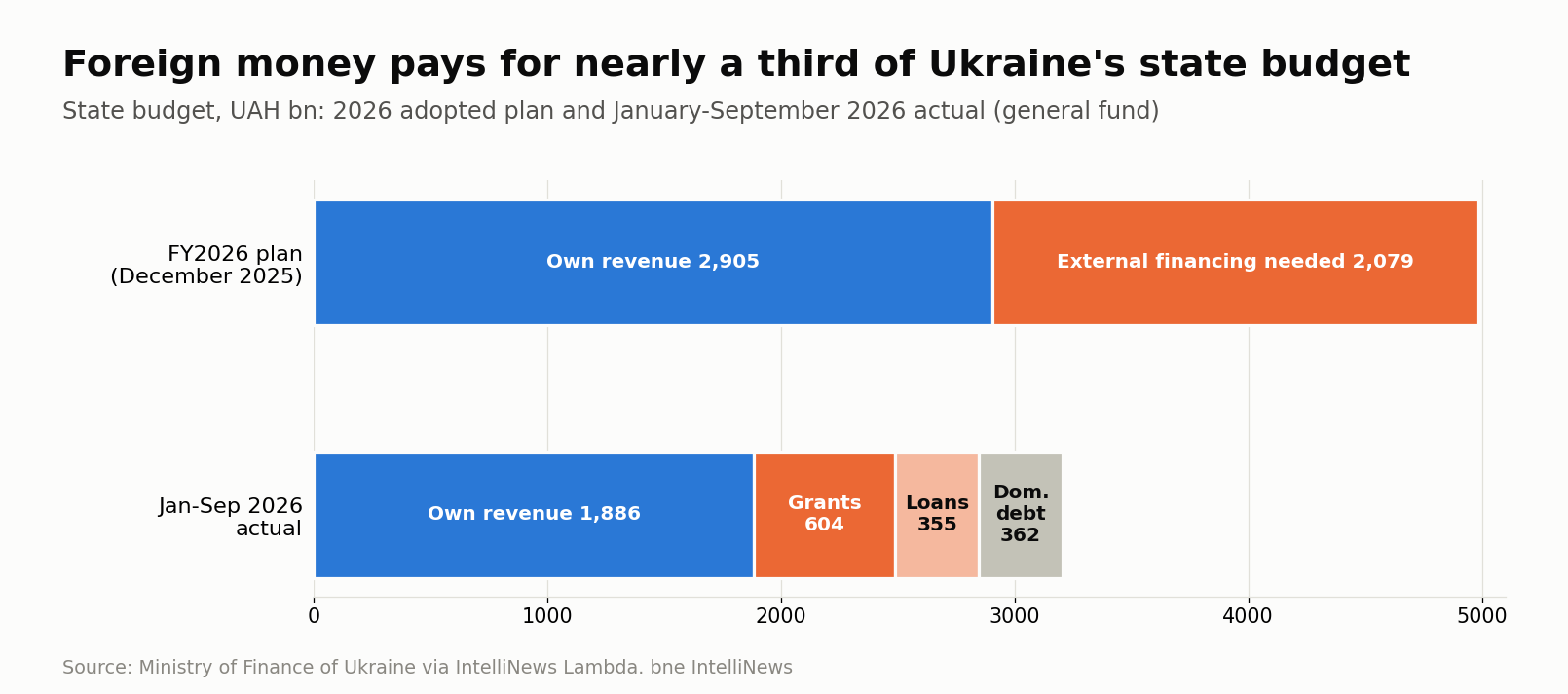
Ukraine's state budget: own revenue against external financing in the 2026 adopted plan, and January-September 2026 receipts of the state general fund, UAH bn. Source: Ministry of Finance of Ukraine via IntelliNews Lambda.
Pledged is not paid
The EU's €50bn Ukraine Facility, the grants-and-loans package running from 2024 to 2027, has paid out more than €32bn, including a €2.9bn eighth disbursement on October 2 that carried the first budget money from the support loan. Every payment is tied to reform targets, and Kyiv has met 84 of the 95 due so far.
The G7's $50bn (about €45bn) Extraordinary Revenue Acceleration loans, repaid from the windfall profits on Russia's immobilised central bank assets, have largely arrived. The EU has paid its €18.1bn share in full, while about €7bn from the US, Japan and the UK was still outstanding in mid-April before the UK sent its final £752mn ($1bn) tranche on April 15, the Ukrainian outlet Razom reported.
The IMF approved a four-year $8.1bn programme in late February and has disbursed $2.2bn. A further $1.65bn depends on combined reviews at the end of the year, and the Fund and the EU have tied more money to tax reforms and financing guarantees from partners.
Help from outside the EU is drying up. Non-EU partners have pledged just €4bn for 2027, down from €19bn for 2026, and the US, the UK, Canada and Japan together account for only €1bn of it, the Financial Times reported, citing Commission projections. Direct US funding has stopped under President Donald Trump.
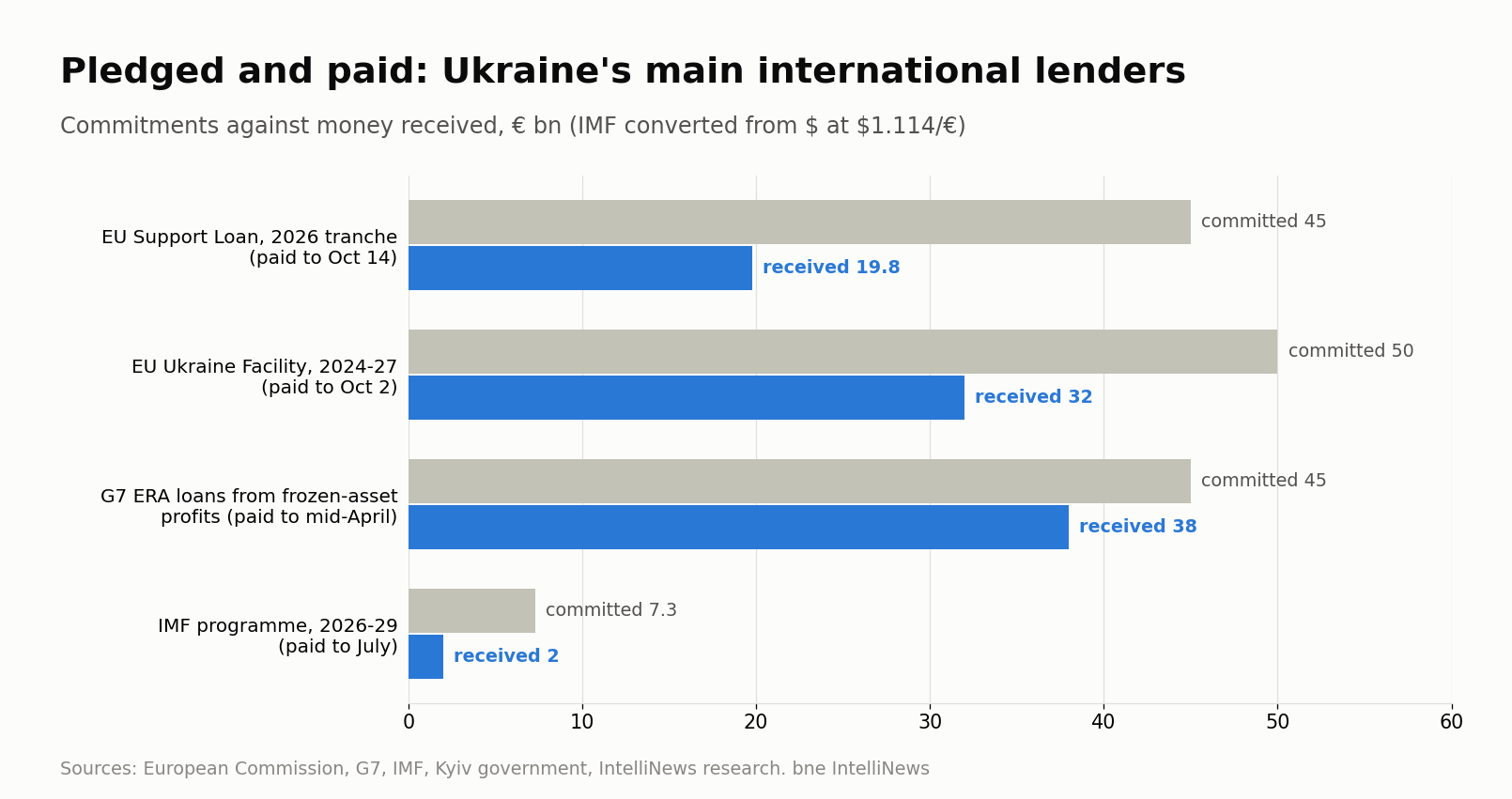
Commitments against money received from Ukraine's main international lenders, € bn. IMF figures converted at $1.114/€. Sources: European Commission, G7, IMF, Razom.
The 2027 hole
President Volodymyr Zelenskiy asked EU leaders for at least €70bn more for 2027, putting next year's war bill at €155bn. Finance Minister Serhiy Marchenko puts the gap at $78bn, $32.6bn for the budget and $45bn for the military. The IMF's preliminary estimate is narrower, at $30bn-35bn in 2027, $17bn in 2028 and $2bn in 2029.
EU leaders agreed on October 16 that the gap must be covered and told the Commission to draw up a plan, without saying who would pay. European Council President Antonio Costa has said the EU expects to cover about €46.7bn of it, on top of the €45bn loan tranche already due, leaving €23.3bn for other partners. "We usually cover two-thirds of Ukraine's financial needs," he said. A decision could come at the November 26-27 summit, or slip to December.
The options include new joint EU borrowing, which some members will not join, and the roughly €210bn of frozen Russian central bank assets, most of it held at Euroclear in Belgium, which Belgian Prime Minister Bart De Wever refuses to touch before the war ends.
The bill for earlier loans is also arriving. The EU's next seven-year budget will have to find at least €35bn to cover interest on loans to Ukraine, rising to €41.9bn if interest rates rise by one percentage point, according to a Commission note seen by Politico. The Commission has lent Ukraine €171bn since 2014, and Hungary, the Czech Republic, Slovakia and Bulgaria do not want to service the borrowing costs of any future loan, the note said.
Less in the seven-year budget
The reports of the EU cutting Ukraine's money concern its 2028-2034 Multiannual Financial Framework (MFF). The Commission proposed a €100bn reserve for Ukraine; compromise drafts, the latest published on October 10, have cut that to €89bn. The cut is not final: leaders failed to agree the MFF in October and meet again at an extraordinary summit on November 26, and the budget needs unanimity.
Pressure is still for less. The Irish presidency's €1.62 trillion compromise already trims about €159bn from the Commission's plan, six net contributors led by Germany want deeper cuts, and Czech Prime Minister Andrej Babis objects to the Ukraine money being borrowed. "I don't like that there are 100 billion euros from the European budget for Ukraine, that this money should be borrowed," he said. "In any case, Czechia will not guarantee for it."
Even the €89bn falls far short of the cost of rebuilding. The Centre for Social and Economic Research puts the minimum public funding needed for ten years of recovery at €196.5bn, leaving a gap of more than €100bn over the MFF period, while the World Bank, EU and UN put total recovery and reconstruction needs at $587.7bn.
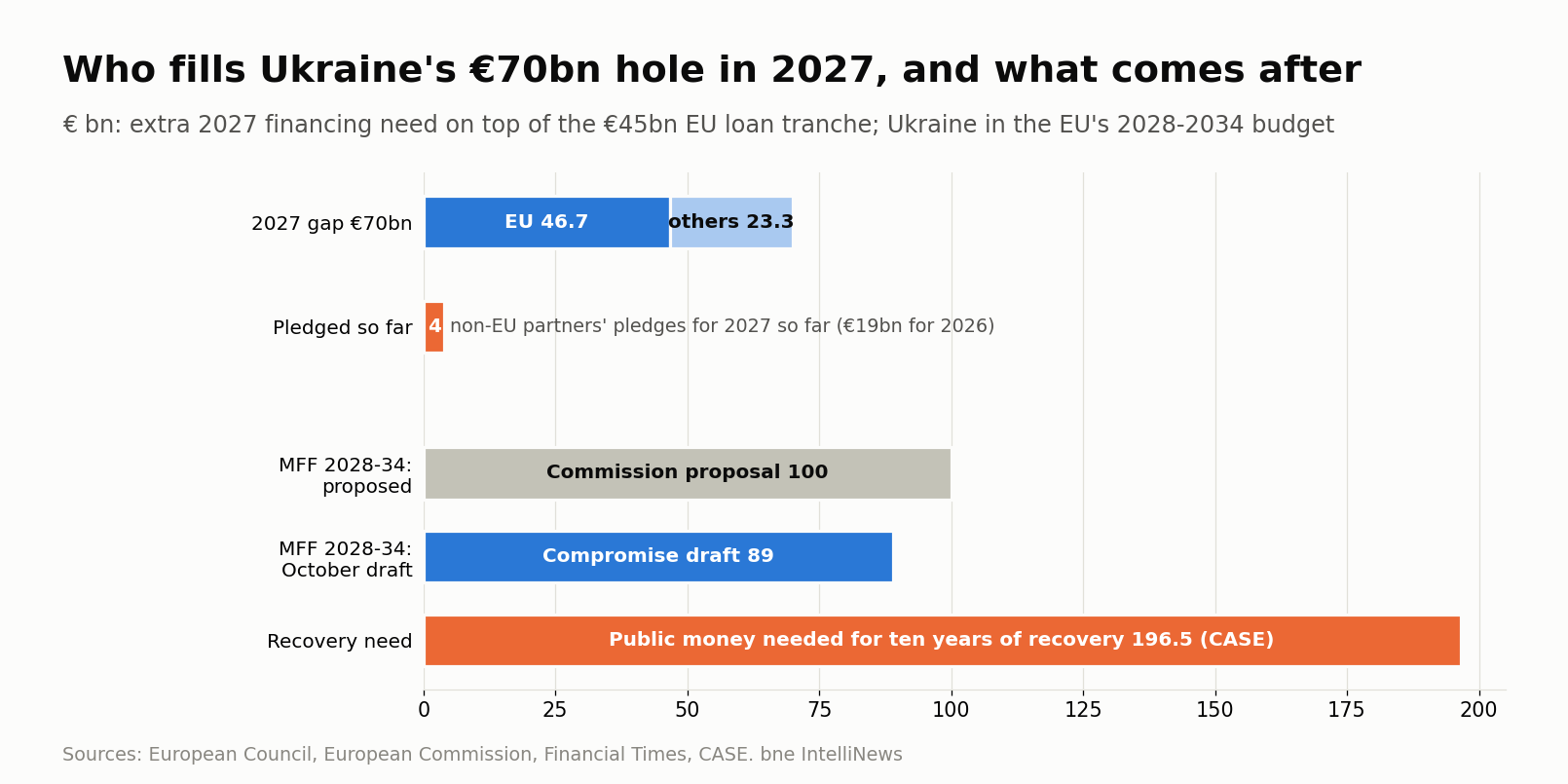
Who covers Ukraine's extra €70bn need in 2027, what non-EU partners have pledged, and Ukraine's share of the EU's 2028-2034 budget against the public money needed for recovery, € bn. Sources: European Council, European Commission, Financial Times, CASE.
Sources
[1] Ministry of Finance of Ukraine, Law on the State Budget of Ukraine for 2026, adopted plan, December 2025
[2] Ministry of Finance of Ukraine, amendments to the 2026 state budget, June 2026
[3] Ministry of Finance of Ukraine, state budget execution, January-September 2026, published October 5 and October 19, 2026
[4] Accounting Chamber of Ukraine, state budget execution against the period schedule, January-September 2026, published October 2026
This article was produced with the help of IntelliNews Lambda analytical tool
Unlock premium news, Start your free trial today.


