
Turkey’s central bankers feel the winds of war, benchmark rate kept on hold


Impacts of the Middle East conflict hit the monetary policy committee (MPC) of Turkey’s central bank on March 12 as it left the country’s main policy rate (one-week repo) unchanged at 37%.
In the days leading up to the MPC meeting, as the US-Israeli war on Iran got messier, the market switched from expecting a 100-bp rate cut to anticipating no cut.
The underlying trend of official inflation in Turkey was essentially flat in February, the authority said in its statement announcing the rate hold. Uncertainty was heightened amid the geopolitical developments, causing a deterioration in global risk appetite and higher energy prices, it added.
To contain risks posed to the inflation outlook, decisions made in support of tight monetary policy were enacted alongside coordinated fiscal measures, the MPC said. It referred to a tax relief mechanism re-introduced in fuel prices.
Effects of the geopolitical course on the inflation outlook through the cost channel and economic activity were being closely monitored, the MPC also stated.
Corridor back, effective rate 40%
On March 1, the central bank suspended its one-week repo auctions. The authority occasionally scraps or limits one-week repo auctions to push local lenders to the overnight window for the sake of additional tightening within the interest rate corridor.
As a result of the suspension, the central bank’s weighted average cost of funding and market rates (TLREF) rose to 40%.
On March 12, the regulator also left its overnight lending rate unchanged at 40%. It did so without fixing the symmetry of its so-called interest rate corridor – the overnight borrowing rate remains at 35.5%.
The central bank also has the option of shutting down its overnight window to push local lenders to the late liquidity window, where the funding rate stands at 43% within the interest rate corridor.
$22bn in reserves burnt through so far
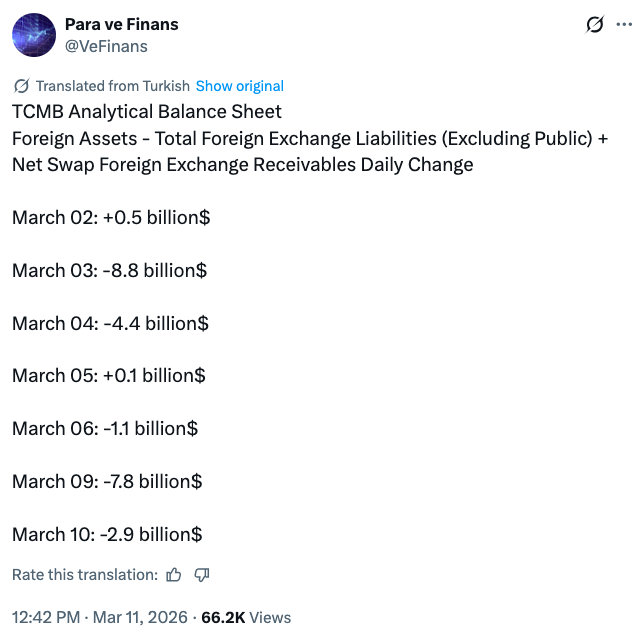

Tweets: The interventions are reflected on the central bank’s balance with a one-day lag. Data suggest strong FX demand on the first trading day (Monday, March 2) and last trading day of the first week (March 6, Friday) of interventions.
According to calculations by @VeFinans, the central bank’s net interventions in the currency market amounted to $22bn between March 2 and March 10, roughly the first week of its interventions.
Data suggest that the interventions slowed in the second week.
Prior to that, between February 27 and March 6, portfolio outflows amounted to $8.2bn ($0.8bn from Borsa Istanbul, $1.7bn from government lira bonds and $5.7bn in carry trade).
All in all, the USD/TRY pair remains under control. The central bank delivered a slight devaluation, bringing the pair to the 44s from the 43s prior to February 28.
Turkey’s government still has the firepower to face at least a few more tens of billions of dollars of shed reserves with no stress. Thus, Turkey’s five-year credit default swaps (CDS) stabilised around the 250s, up from the 230s that were on screens prior to February 28 (when the war started), after hitting the 260s.
Eurobond auctions and external loan deals have, meanwhile, ceased in the face of the first shock.
On March 1, the central bank also relaunched Turkish lira-settled foreign exchange forward selling transactions. They provide local banks with an alternative in fixing their balance sheets amid strong FX demand.
To date against the backdrop of the conflict, the Turks have remained calm. There have been no long queues at FX exchange outlets or jewellery shops.
April 22, next meeting
On April 22, the MPC will hold its second rate-setting meeting of the year. Currently, the expectation has to be that “no change” is the likeliest move.
Depending on developments in the war, an emergency rate hike could also be on the cards. A cut of around 100bp might become a possibility if the conflict is paused and oil prices stabilise.
The central bank is scheduled to hold eight rate-setting meetings in 2026. A 100 to 150-bp rate cut on average per meeting, making for a combined cut of 1,000bp, would bring the policy rate down to 28% at end-2026.
Such a path was expected prior to the outbreak of the war on February 28.
Two meetings have been held so far. A 100-bp cut was introduced in January.
No argument anymore: above 20% at end-2026
On February 12, the central bank raised its end-2026 official inflation “forecast” range to 15-21% in its latest quarterly inflation report. It was moved up from the previously stated range of 13-19% provided in the previous quarterly report released in November.
Even prior to February 28, the realisation was expected to come in at above the 20%-level at end-2026.
Given the conflict’s first impact on fuel prices, there is now no discussion on whether the end-year figure will definitely be released at above the 20%-level. Depending on the oil price, it could approach the 30%-level.
Oil price update in May report
On May 14, the central bank will release its next quarterly inflation report, the second of 2026. It will include updated forecasts and a look at the impact of the war.
In its report published last month, the authority expected the Brent oil price to average in the $60s per barrel in 2026. The per barrel price is currently hovering around $100.
A sharp upward revision in headline expectations is on the cards with the upcoming May report. Based on the central bank’s previous estimates, the authority calculates a headline inflation increase of about 0.8pp with each 10% increase in the Brent oil price.
Around 31% since November
On March 3, the Turkish Statistical Institute (TUIK, or TurkStat) said that Turkey’s consumer price index (CPI) inflation officially edged up to 31.53% in February from 30.65% y/y in January and 30.89% at end-2025.
Official inflation stood at 44% y/y at end-2024. It hovered around 33% between July and October 2025 while it has been hovering around 31% since November.
Prior to the war impact, the official series were expected to break down the “above-30%” inflation deadlock. Currently, this is not visible in the near future.
First impact from fuel prices
Prior to the February 28 dawn of war, fuel price increases in Turkey hovered in the 20%s on an annual basis. In the aftermath, the annual rise climbed into the 40%s. A stabilisation has yet to be observed in the oil price.
On March 2, the government revived a tax relief mechanism (known as “echelle mobile”) to smoothen the impact of the oil price gains.
Fuel prices in Turkey are automatically updated based on a formula. Based on the tax relief mechanism, 75% of the required price hike is deducted from the special consumption tax (OTV) and the remaining 25% is reflected in the sales price.
Prior to March 2, the OTV on diesel prices stood at Turkish lira (TRY) 13.90 per litre versus TRY 14.82 on gasoline prices.
As of March 12, the OTV on diesel prices fell below the TRY 3-level. Soon, the OTV will be zeroed and price hikes will be directly reflected in sales prices.
Unlock premium news, Start your free trial today.


