Moldova’s GDP up 2.4% y/y in 2025 after robust growth in H2


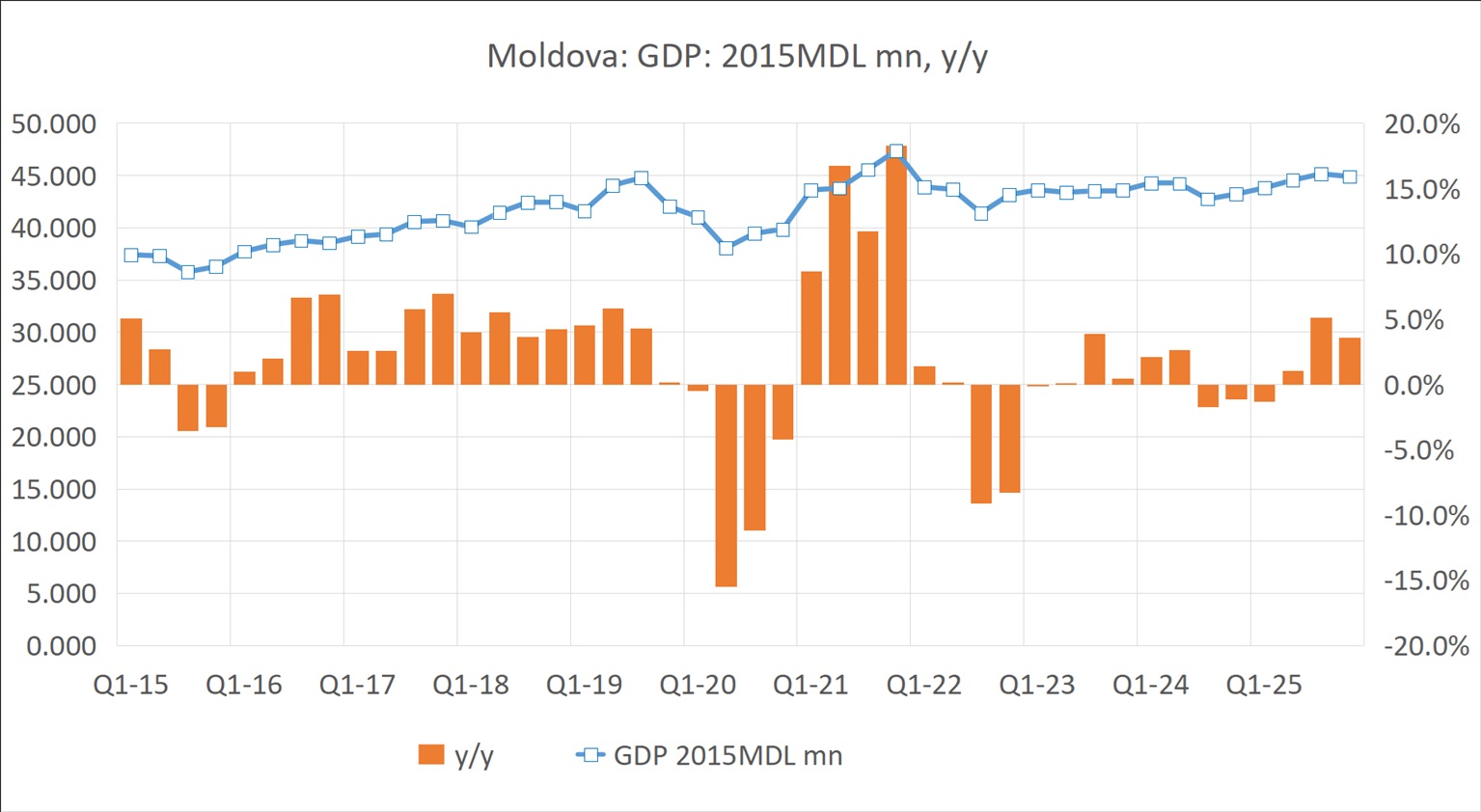
Moldova’s economy expanded by 2.4% y/y in 2025, supported by a strong recovery in the second half of the year after a weak start (chart), according to national statistics data.
In Q4 alone, GDP increased by 3.6% y/y, although it declined slightly by 0.6% q/q compared to Q3 (when it expanded by 5.1% y/y). Overall, Moldova’s economy posted growth for four consecutive quarters starting from Q3 2024, though the momentum was lost toward the end of 2025.
Looking ahead, EU financial support linked to Moldova’s accession process is expected to provide additional stimulus to economic growth in the coming years. The International Monetary Fund (IMF) projects Moldova’s economy will grow by 2.3% in 2026, after an estimated 2.7% expansion in 2025, followed by annual growth rates of over % per annum in the coming years.
The medium-term outlook drafted under the Article IV Consultations in February this year, envisaging what the IMF describes as "moderate growth", assumes that higher investment and productivity-enhancing reforms will lift potential output, while labour shortages will continue to weigh on growth.
Sector-wise, the largest contribution to GDP growth in 2025 came from the IT&C sector, which expanded by 12.5% y/y and contributed 0.9 percentage points to the overall growth rate. Construction also supported economic activity, with value added rising by 6.6% y/y and contributing 0.5pp.
Manufacturing generated a moderate increase in value added of 3.0% y/y, adding 0.2pp to GDP growth. The traditionally strong agricultural sector contributed 0.8pp, as value added in agriculture increased by 10.7% y/y.
By contrast, the retail sector posted a moderate contraction of 2% y/y in terms of value added, while the transportation sector declined by 7.2% y/y. Each of the two sectors contributed negatively to overall GDP growth by about -0.3pp.
On the demand side, consumption rose by 3.5% y/y, driven mainly by a 4.0% y/y increase in household consumption. Gross fixed capital formation expanded even more strongly, rising by 16.9% y/y.
The robust growth in domestic demand, combined with an increase in inventories, led to a widening trade deficit, which reached 29.2% of GDP and covered about 22.6% of total domestic demand.
Unlock premium news, Start your free trial today.