
Thailand holds policy rate at 1% as oil and El Niño threaten inflation


The Bank of Thailand held its policy rate at 1.00% on October 28 for a fourth straight meeting, but warned that oil prices and El Niño could push inflation higher.
The Monetary Policy Committee voted unanimously to hold, with one of its seven members absent, the central bank said in a statement. All 26 economists polled by LSEG had expected no change. The rate has been at 1.00% since a 25bp cut in February, the last of six cuts worth 150bp in total since October 2024.
Thailand is sticking with cheap money while others in the region tighten. The Philippines and several other Asian central banks have raised rates as the Middle East war lifted oil prices, but the BoT has kept rates on hold since February, supporting an uneven recovery while monitoring inflation risks.
"The Committee assesses that an accommodative monetary policy stance, coupled with targeted financial measures, has helped support the economic recovery amid uneven growth," the statement said.
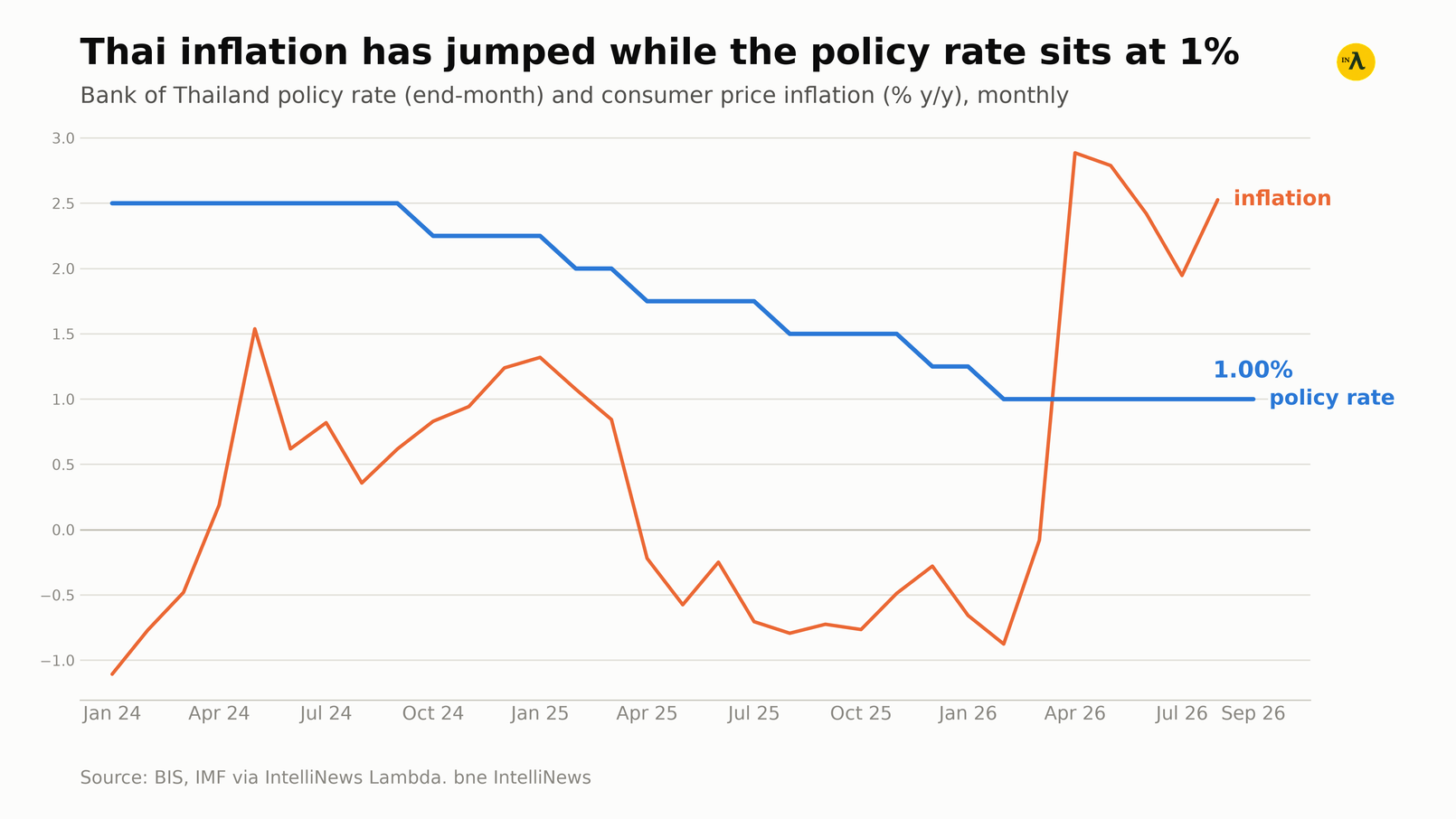
Bank of Thailand policy rate (end-month) and CPI inflation (% y/y), January 2024 to September 2026 for the rate and August 2026 for inflation. Source: BIS, IMF via IntelliNews Lambda.
The bank raised its growth forecasts to 2.4% for 2026 and 2.1% for 2027, from 2.3% and 1.8%, on stronger-than-expected exports and private investment tied to the technology and AI cycle. The gains are concentrated in the businesses and workers linked to those industries, while household debt, a fragile labour market and weak purchasing power hold back consumption, and foreign tourist arrivals are expected to fall as oil prices rise. "Overall economic growth remains below its potential," the statement said.
GDP growth slowed to 1.9% y/y in the second quarter from 2.8% in the first, and the economy shrank by 0.2% quarter on quarter.
Inflation rose to 2.82% in September, near the top of the BoT's 1-3% target range, after prices were falling as recently as February, when CPI was down 0.9% y/y. The bank expects headline inflation to average 2.1% this year and 1.3% in 2027, with core inflation at 1.2% and 1.3%.
Prices will keep rising through the rest of this year and into early 2027, driven by energy costs and El Niño, before base effects and weak demand bring inflation back down, according to the BoT. "The heightened inflation risks stemming from oil prices and El Niño warrant close monitoring, as they could intensify cost pass-through going forward," the statement said. The committee also flagged the conflict in the Middle East and the limited room left for energy subsidies.
The baht has weakened against the dollar as markets priced in tighter US monetary policy and oil prices climbed. Credit growth has picked up on loans to large companies, but lending to small and medium-sized enterprises is still shrinking as banks avoid riskier borrowers.
Capital Economics expects the rate to stay at 1.00% until the end of the year, in line with consensus, followed by a final 25bp cut in 2027. That makes it more dovish than most analysts, who expect the BoT to hold throughout next year. The committee next meets on December 23.
Unlock premium news, Start your free trial today.


