
Russia hosts 48 African nations in Moscow as the race for Africa heats up


Delegations from 48 of Africa's 54 countries, 22 led by heads of state, are in Moscow for the third Russia-Africa summit, where Putin is selling Russia as Africa's anti-colonial partner.
President Vladimir Putin opens the third Russia-Africa Economic and Humanitarian Forum at Gostiny Dvor on October 28 alongside the African Union's current chair, Burundi's President Evariste Ndayishimiye.
He will then receive the heads of the continent's main regional blocs - among them the African Union, the African Continental Free Trade Area, ECOWAS, SADC and COMESA - and Afreximbank in the Kremlin's St Andrew's Hall, TASS reported. The leaders' summit proper follows on October 29.
The summit is due to approve a cooperation plan for 2027-2029, and 33 intergovernmental documents are lined up for signing with African states, Kremlin aide Yuri Ushakov said on October 26.
The gathering is the high point of a push that began at the first summit in Sochi in 2019, and it comes as the US, Europe, China, the Gulf states and Turkey compete for the same partners, minerals and votes.
Russia is well ahead of most of its rivals, bar China: military governments in the Sahel have sent French and US troops home and turned to Moscow, and not one African government signed a 51-nation statement backing Ukraine at the UN in September. In economic terms Russia is still a small player, with 0.5% of Africa's foreign economic interaction, according to calculations by Vedomosti.
Bigger than St Petersburg
This is the first of the summits to be held in Moscow. The inaugural one, in Sochi in October 2019, came before the invasion of Ukraine and drew all 54 African states, 43 of them at head-of-state level. The second, in St Petersburg in July 2023, was held 17 months into the war and drew 49 delegations but only 17 heads of state, after the Kremlin accused the West of trying to undermine it.
This year's turnout sits between the two, despite fresh Russian complaints. Foreign Ministry spokeswoman Maria Zakharova accused Western governments in September of pressuring African states to stay away, without naming the countries involved.
Moscow's appeal is that Russia never held colonies in Africa, while the Soviet Union backed the continent's independence movements and educated much of its elite, a head start in what IntelliNews has described as a new Great Game in its long read on Russia in Africa.
In St Petersburg Putin told delegates that Moscow had "invariably provided support during the African countries' difficult fight against colonialism", and wrote off debts and promised free grain. This time his address is due to stress sovereign development on an equal footing and Africa's access to resources, fertiliser and modern technology, according to Ushakov.
Grain, fertiliser and guns
Russia's trade with Africa topped $27bn in 2025, about 1.5 times its level at the time of the 2023 summit, Ushakov said. Russia shipped more than 18mn tonnes of grain to the continent last year and 13mn tonnes in the first nine months of 2026, and more than 2.2mn tonnes of mineral fertiliser so far this year, he said, according to TASS.
Russia's share of Africa's fertiliser imports rose from 4% in 2018 to 18-20% in 2025, producer UralChem told TASS on October 27. Its own sales to the continent grew from 100,000 tonnes to about 1mn tonnes over the same period, and it says it shipped about 135,000 tonnes free of charge in 2022-2024, covering the transport costs too.
Those grain flows are now under strain. Russian wheat exports were heading for a 60% collapse in September after Russia and Ukraine began striking each other's grain ports, a food price shock that falls hardest on North African importers. Weapons are the other staple: Africa accounts for 30% of the order book of state arms exporter Rosoboronexport.
Reactors for the continent
Nuclear power leads Russia's technology offer. Russia's nuclear exports are booming, and state nuclear corporation Rosatom is building 28 reactors abroad in nine countries, chief executive Alexey Likhachev said in August. Egypt's El Dabaa is the only one in Africa: four 1,200 MW VVER-1200 units, with first fuel due in 2027 and grid connection in 2028. Rosatom is in talks to add two more, which would lift the plant's capacity from 4.8 GW to 7.2 GW.
Egypt's Nuclear Power Plants Authority accused Rosatom in a June letter of structural defects in the foundation slabs of three units and of failing to uphold nuclear safety culture, Politico reported in August, citing leaked documents.
Elsewhere the deals are at an earlier stage. Ethiopia signed a nuclear action plan with Rosatom in Moscow in September 2025, Rwanda agreed a small modular reactor roadmap in July, Russia agreed in 2023 to build a plant in Burkina Faso and Uganda picked Russia and South Korea for two nuclear plants the same year. Mali's delegation came to Moscow to press for faster progress on its own planned plant, the Sahel Tribune reported.
Every reactor sold brings decades of Russian fuel, servicing and often financing with it - the reason uranium is the new gas in Moscow's dealings with emerging markets. Russia is also chasing African uranium itself, in Namibia and Niger.
The anti-colonial card
Putin presents Russia's offer as a partnership between sovereign equals, set against Western sanctions, aid conditions and the legacy of empire. The message has landed hardest in the Sahel, where Burkina Faso cut diplomatic ties with France in June over what it called "neo-colonial ambitions".
Moscow took the argument to the UN this month. A Russian-drafted resolution that counts unilateral economic sanctions among contemporary forms of colonialism cleared the General Assembly's Fourth Committee by 85 votes to 49, with 23 abstentions, on October 15, according to the UN's meetings coverage. South Africa, Egypt, Ethiopia, Algeria and Ghana voted in favour, while the US, the UK, Japan and all 27 EU member states voted against. African support was broad but not unanimous: Morocco abstained and no vote was recorded for Nigeria or Kenya. The text now goes to the full General Assembly.
Africa's 54 states hold no permanent seat on the UN Security Council, only three of its ten rotating ones, and the African Union's Ezulwini Consensus demands two permanent seats with veto rights. In the council Africa often looks to Russia and China, two veto-holding members, to carry its positions, and Foreign Minister Sergei Lavrov has called the continent's bid for a permanent seat "legitimate", Africanews reported in September 2024.
Putin's address to the summit will focus on "the priorities for Russia's engagement with the continent's nations within the UN", Ushakov told TASS.
Hearts, not wallets
Europe still accounts for 28.5% of Africa's total foreign economic interaction - trade, external debt, investment, aid and remittances - against 10.0% for the US and 16.4% for the BRICS countries, according to Vedomosti's calculations from World Bank, IMF, UNCTAD, UN, TOSSD and OECD data. China alone has 7.8%, India 2.1% and Russia 0.5%. Altogether the flows came to $5.27 trillion, or 167% of Africa's GDP.
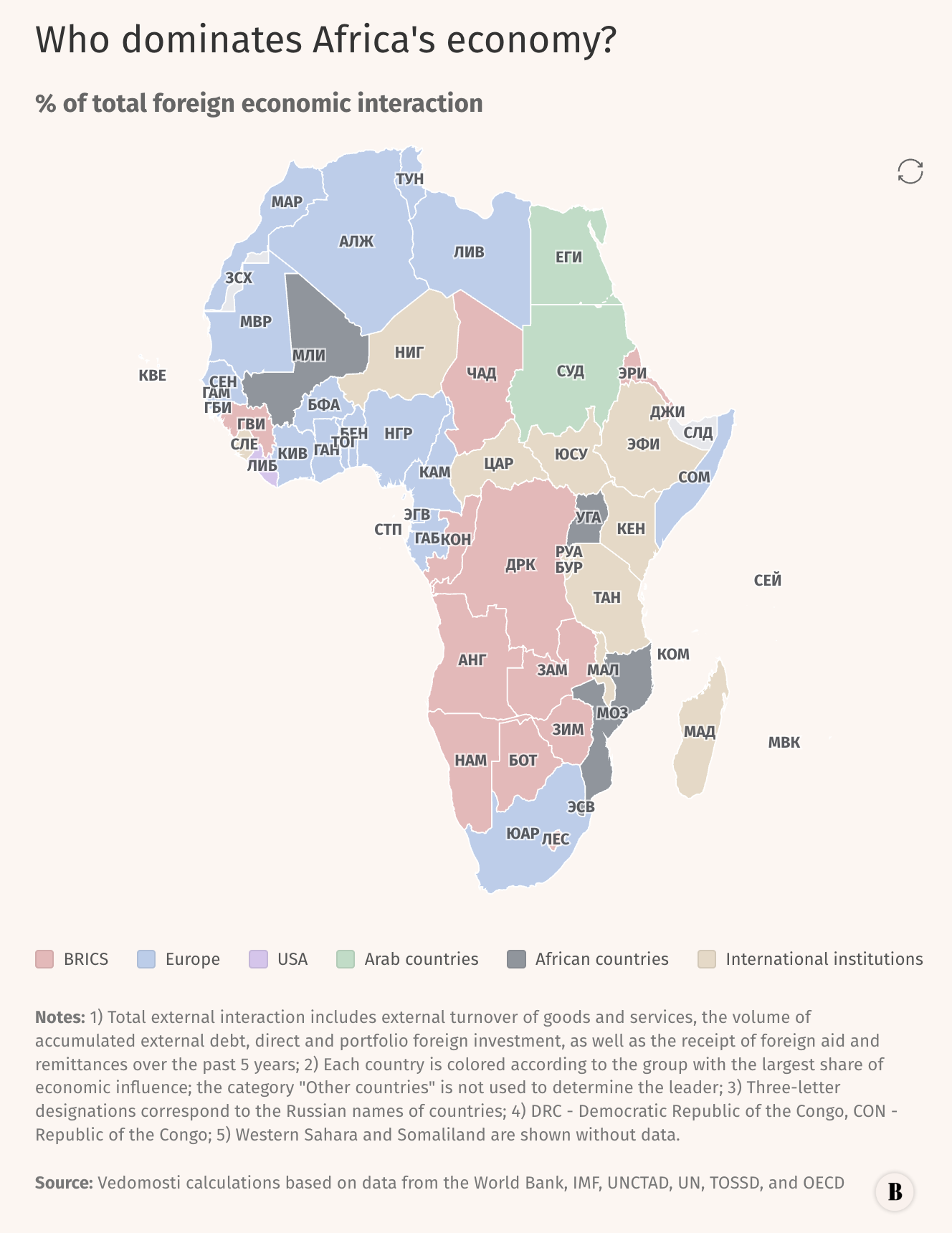
Who dominates Africa's economy: each country is coloured by the group with the largest share of its foreign economic interaction (country labels in Russian). Source: Vedomosti calculations based on World Bank, IMF, UNCTAD, UN, TOSSD and OECD data.
BRICS is gaining fastest in trade. Its members' goods exports to Africa rose 65% in 2015-2025, from $187bn to $309bn, while OECD exports grew 18% to $287bn, a fall in real terms. China is now the largest single supplier, with $161bn, or 21% of the total, and BRICS countries hold the biggest shares in East Africa, at 31%, and Central Africa, at 19%.
In finance BRICS lags far behind. Its members hold 11% of the stock of foreign direct and portfolio investment in Africa, $106bn of $981bn, against $438bn for Europe and $250bn for the US. China is the largest single creditor, with $84bn, or 7.2%, of Africa's $1.17 trillion external debt, but BRICS countries supplied only $20bn, or 2.9%, of the $689bn of foreign aid the continent received in 2019-2024.
| Partner | Share of Africa's foreign economic interaction (%) |
| Europe | 28.5 |
| - France | 4.9 |
| - UK | 3.8 |
| BRICS | 16.4 |
| - China | 7.8 |
| - India | 2.1 |
| - Russia | 0.5 |
| Other African countries | 11.0 |
| International institutions | 10.3 |
| US | 10.0 |
| Arab world | 7.7 |
| Total ($ trillion) | 5.27 |
| Total (% of GDP) | 167 |
Trade, accumulated external debt, direct and portfolio investment, and aid and remittances over five years. Source: Vedomosti calculations based on World Bank, IMF, UNCTAD, UN, TOSSD and OECD data.
The 0.5% figure misses Russia's role as a supplier of grain, arms and nuclear technology that create long-term dependence, Ekaterina Novikova of the Plekhanov Russian University of Economics told Vedomosti. Russia's military and political influence is far greater than its economic role, said Mikhail Margelov, vice-president of the Russian International Affairs Council, who described Africa not as a continent carved into spheres of influence but as one of "competitive coexistence" among many outside powers.
Nigeria and the bilateral marathon
Putin met Mozambique's Daniel Chapo, Equatorial Guinea's Teodoro Obiang Nguema Mbasogo and Libya's Mohamed al-Menfi on October 27, on the sidelines of a Gas Exporting Countries Forum summit. Egypt's Abdel Fattah el-Sisi, Ethiopia's Prime Minister Abiy Ahmed and the Republic of Congo's Denis Sassou Nguesso are due on October 28, followed on October 29 by Ndayishimiye and the leaders of Madagascar, Zimbabwe, Namibia and Sudan, according to Ushakov's schedule. October 30 is set aside for ten more: Ghana, Mali, Mauritania, South Sudan, the Central African Republic, the Democratic Republic of Congo, Togo, Eritrea, Somalia and Comoros.
Nigeria, Africa's most populous country, is not on the published list. Vice President Kashim Shettima, who represented President Bola Tinubu in St Petersburg in 2023, is leading the delegation, Nigeria's ambassador to Moscow, Joseph Olusola Iji, told TASS.
Nigeria is the kind of partner Moscow needs if its African ties are to move beyond the Sahel. Its crude output averaged 1.53mn barrels per day in September, above its Opec quota for a fifth month running, and the Dangote refinery, Africa's largest, launched a $1.6bn IPO in September. Abuja asked for Russian oil and gas technology at the 2023 summit.
Summits have struggled to turn into contracts before. St Petersburg produced no new energy deals, and the 33 documents due this week will be judged on how many become reactors, fertiliser plants and trade rather than memorandums, as Moscow tries to turn political goodwill on the continent into an expanding pull that shows up in the numbers.
Unlock premium news, Start your free trial today.


