
Croatia's growth to hold at 2.1% despite sticky inflation, Raiffeisen says


Croatia's economy will keep growing at 2.1% this year and next despite a second-quarter slowdown, while inflation stays well above target, Raiffeisen Research said in a note on October 27.
Real GDP growth eased to 1.7% year-on-year in the second quarter. Raiffeisen’s note puts first-quarter growth at 2.2%, against 2.3% in the Eurostat series recorded in stats.db; quarter-on-quarter growth picked up to 0.4%, leaving first-half output 1.9% higher than a year earlier. Investment and private consumption are still carrying the economy, but strong imports and softer foreign demand have turned net exports into a drag.
The slowdown ends a run in which Croatia was one of the fastest-growing economies in the euro area. Annual growth averaged almost 4% in 2024 and about 3.6% in 2025, according to Eurostat data, before dropping to the slowest pace since the pandemic in the second quarter. "After several years of exceptionally strong expansion, normalisation was always on the cards," wrote Zrinka Zivkovic Matijevic, head of economic and financial research at Raiffeisen's Croatian unit. The bank's 2.1% forecast for 2026 sits just below the IMF's 2.2%, while the Croatian National Bank expects growth to average 2.3% in 2026-28.
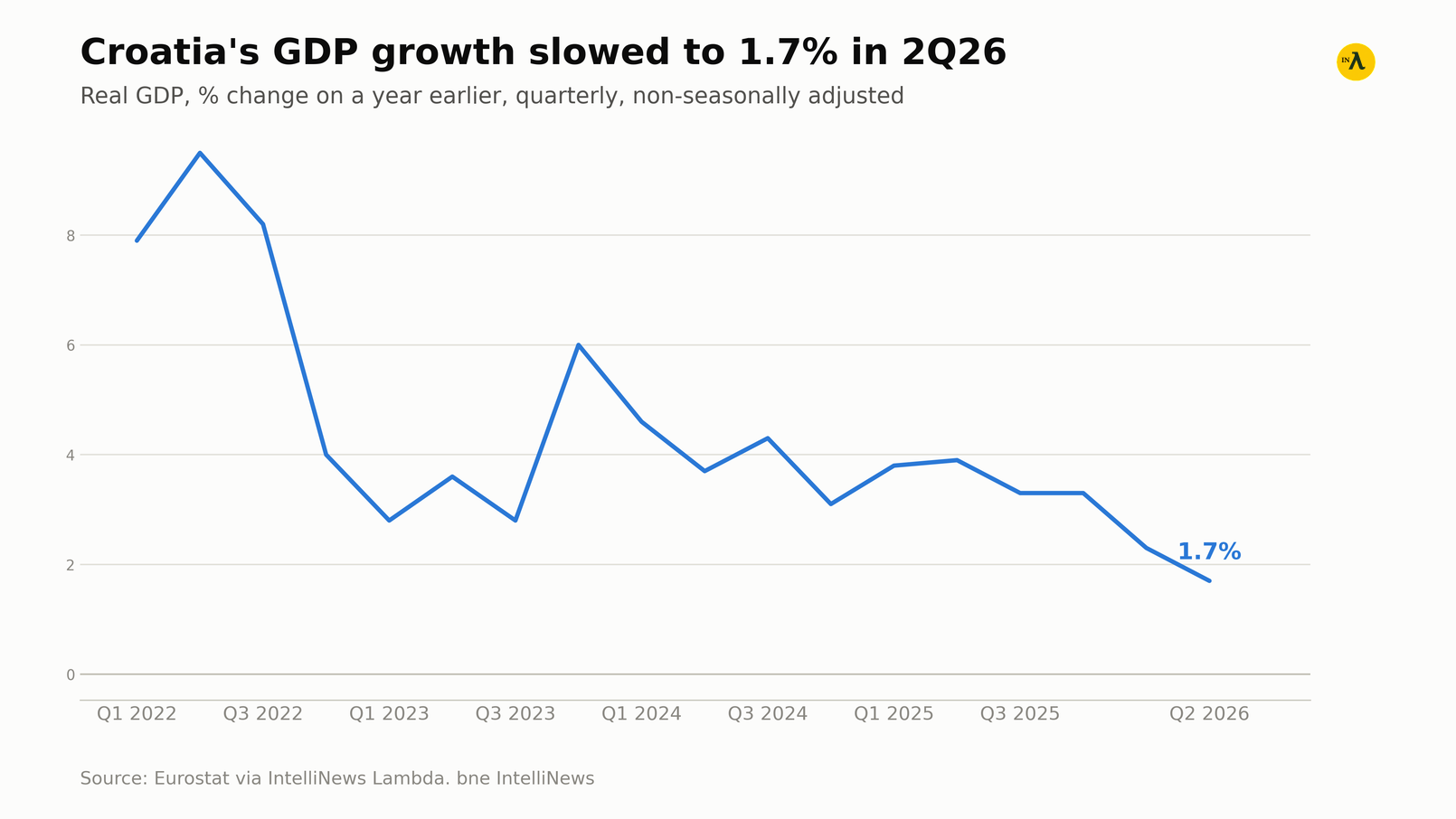
Croatia's real GDP growth, % y/y, quarterly. Source: Eurostat via IntelliNews Lambda.
Early third-quarter indicators point to faster activity, and business confidence is above its long-term average in every sector except construction. Industrial output has recovered since June after a weak start to the year, and a new heavy-residue unit at the Rijeka refinery should lift diesel output. Construction is cooling, with annual growth just below 3% as permits, new orders and hiring plans weaken, but Raiffeisen expects a gradual slowdown rather than a reversal.
EU money will keep investment going. Croatia has filed its final payment request for the ninth and tenth tranches of its National Recovery and Resilience Plan (NPOO), worth €2.7bn, and will then lean on about €9bn of cohesion funds from the 2021-2027 budget, more than €10bn with national co-financing.
Retail sales grew by more than 3% y/y in July and August, the best result this year. Employment should rise 0.9% in 2026, unemployment should stay at a record low below 5%, and wage growth should ease towards 5% in 2027, the bank said. The minimum wage rose 8.5% this year, and the government is due to set the 2027 level in the coming weeks. Spending could surprise on the upside before the parliamentary elections due in spring 2028.
Fuel drives inflation
Consumer prices rose by an average of 4.5% y/y in the first nine months of the year, with energy and services each adding about two percentage points. Inflation accelerated to 4.7% in September.
Energy prices were on average 13% higher than a year earlier, and liquid fuels about 40% higher, as the Middle East conflict pushed up oil and refined product prices. Lower excise duties and capped retail margins softened the pass-through at the pump, while the partial withdrawal of regulated household energy prices added to the rise: electricity was 12% dearer on average, contributing 0.6 percentage points to headline inflation.
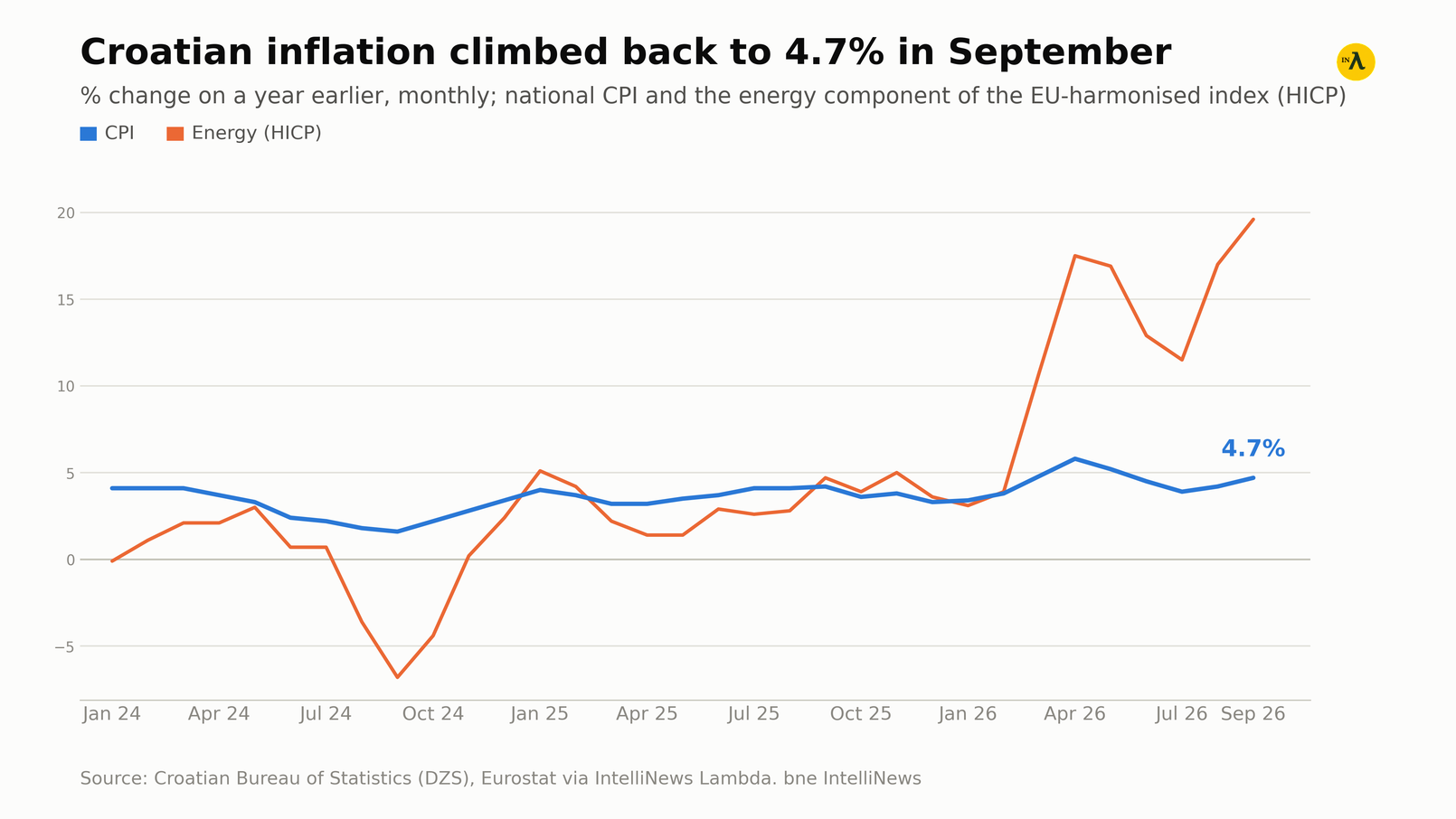
Croatia's consumer price inflation and HICP energy inflation, % y/y. Source: Croatian Bureau of Statistics, Eurostat via IntelliNews Lambda.
Services prices rose 7.8% on average, pushed by domestic and tourist demand and by earlier increases in administered prices for rents, utilities, supplementary health insurance and vehicle inspections. Food, drink and tobacco prices rose a modest 2.1%, and non-food industrial goods excluding energy were 0.7% cheaper.
Raiffeisen kept its forecast of average inflation at 4.4% this year and 2.9% in 2027, with risks tilted upwards. Energy inflation is not expected to fall back into single digits before the end of the first quarter of 2027, when base effects kick in, analyst Petar Bejuk wrote. The main upside risk now comes from second-round effects of dearer energy rather than from domestic demand, he said.
| 2026 (RBI) | 2027 (RBI) | 2026 (government) | |
| Real GDP growth | 2.1% | 2.1% | - |
| CPI inflation, average | 4.4% | 2.9% | - |
| General government deficit, % of GDP | 3.1% | c.3% | 2.9% |
| Public debt, % of GDP | just under 56% | 56% | 55.5% |
Raiffeisen Research forecasts for Croatia against the government's 2026 targets. Source: Raiffeisen Research, October 27, 2026.
Windfall spent, not saved
The October budget revision raised projected revenues by €853mn to €36.6bn on stronger VAT, profit tax and social contributions, but only €108mn of that went to cut the deficit. The rest paid for pensions, social benefits, public-sector wages, defence and energy support, so the central government deficit eases only from €4.12bn to €4.02bn.
The government expects a general government deficit of 2.9% of GDP this year and debt of 55.5%; Raiffeisen pencils in 3.1% and debt just under 56%. With the four-quarter deficit at 3.5% of GDP, hitting the target depends on strong revenues and spending restraint in the second half.
"Put simply, much of the windfall was spent rather than saved, which leaves less room for future shocks," wrote analyst Elizabeta Sabolek Resanovic. Croatian employers made a similar warning against locking in permanent spending on the back of rising revenues.
Financing looks comfortable. The revision cut the borrowing envelope by €1.5bn, and Raiffeisen expects most of the remaining needs to be met at home, with a strong retail focus. Households held €44bn of deposits at the end of August, €34.2bn of it overnight, and companies €19.7bn, while general government deposits of €8.6bn, including €3.3bn at the central bank, give the treasury a large cash buffer.
Bond prices have tracked global markets. A more hawkish European Central Bank and higher global yields pushed the long end of the Croatian curve up by 40-50 basis points in the third quarter, and the 10-year Eurobond yields around 3.9%, roughly 50bp over the German Bund. Moody's affirmation of Croatia's 'A3' rating with a stable outlook supports that picture, and the spread could narrow towards 40bp if geopolitical tensions ease, the bank said.
Raiffeisen's 2027 baseline is a deficit of about 3% of GDP and debt of 56%. The risks are mostly home-grown: pension, wage and subsidy pressure, the fading of EU money once the NPOO ends, rising interest costs and higher defence spending. "The 2027 budget will be the first real test," Sabolek Resanovic wrote. "Discipline in good times remains the cheapest insurance for market confidence and borrowing costs."
Unlock premium news, Start your free trial today.


