
Taiwan leaves South Korea in the dust as AI chip boom sends growth soaring


Taiwan's economy is growing four times as fast as South Korea's, although both are being carried by the same artificial intelligence (AI) chip boom.
Taiwan's GDP rose by 14.4% y/y in the third quarter, according to advance estimates released by the island's statistics agency on October 30. South Korea managed 3.4% in advance figures published by the Bank of Korea (BOK) three days earlier.
Capital Economics expects full-year growth of 12% for Taiwan and 4.0% for South Korea, and its economists Gareth Leather and Jason Tuvey set out the reasons for the gap in a note on October 30.
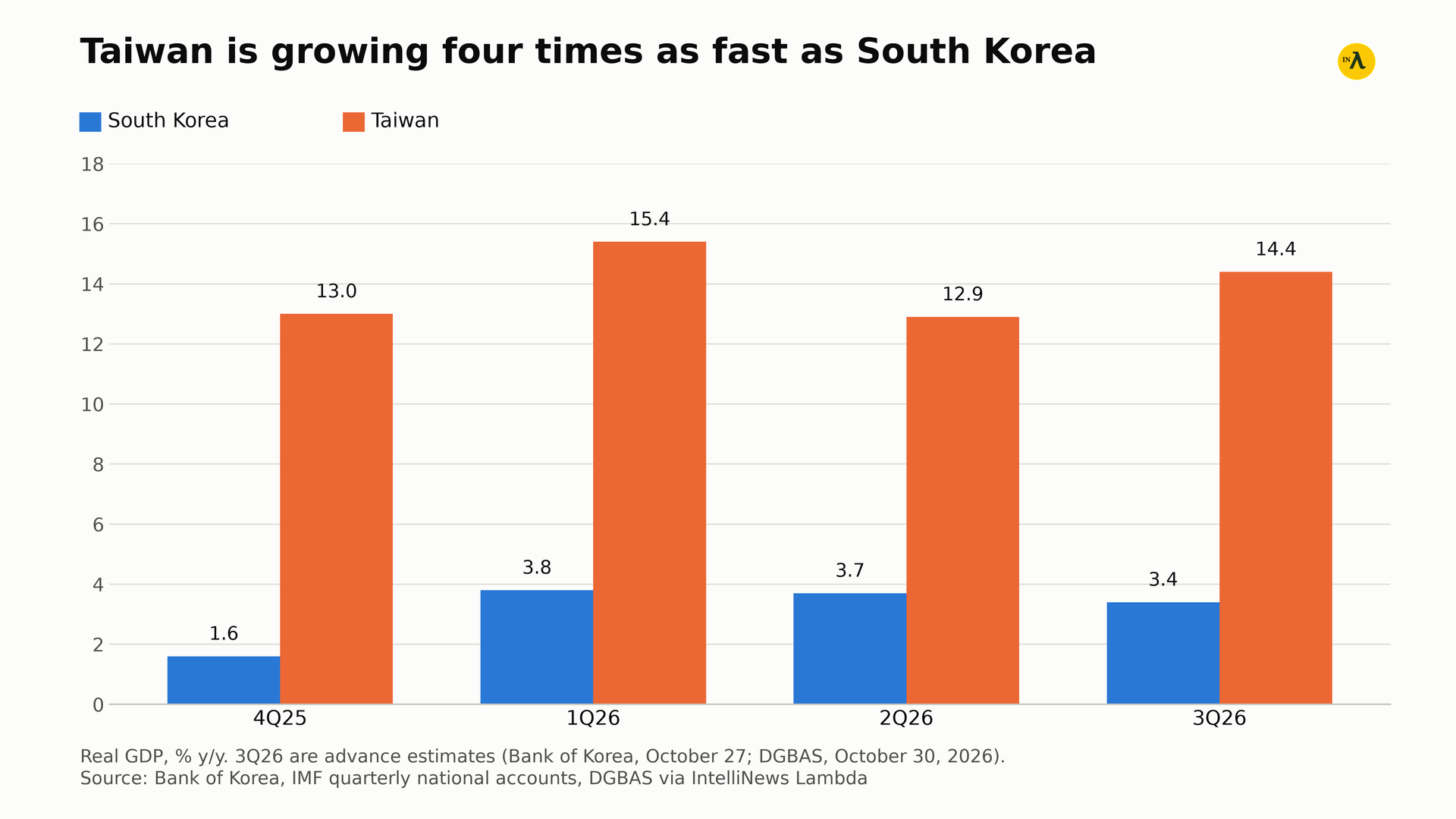
Real GDP growth, % y/y. Source: Bank of Korea, IMF quarterly national accounts, DGBAS via IntelliNews Lambda.
South Korea is not short of foreign demand. Measured in dollars, its exports are growing faster than Taiwan's: shipments jumped 83.5% y/y to a record $120.9bn in September, more than half of it semiconductors, while Taiwan's rose 60.9% to $87.2bn. On that measure Seoul should be the one pulling ahead.
The explanation lies in what each economy is selling more of. Taiwan's boom rests on shipping larger quantities of servers and chips, whereas South Korea's mostly comes from higher prices for its memory chips, the note argues. Price gains swell export receipts but do nothing for real output.
"This distinction matters for real GDP growth, which measures changes in the volume of output rather than its nominal value," Leather and Tuvey wrote.
IMF data show how far the two had already diverged last year. Taiwan's export volumes grew by 32.1% in 2025, South Korea's by 4.3%. The price windfall has instead surfaced in South Korean incomes: real gross domestic income, which captures changes in the terms of trade, rose 18.8% y/y in the third quarter, the biggest jump since late 1977.
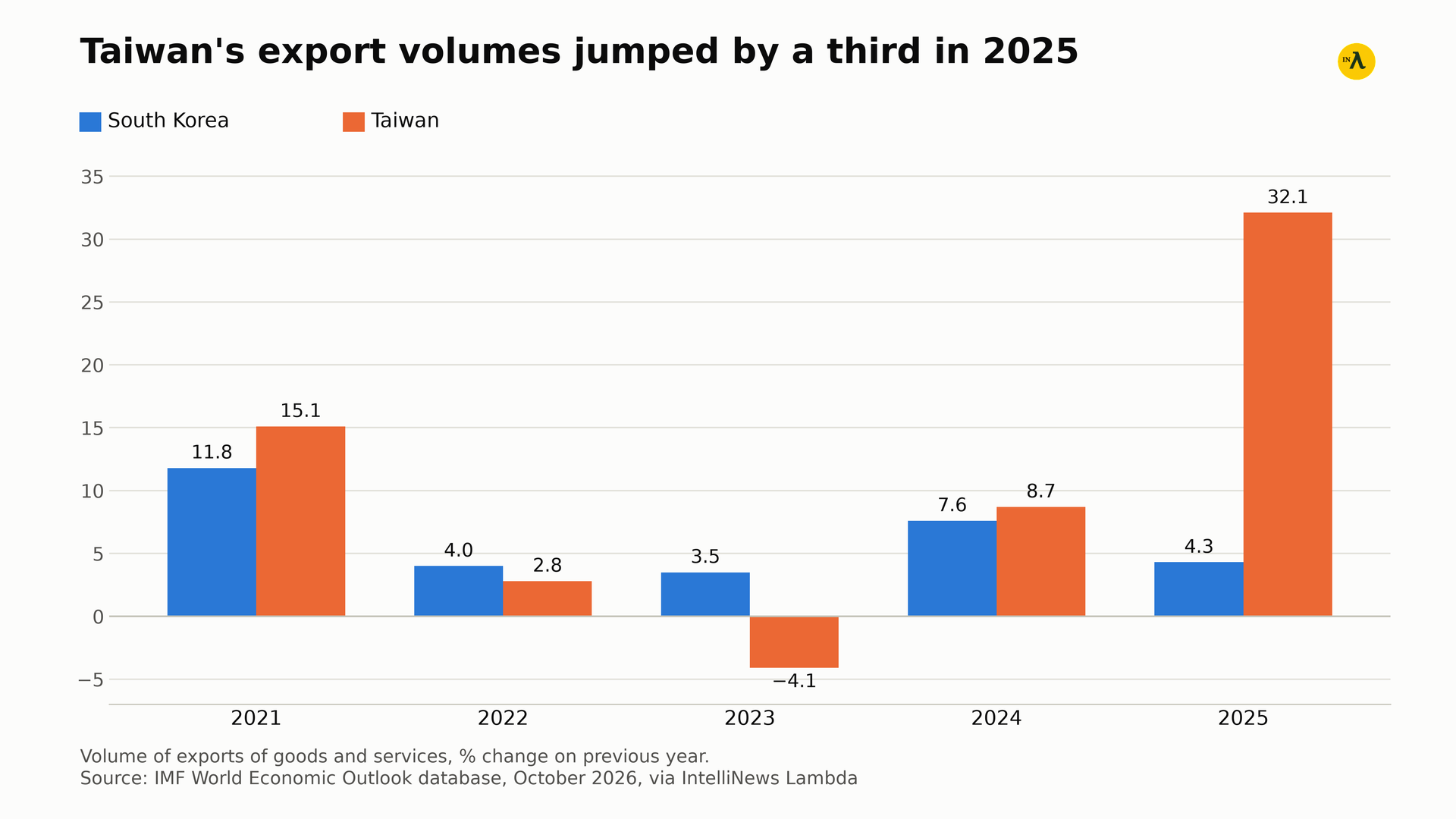
Volume of exports of goods and services, % change on previous year. Source: IMF World Economic Outlook database, October 2026, via IntelliNews Lambda.
Scale adds to the gap. Exports were equivalent to 73% of Taiwan's GDP last year against 45% in South Korea, according to Capital Economics, so the same AI order book moves the island's economy much further. Both are among the biggest winners of the data-centre build-out, which lifted South Korea to fifth place among the world's exporters in the first half and Taiwan to sixth.
At home the picture is weaker in Seoul. Private consumption, about half of South Korea's GDP, slipped 0.2% q/q in the third quarter. The BOK blamed lower spending on financial services during a stock market correction and poor car sales after strikes at major carmakers. Capital Economics adds higher energy prices, households still paying down debt and dearer borrowing; the BOK has lifted its policy rate to 3.00% and held it there on October 22.
Taiwanese households have kept spending, with consumption up 5.4% y/y in the quarter, even as consumer confidence slipped in October on rising prices for electronics.
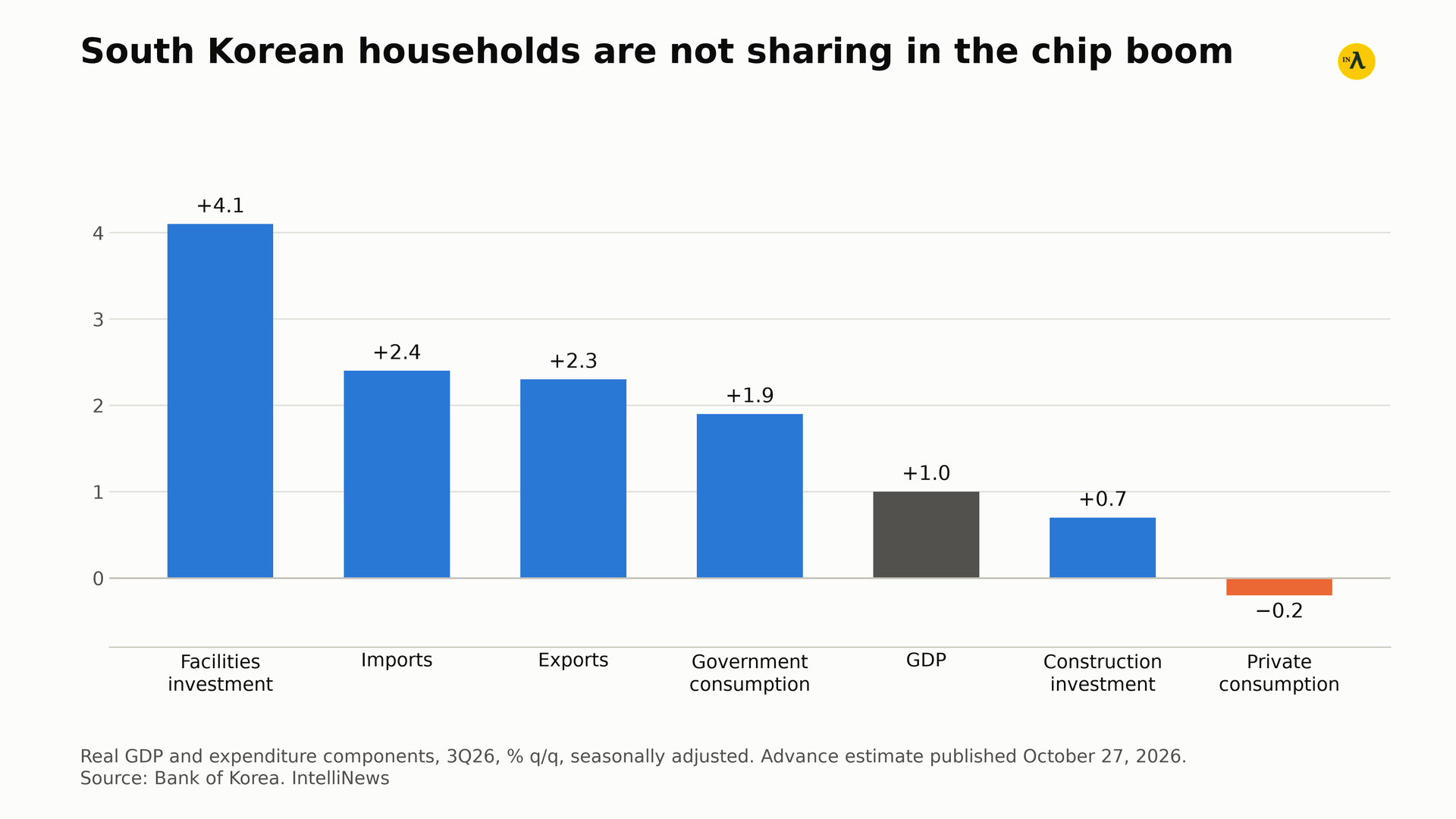
South Korea real GDP and expenditure components, 3Q26, % q/q. Source: Bank of Korea. IntelliNews.
There are signs South Korea is starting to sell more, not just charge more. Facilities investment rose 4.1% q/q, its fastest growth in five years by Capital Economics' reckoning, as chipmakers add capacity. Government consumption climbed 1.9% as surging tax receipts from chipmakers are recycled into public spending, a theme of the consultancy's earlier forecast of 4% growth.
That will not close the gap. With a smaller export sector and households still holding back, the AI boom "is unlikely to generate anything close to the rates of growth achieved in Taiwan", the note concludes. Capital Economics also expects AI demand to start fading towards the end of next year, a slowdown that would bite hardest in the economies most exposed to the technology cycle.
This article was produced with the help of IntelliNews Lambda analytical tool
Unlock premium news, Start your free trial today.


