
US growth leans on AI as rest of rich world stalls - Oxford Economics


Without the artificial intelligence boom, the US economy would have grown at a moderate annualised 1.4% in the first half of 2026, and other big advanced economies more slowly still, Oxford Economics estimated in a research briefing on October 29.
Should the AI boom slow or go into reverse, the risk of recession in the advanced economies would be substantial, according to Adam Slater, lead economist at the consultancy and author of the briefing, "The AI and non-AI economies - two different growth stories".
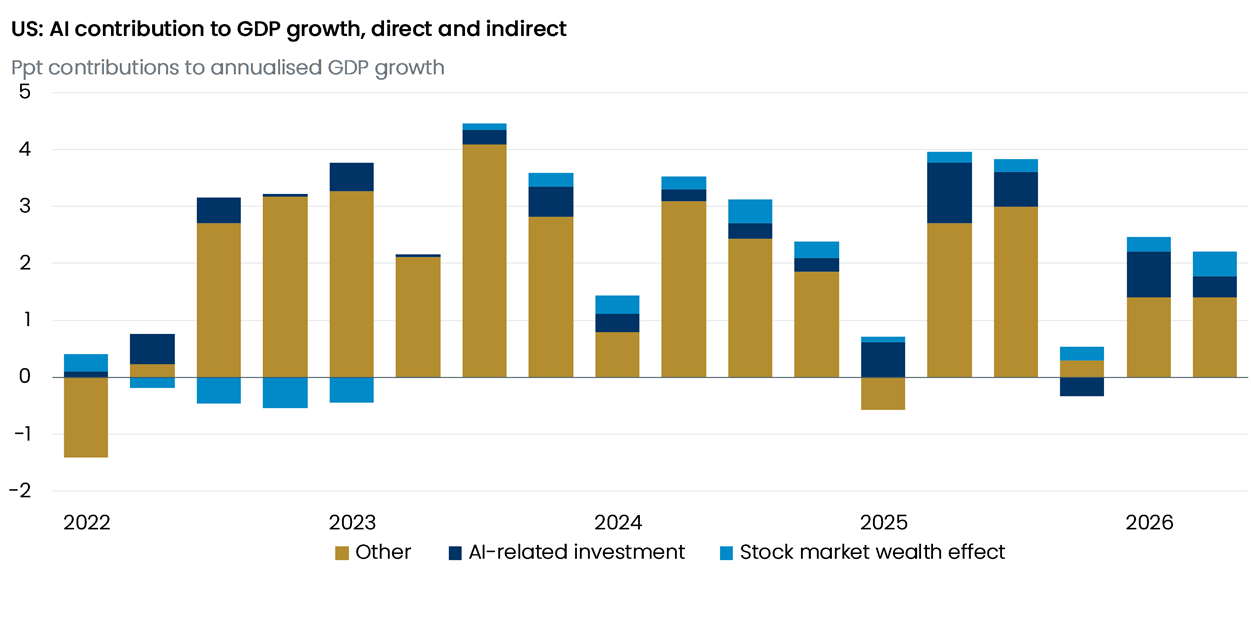
US: AI contribution to GDP growth, direct and indirect (ppt contributions to annualised GDP growth). Source: Oxford Economics. Note: investment is net of estimated imports
The estimate lands as investors grow nervous about how the AI build-out is being financed, after worries over AI debt triggered a chip sell-off across Asia in mid-October. It suggests that much of the strength in US output this year has come from a single sector, and that the rest of the rich world has little underlying momentum to fall back on.
A narrow US boom
Oxford Economics counts two main channels: investment in computer equipment, software, data centres and power generation, and the wealth effect of an AI-driven surge in share prices on consumer spending. Some estimates suggest AI-related stocks have accounted for about 75% of recent S&P 500 returns. Surging imports of the equipment used in the build-out partly offset the gain.
AI-related factors added about 1.1 percentage points to annualised US GDP growth in 1Q26 and about 0.8ppt in 2Q26, the consultancy estimates. In 2Q26 investment net of imports added 0.4ppt and stock market wealth effects a similar amount, so much of the headline 2.2% annualised growth rate can be put down to AI.
The US is leaning on technology far more than it did in the dotcom boom. That boom added about 0.8ppt a year to growth in 1996-2000, but underlying growth was strong too, at more than 3.0% a year. The narrow spread of today's gains, which accrue to a fairly small slice of US households, may help explain why consumer confidence has fallen since 2024 and sits below dotcom-era levels.
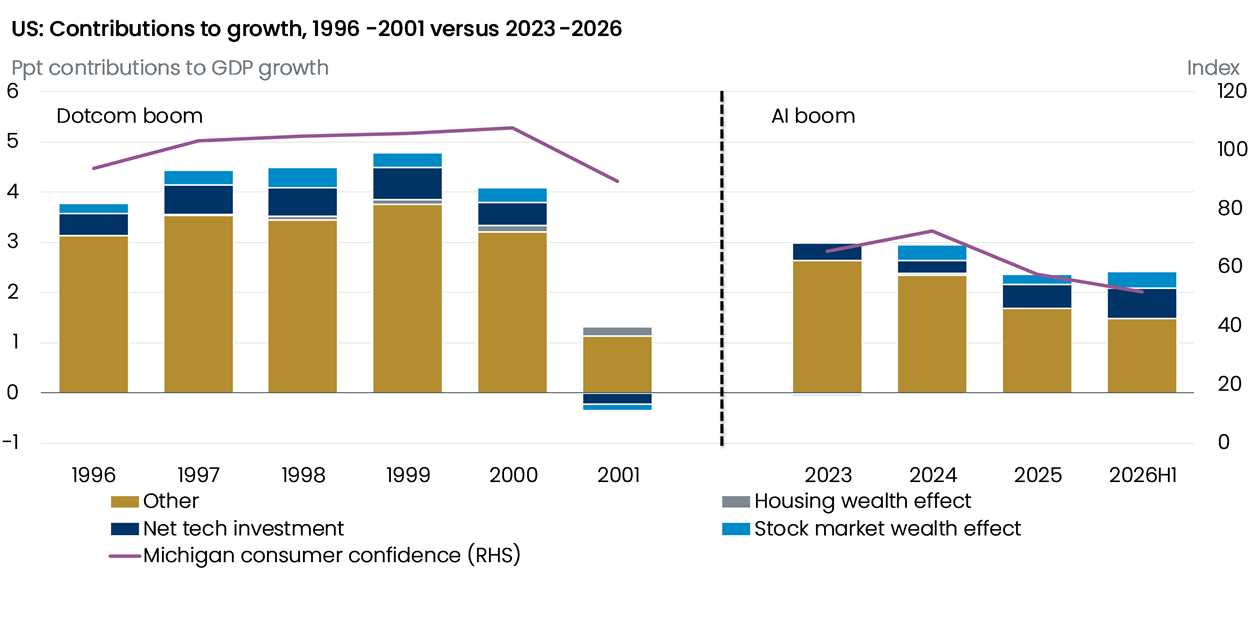
US: contributions to growth, 1996-2001 versus 2023-2026 (ppt contributions to GDP growth; Michigan consumer confidence index, right-hand scale). Source: Oxford Economics, Haver Analytics
Little to show elsewhere
Outside the US the effect is much smaller. Across six other advanced economies, AI-related factors added an average of 0.2ppt to growth in 2025-1H26, about a third of the US effect, ranging from about 0.1ppt in Germany to 0.3-0.4ppt in Sweden and Japan. Stripped of AI, growth in the group ran mostly at 0.5-1.0% a year.
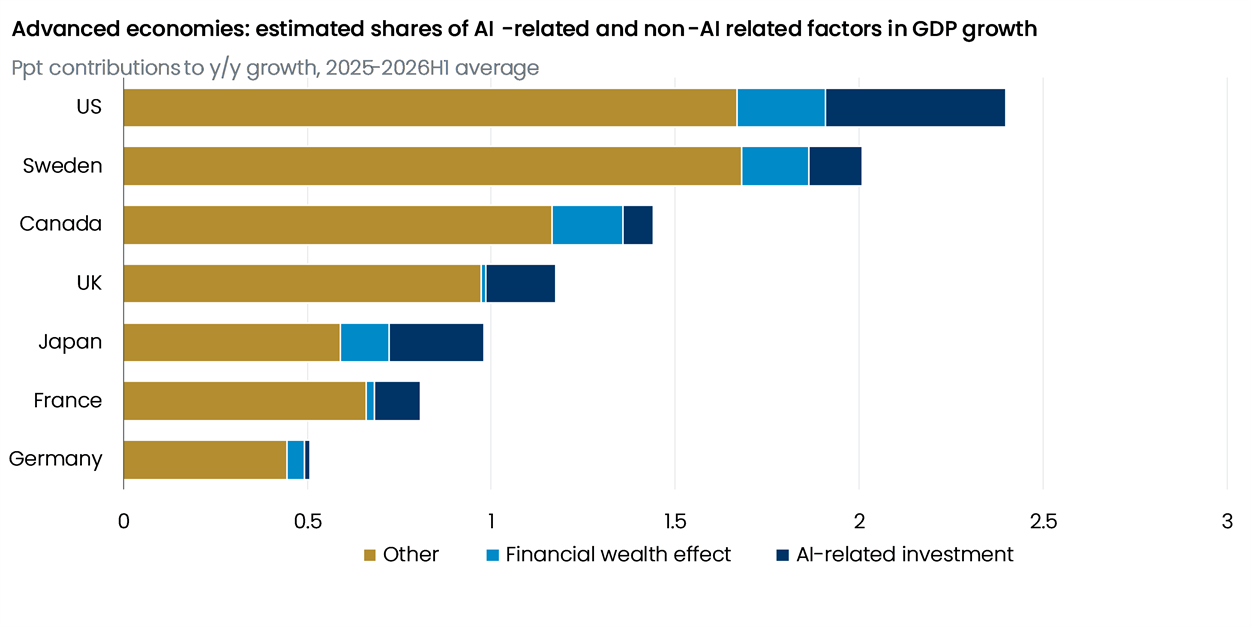
Advanced economies: estimated shares of AI-related and non-AI factors in GDP growth (ppt contributions to y/y growth, 2025-1H26 average). Source: Oxford Economics
US growth without AI would still beat most of its peers, but by a narrower margin. Part of the weakness lies in interest-sensitive spending, which has been flat for three years outside the US as rates rose from 2022. Residential investment has shrunk in most economies, with especially big falls in Canada, Germany, France and Italy.
In the US, interest-sensitive sectors have grown by about 5% since 2022, less than GDP as a whole, but they are a smaller drag than they once would have been. Their share of US investment has fallen from 50-55% in 1980-2005 to below 40%, partly because tech has taken a growing share of equipment spending, and they respond less to rate changes than before.
The cost of the build-out
Data centres' energy needs, which grew by more than 25% last year, are pushing up US wholesale electricity prices, one of several costs the boom imposes on the rest of the economy. The Dallas Fed estimated earlier this year that existing data centres had raised prices by 3-5% nationwide, and US power prices relative to the rest of the G7 had opened a gap of about 12% by 3Q26. That could add up to 0.3ppt to consumer prices and, other things equal, take about 0.2% off GDP, Oxford Economics estimates.
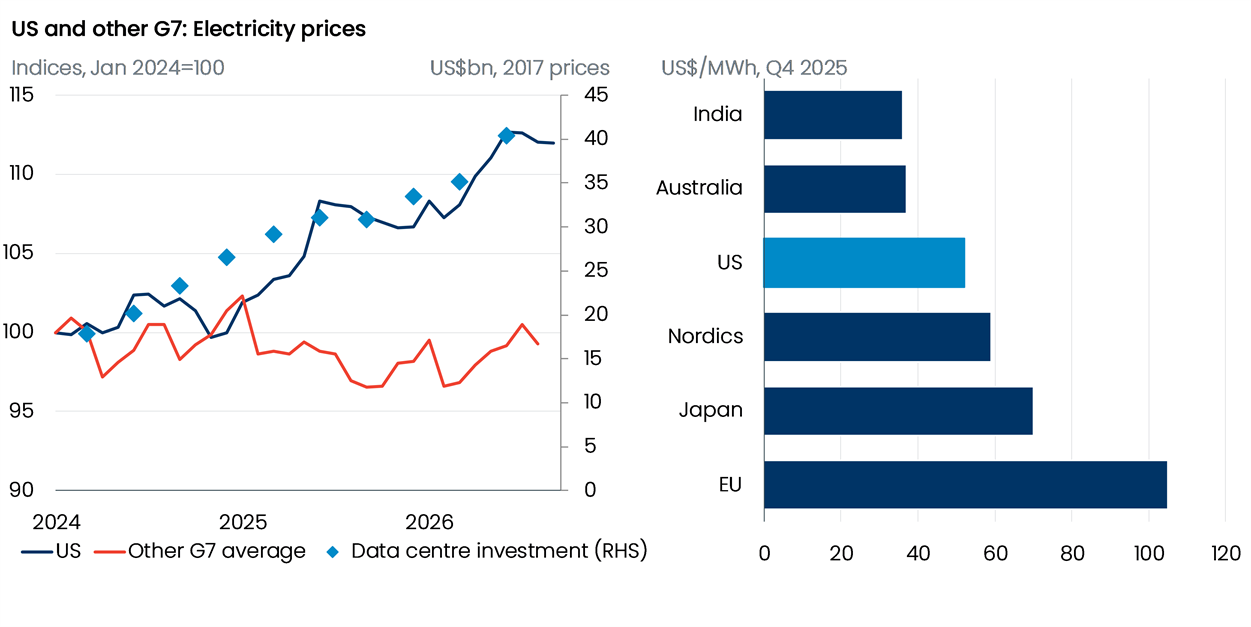
US and other G7: electricity prices (indices, January 2024=100; data centre investment, $bn at 2017 prices; $/MWh, 4Q25). Source: Oxford Economics, Haver Analytics, IEA
US prices of computers and peripherals are up 10% y/y and software nearly 30%, together adding about 0.04ppt to the consumer price index, while construction materials are rising about 5% y/y. More speculatively, heavy borrowing by AI companies may have helped push up bond yields: a 100bp rise in 10-year yields cuts US GDP by 0.1-0.3%, by the consultancy's modelling.
Altogether, these spillovers could cut 0.2-0.3% from US GDP. In economies that have gained little from the boom, they could wipe out much of what modest gains there have been, according to Oxford Economics.
Unlock premium news, Start your free trial today.


