
Russian banks match last year's profit in nine months as uncovered bad loans swell to $89bn


Russian banks earned RUB3.71 trillion ($46.1bn) in 9M26, as much as in all of 2025, the Central Bank of Russia (CBR) said in its monthly banking review on October 26.
The same review shows that problem corporate loans covered by neither provisions nor quality collateral rose to RUB7.2 trillion ($89.4bn) at the start of September from RUB6.1 trillion a month earlier. The CBR puts that sum at about 70% of the capital banks hold above regulatory minimums, up from about 60% in its previous review.
Profits on this scale are possible partly because losses are being recognised slowly, and the regulator's own rules allow banks to put off provisioning against restructured loans, according to Alexandra Prokopenko, a senior fellow at the Carnegie Berlin Centre. Stress among borrowers is already visible: 33 Russian bond issuers made first-time technical defaults in 9M26, and bonds of developer Samolet slumped 14% on October 30 after VTB floated a rehabilitation of its debt.
| Russian banking sector | Latest | Comparison | Change |
| Net profit, 9M26 vs 9M25 (RUB bn) | 3,710 | 2,826 | +31% |
| Net profit, 9M26 vs full-year 2025 (RUB bn) | 3,710 | 3,719 | -0.2% |
| Net profit, September vs August 2026 (RUB bn) | 414 | 440 | -5.9% |
| Net profit, September 2026 vs September 2025 (RUB bn) | 414 | 367 | +12.8% |
| Provisioning charges, September vs August 2026 (RUB bn) | 165 | 208 | -21% |
| Uncovered problem corporate loans, September 1 vs August 1 (RUB trillion) | 7.2 | 6.1 | +18% |
| Borrowing from the CBR, October 1 vs September 1 (RUB trillion) | 8.4 | 6.7 | +24.7% |
Cumulative profit from the CBR's sector balance sheet; monthly figures as published in the September review. Source: Central Bank of Russia monthly banking sector reviews. IntelliNews
Accounting does the heavy lifting
Net profit fell 5.9% month on month to RUB414bn ($5.1bn) in September, but was 12.8% higher than in September 2025. Return on equity slipped to 22.6% from 23.6%, after 24% in August.
Non-core income fell by 72% to RUB40bn. Dividends from subsidiaries dropped 69%, securities trading turned to a loss and income from currency and precious-metals operations fell 35% as the ruble strengthened 1.4%. Interest and fee income barely moved.
Core profit still rose 4% to RUB448bn, because provisioning charges fell by RUB43bn, or 21%, to RUB165bn. Much of the saving came from banks recognising RUB35bn less in losses on their investments in non-core businesses.
That makes four months in a row in which one-off or accounting items carried the result, according to Prokopenko, and the CBR's own reviews bear out the sequence. June profit was lifted by positive currency revaluation. In July provisioning against corporate loans fell by RUB103bn, or 77%, as some banks released reserves after borrowers "updated their business plans to take account of revenue growth", the regulator said. In August dividends from subsidiaries rose by RUB40bn.
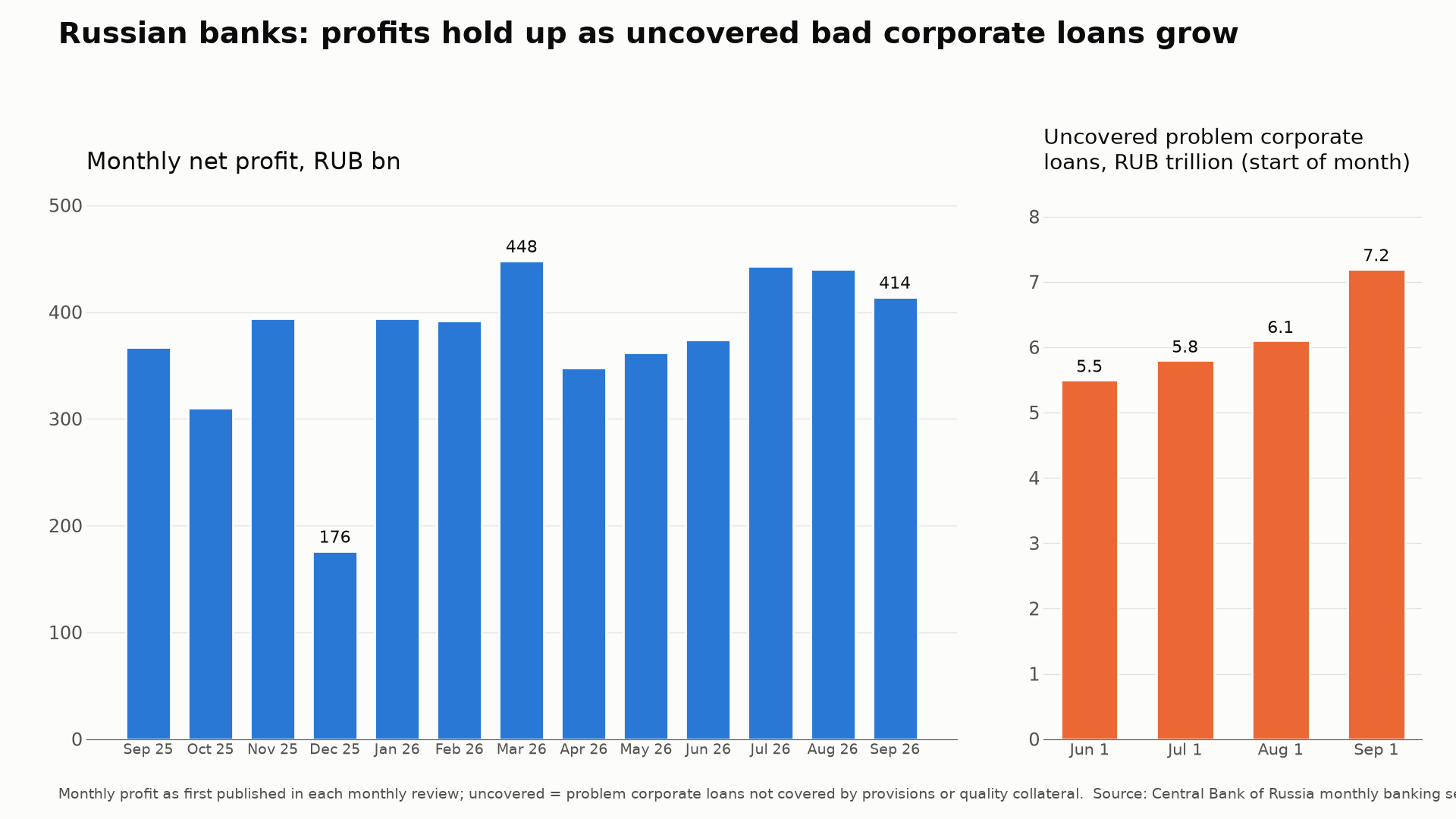
Russian banks' monthly net profit, September 2025 to September 2026 (RUB bn), and problem corporate loans not covered by provisions or quality collateral (RUB trillion). Source: Central Bank of Russia monthly banking sector reviews. IntelliNews
Problem loans pile up
Problem corporate loans, a category that covers the worst-graded loans, risky restructurings and other loans showing signs of distress, reached RUB13.3 trillion ($165bn), or 12.9% of the corporate book, at the start of September. The CBR said the portfolio grew by RUB0.6 trillion in August, mainly because of "the deterioration in the financial position of certain coal and power companies".
Overdue corporate debt, where payments have actually been missed, is far smaller: 3.5% of the portfolio at the start of September and 3.7% on October 1. The gap of close to RUB10 trillion is debt whose quality the regulator can see deteriorating but against which banks do not have to reserve in full.
Coverage of corporate loans by provisions and quality collateral fell to about 45% from about 50%. The uncovered RUB7.2 trillion is larger than the sector's expected profit for the whole of 2026, even at the top of the RUB3.9 trillion-RUB4.4 trillion ($48bn-$55bn) range the CBR forecast in September.
In June the CBR called the risks on the uncovered volume "manageable" and said some borrowers would recover, and it extended its easing of provisioning rules for restructured loans until October 1, 2026. From July it added that the portfolio "will mature gradually, and banks will be able to cover losses from profits".
The September review added a new line on provisioning:
"If a loan has fallen into the category of risky restructurings or other problem loans, this does not mean that it automatically has to be provisioned further," the CBR said.
Russian rules tie provisioning largely to missed payments, so a loan given a new schedule, a payment holiday or capitalised interest shows no arrears and needs no extra reserve. Since May 2025 CBR information letters have let banks hold provisions steady on restructured loans to moderately indebted borrowers that submit a "realistic" business plan, according to Prokopenko.
Profit on paper
Accrued but unpaid interest on corporate loans rose to RUB4.6 trillion on September 1 from RUB3.4 trillion at the start of the year, before quarter-end payments cut it to RUB4.3 trillion ($53.4bn) on October 1. That is still up 25% this year, against 7.9% growth in corporate lending, so part of the interest income behind sector profits exists only in the accounts, according to Prokopenko.
Banks also hold RUB12.4 trillion ($154bn) of bonds, 40.7% of their portfolio, at amortised cost rather than market value. Unrecognised losses on them rose by RUB0.1 trillion in September to RUB0.7 trillion ($8.7bn), about 3% of sector capital. The CBR said this posed no significant risk because banks can raise repo funding against the bonds instead of selling them at a loss.
Banks fund the budget
The finance ministry resumed OFZ treasury bond auctions in September after a pause in July and placed RUB1.4 trillion ($17.4bn) at face value, the largest monthly volume this year. About 72% were floaters tied to the key rate, and Russian banks bought 77% of the new paper.
In the same month banks' borrowing from the CBR jumped by RUB1.7 trillion, or 24.7%, to RUB8.4 trillion ($104bn), almost all of it through repo, while government funds held at banks rose by RUB0.9 trillion. The finance ministry cannot borrow without the banks, the banks cannot buy without CBR liquidity, and the CBR cannot withdraw that liquidity without disrupting deficit financing, a form of fiscal dominance, according to Prokopenko. Government bonds also carry no capital charge for credit risk, unlike corporate loans.
The arrangement depends on rates falling faster than losses materialise, according to Prokopenko. The CBR held its key rate at 14% for a second meeting on October 23, raised its 2026 inflation forecast to 7.1-7.6% and lifted its forecast for the average 2027 key rate to 12.5-13.5% from 10.5-12.5%. Companies carry more than RUB20 trillion ($248bn) of floating-rate bond debt, so each percentage point on the rate costs them about RUB200bn ($2.5bn) a year, by her estimate.
Household funds in banks slipped 0.1% to RUB68.4 trillion ($849bn) in September after a 0.2% fall in August, even though deposit rates remain well above inflation.
A conventional banking crisis with queues outside branches is unlikely, because the largest lenders are state-owned and losses are recognised on a timetable the CBR sets, according to Prokopenko. If rates stay high, the bill falls on borrowers and the budget through provisions, defaults and recapitalisations of state banks; if they are cut while inflation persists, it falls on depositors.
This article was produced with the help of IntelliNews Lambda analytical tool
Unlock premium news, Start your free trial today.


