
Russia's 2027 budget lifts defence spending 41% as oil's share of revenue falls to 16%


Russia's draft 2027 budget raises defence spending by 41% to a record RUB17.1 trillion ($212bn), while oil and gas will supply only 16% of federal revenue.
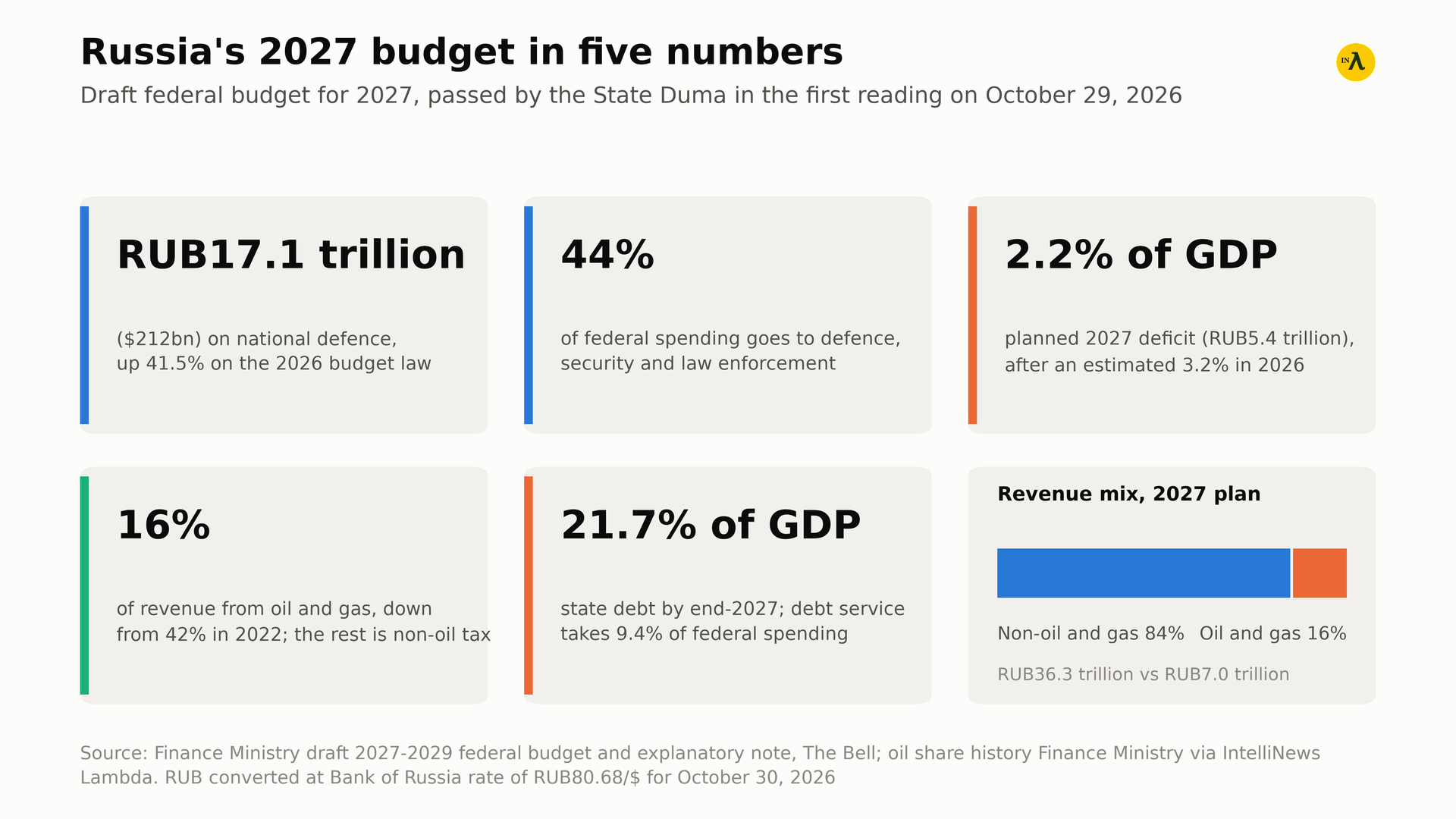
Russia's 2027 draft budget in five numbers: record defence spending, a 2.2% of GDP deficit, debt above 20% of GDP and oil and gas down to 16% of revenue.
The "National Defence" chapter of the new federal budget is set at RUB17.15 trillion, 35.2% of all federal spending and 6.9% of GDP, against RUB12.1 trillion ($150bn) in the 2026 budget law.
Adding the RUB4.3 trillion ($53.3bn) for national security and law enforcement puts 44% of federal spending on the military and the security services, before counting the military items carried in civilian budget lines, The Bell calculated from the budget documents on October 2.
The State Duma passed the 2027-2029 budget in the first reading on October 29, after Finance Minister Anton Siluanov told deputies that the plan was "realistic and balanced" and that funding for the armed forces and the defence industry had been agreed with the security agencies. The government submitted the package on September 30 with spending broken down line by line for all three years.
The budget concedes that the war bill cannot be held down, and much of the 41% rise has in effect already been spent. Federal spending this year is now expected to reach RUB48.5 trillion ($601.2bn), RUB4.5 trillion above the RUB44 trillion written into the 2026 law, and most of that overrun has probably gone on the military, according to The Bell.
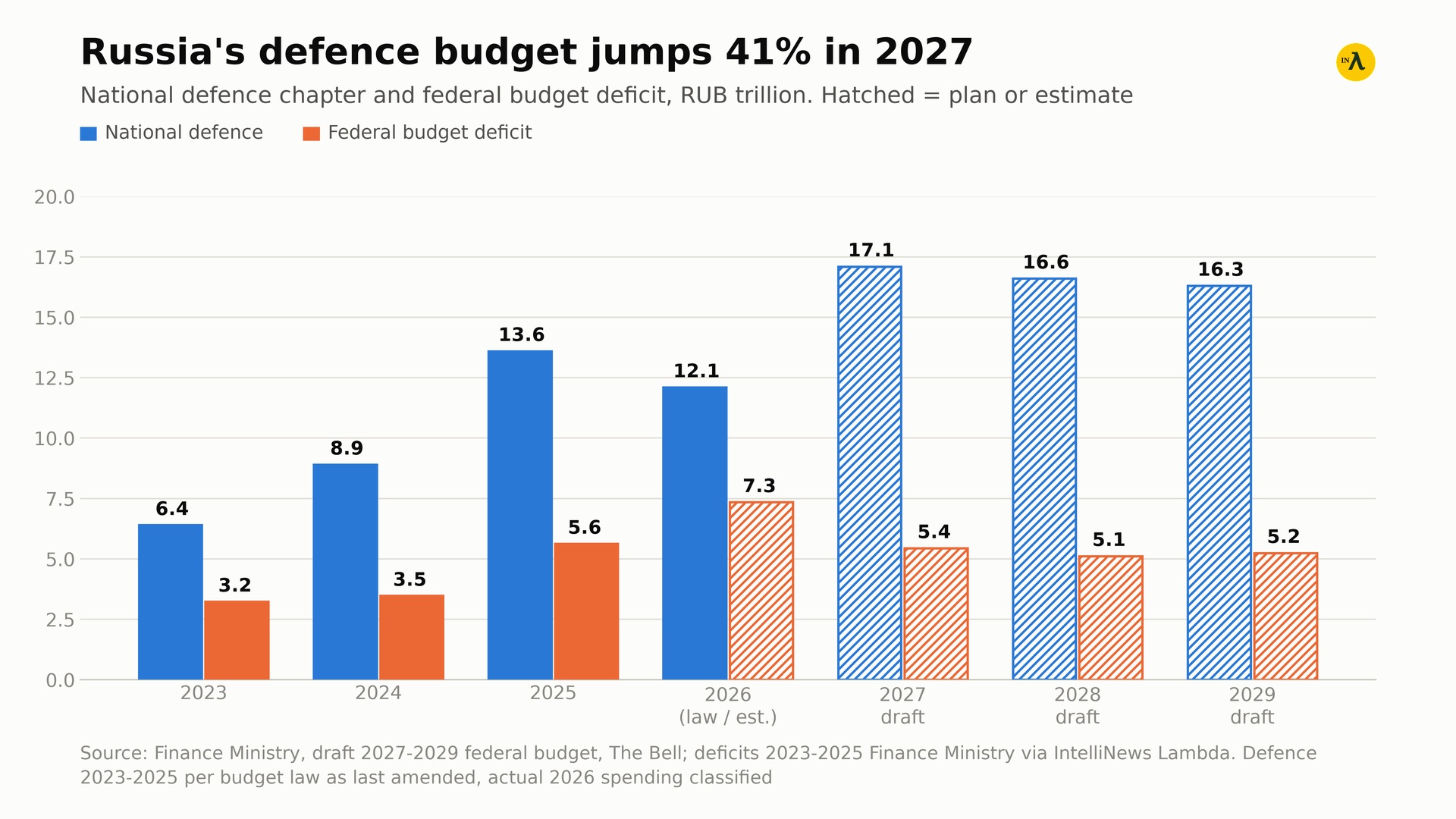
Russia's national defence spending and federal budget deficit, 2023-2029, RUB trillion. 2026 defence is the budget law figure; actual spending is classified.
The war takes more than planned
Against the 2027 figure approved a year ago, defence spending is 27% higher. The government stopped publishing itemised budget execution after the full-scale invasion of Ukraine, so actual military spending in 2026 is classified, and the 2026 law assumed defence would fall from the RUB13.6 trillion of 2025.
Siluanov warned the government in a February letter that war spending would exceed plan by at least RUB2 trillion ($24.8bn), and by up to RUB4 trillion in a worst case, and by mid-June the Defence Ministry's sources were talking of a shortfall of RUB4 trillion-RUB5 trillion, Bloomberg reported. Janis Kluge, an economist at the Berlin-based SWP institute who tracks military spending from Finance Ministry data, put the rise in 1H26 at 30% y/y.
The draft has defence easing to RUB16.6 trillion in 2028 and RUB16.3 trillion in 2029. No Russian budget has held military spending to plan since 2022.
"A reduction in spending relative to GDP is only possible if the war ends. If it doesn't, this three-year plan simply won't be implemented, as has been the case in all previous years," the chief economist of a Russian think tank, who asked not to be named, told The Bell.
The deficit keeps overshooting
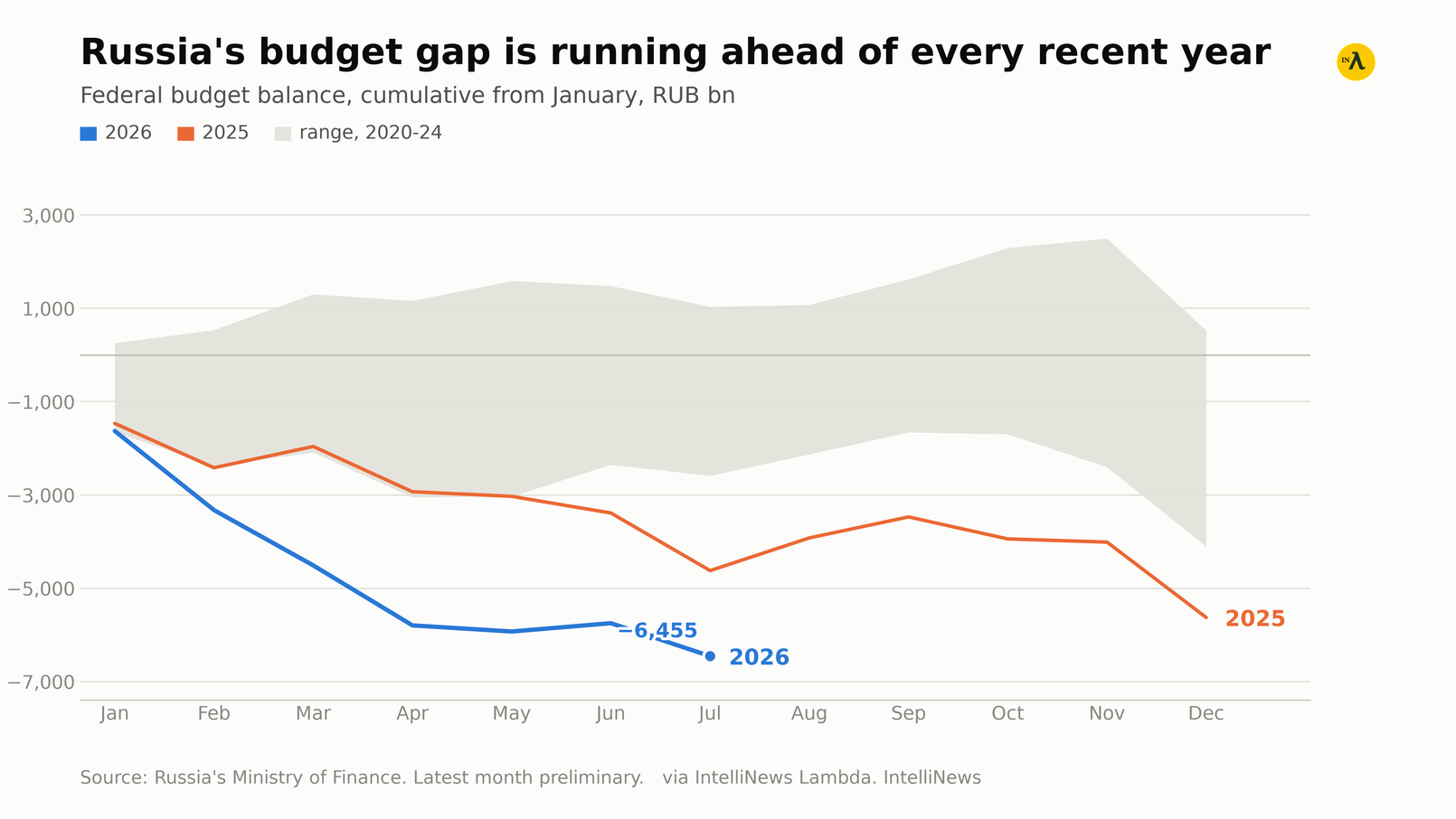
The 2026 federal deficit is now estimated at RUB7.345 trillion ($91bn), or 3.2% of GDP, against RUB3.786 trillion, or 1.6%, in the original law, and at 3.7% of GDP for the whole budget system. Siluanov had said on September 21 that it would stay within 3% of GDP.
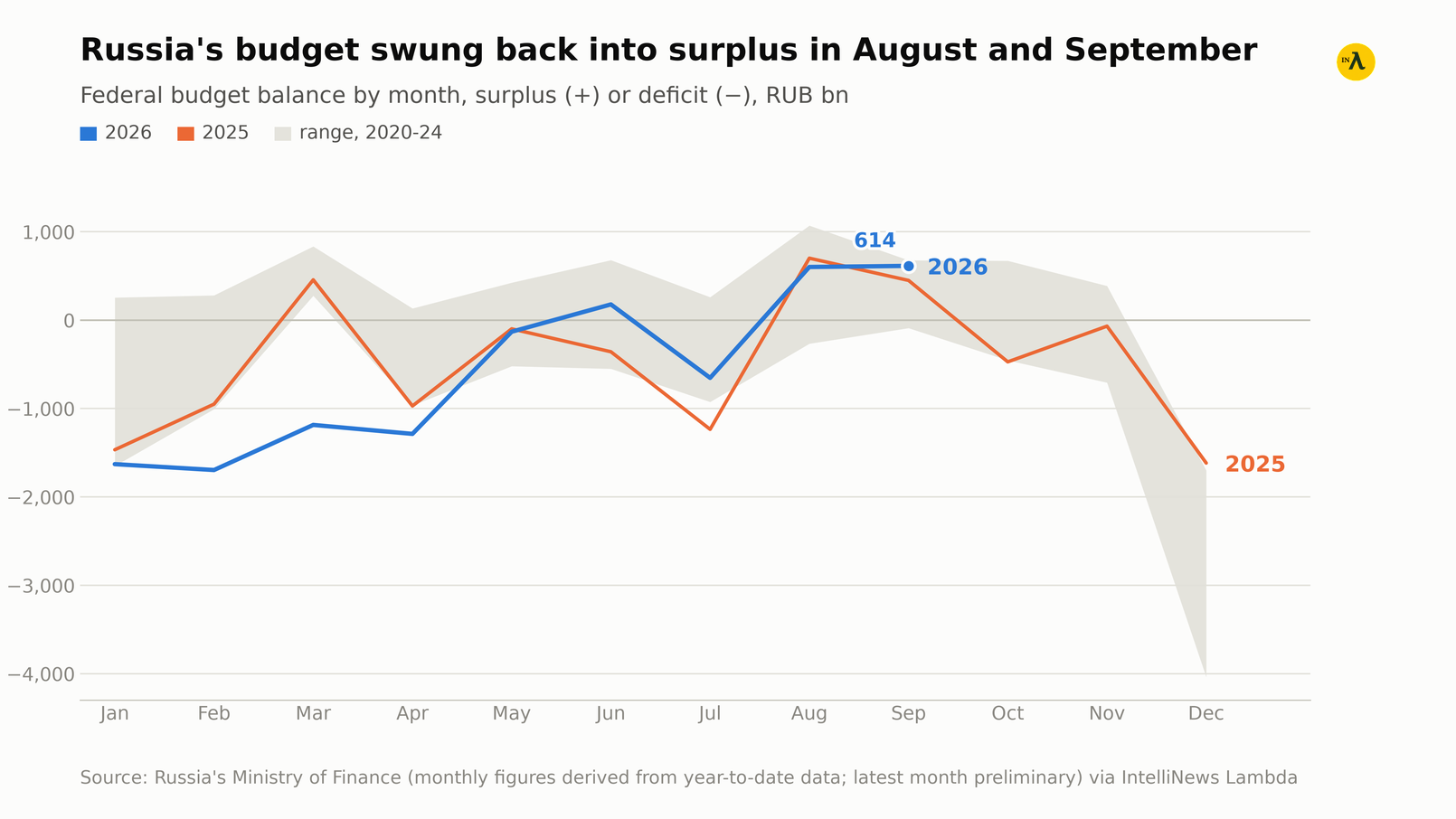
Two monthly surpluses in August and September cut the January-September shortfall to RUB5.186 trillion, or 2.2% of GDP, Finance Ministry data released on October 9 showed, which leaves more than RUB2 trillion of deficit for the last three months, when ministries traditionally rush to spend.
For 2027 the draft targets a deficit of RUB5.44 trillion ($67.4bn), or 2.2% of GDP, narrowing to 1.9% in 2028 and 2029. The federal deficit was RUB5.63 trillion in 2025, Finance Ministry data show. Net borrowing is to rise 22.5% to RUB6.14 trillion ($76.1bn) next year and will remain the main source of financing.
Debt and what it costs
State debt is forecast to reach 19.9% of GDP at the end of 2026 and 21.7%, or RUB54 trillion ($669.3bn), at the end of 2027, above the 20% the authorities regard as safe and up from 14.4% in 2024. President Vladimir Putin told the Valdai Club on October 1 that Russia's debt stood at 17% of GDP.
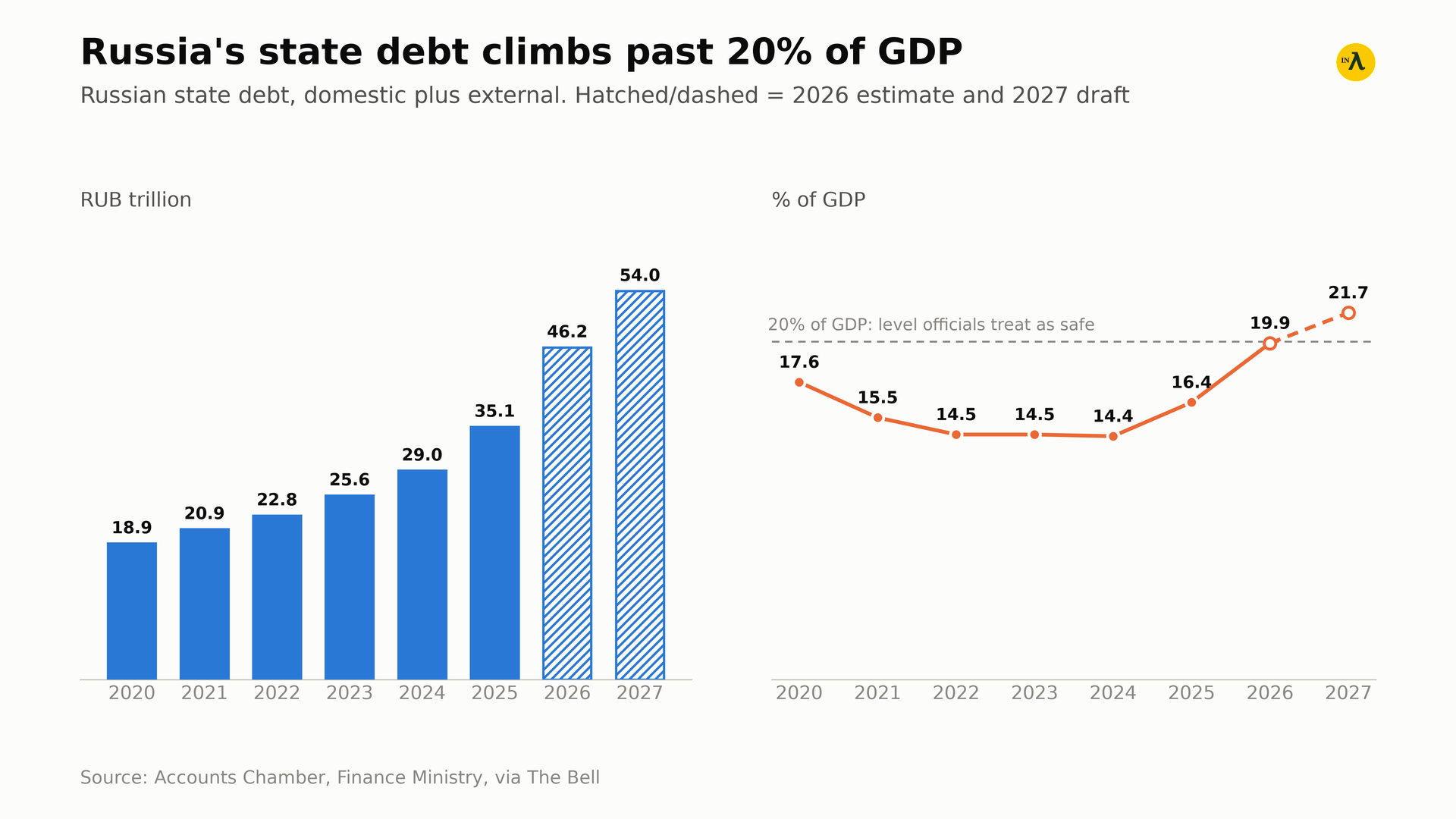
Russia's state debt, domestic and external, RUB trillion and % of GDP, 2020-2027. 2026 is an estimate and 2027 the draft budget.
Servicing the debt is the chinck in the Kremlin's armour and becoming a growing problem; it will cost RUB4.57 trillion ($56.6bn) in 2027, or 9.4% of federal spending, up from 3.4% in 2020 and almost six times the RUB784bn paid that year. The size of these payments is becoming unsustainable but the budget is still far from a crisis thanks to the remaining reserves and room for more tax hikes. But with foreign capital markets closed, the Finance Ministry can borrow only at home, mostly from state-owned banks and at double-digit rates.
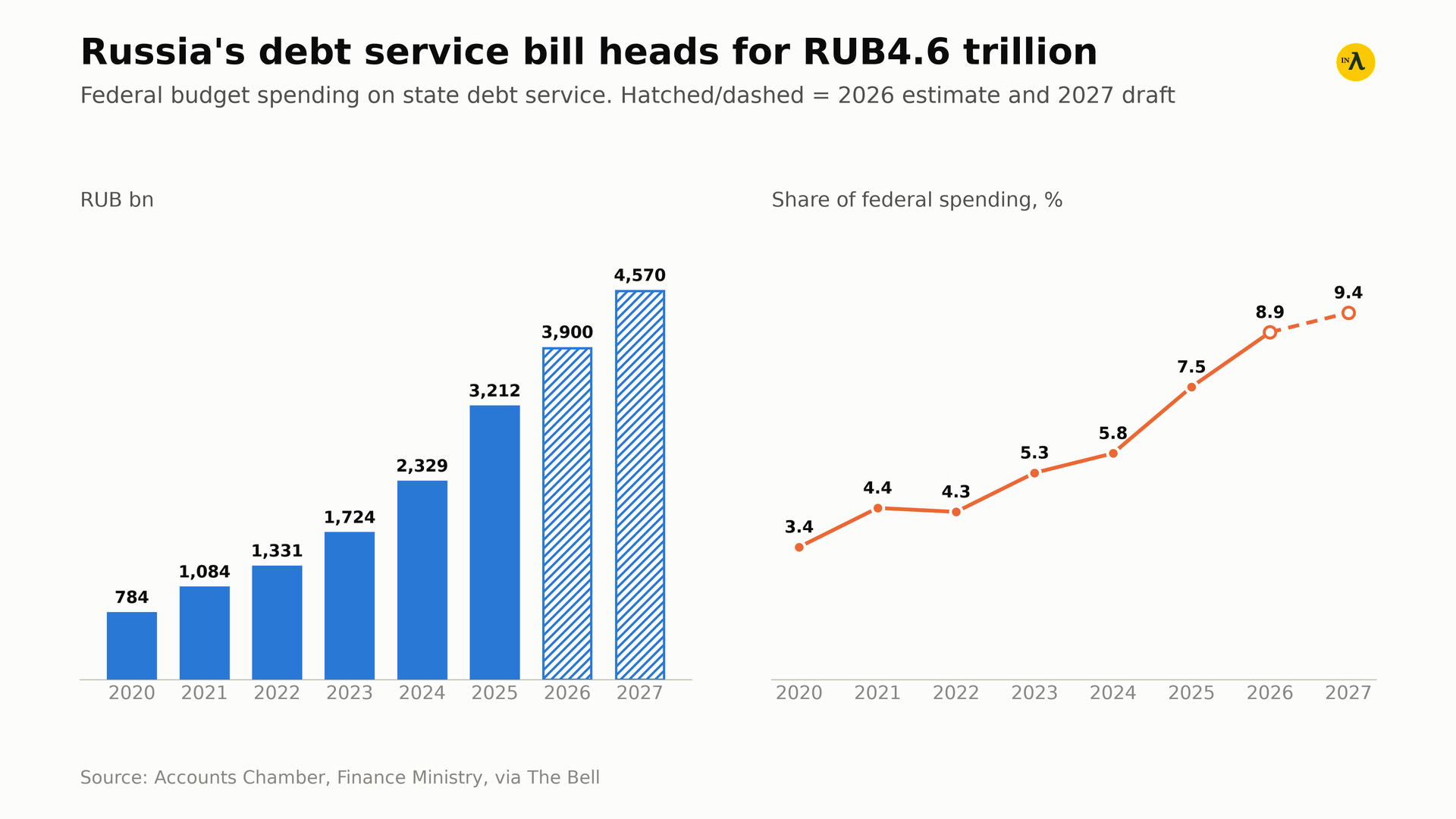
Russian federal spending on state debt service, RUB bn and share of federal spending, 2020-2027.
Oil no longer pays the bills
Oil and gas revenue is planned at RUB7.0 trillion ($86.8bn) in 2027, or 16.2% of total federal revenue of RUB43.3 trillion ($536.7bn), according to the explanatory note to the draft. Non-oil revenue (mainly VAT) is put at RUB36.3 trillion, up 8% on this year's estimate, and the plan rests on a cut-off oil price of $50 a barrel in the fiscal rule.
The government has already cut its 2026 oil and gas revenue estimate to RUB7.6 trillion from RUB8.9 trillion. In the first nine months of the year oil and gas receipts fell 17.2% y/y to RUB5.47 trillion, or 18.5% of federal revenue, while non-oil revenue rose 18.8% to RUB24.17 trillion after VAT was raised to 22% in January. Oil and gas supplied 41.6% of federal revenue in 2022 and 46.4% in 2018, Finance Ministry data show.
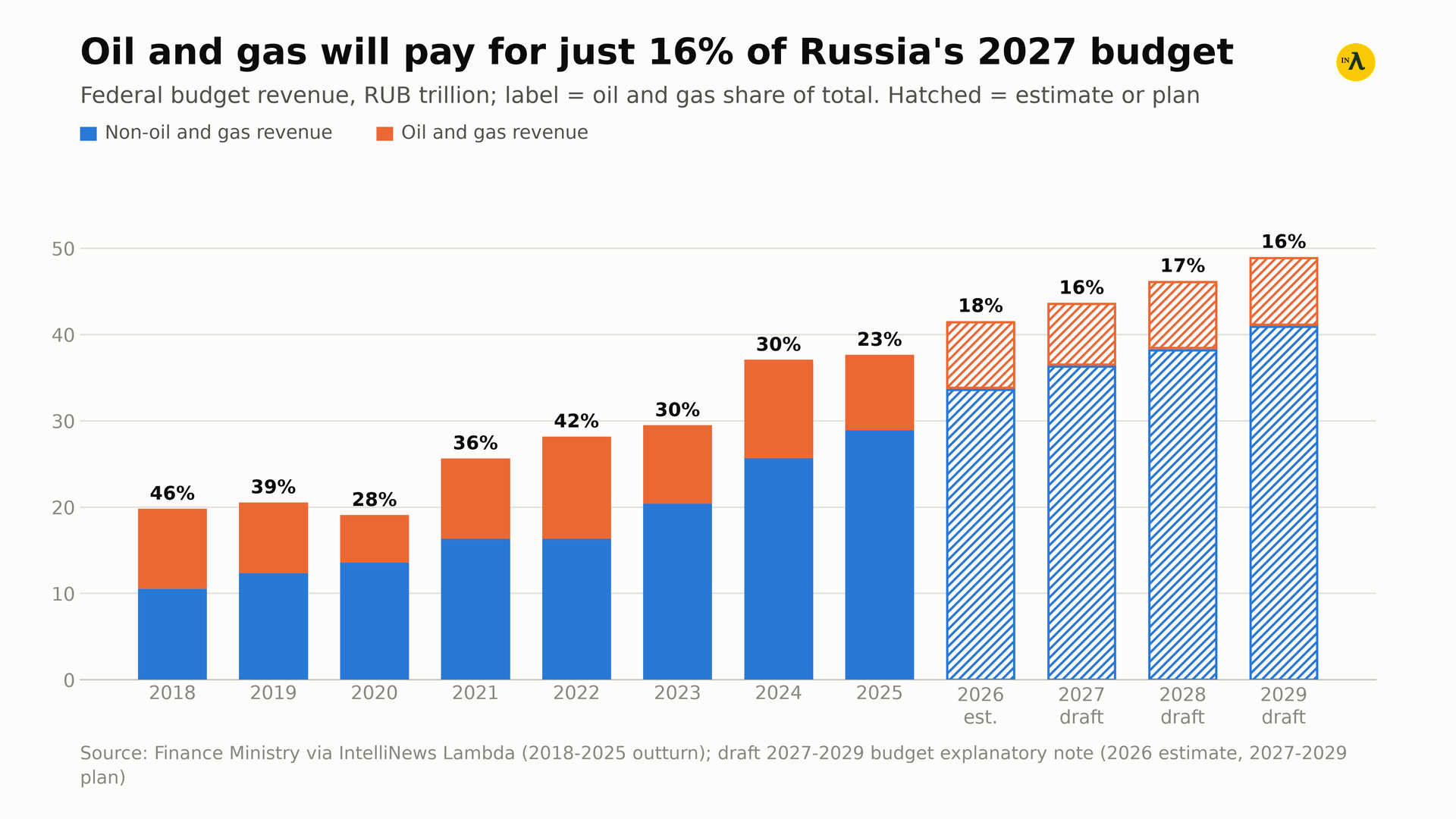
Russian federal budget revenue split between oil and gas and non-oil and gas, 2018-2029, RUB trillion. 2026 is the Finance Ministry estimate and 2027-2029 the draft plan.
The extra money comes from taxes on households and business. Moving deposit interest onto the progressive income tax scale will raise RUB1.02 trillion ($12.6bn) in 2027, up from RUB632bn in 2026, and the latest round of income and consumption tax rises will add about RUB1.5 trillion in all next year, The Bell calculated. The car recycling fee, a hidden tax paid by buyers, is to bring in RUB1.78 trillion in 2027 and RUB2.61 trillion by 2029.
The package shifts the war bill onto savers and consumers, and small business lobbies are pushing to soften the rises on dividends and deposits before the second reading.
"Voluntary" contributions from business will add RUB471.5bn ($5.8bn) this year, according to the explanatory note, and sales of confiscated assets RUB388bn in 2026, up from RUB117bn in 2025, though only RUB9.5bn is budgeted for 2027 because decisions on new sales "have not yet been made". The Bank of Russia, which transferred nothing in 2026, must hand over RUB216bn of profit in 2027 and RUB455bn in 2028.
Civilian spending squeezed
Against the 2026 law, federal spending on social policy falls 15.2% in nominal terms to RUB6.65 trillion ($82.4bn), housing and utilities 9.9%, and healthcare and the national economy 4.6% each, while total federal spending rises 10.6% to RUB48.7 trillion ($603.6bn).
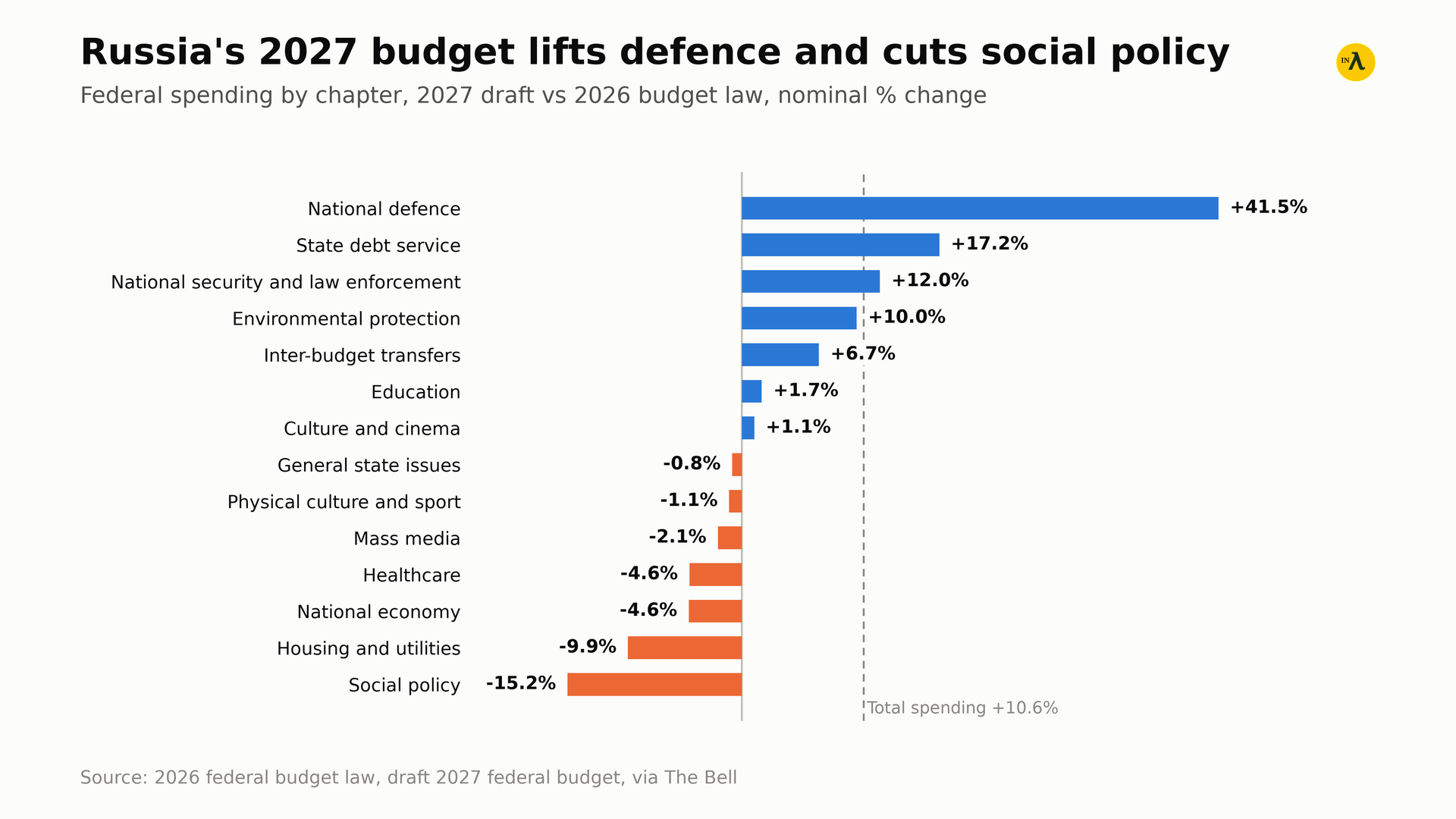
Change in Russian federal spending by chapter, 2027 draft against the 2026 budget law, nominal %.
| Federal budget | 2026 law, RUB bn | Share, % | 2027 draft, RUB bn | Share, % | Change, % |
| Total expenditure | 44,069.7 | 48,740.4 | +10.6 | ||
| General state issues | 2,751 | 6.2 | 2,727.9 | 5.6 | -0.8 |
| National defence | 12,121 | 27.5 | 17,147.4 | 35.2 | +41.5 |
| National security and law enforcement | 3,827 | 8.7 | 4,286.6 | 8.8 | +12.0 |
| National economy | 4,844 | 11.0 | 4,620.2 | 9.5 | -4.6 |
| Housing and utilities | 2,031 | 4.6 | 1,829.9 | 3.8 | -9.9 |
| Environmental protection | 1,103 | 2.5 | 1,213.1 | 2.5 | +10.0 |
| Education | 1,747 | 4.0 | 1,777.4 | 3.6 | +1.7 |
| Culture and cinema | 305 | 0.7 | 308.3 | 0.6 | +1.1 |
| Healthcare | 1,905 | 4.3 | 1,818.1 | 3.7 | -4.6 |
| Social policy | 7,839 | 17.8 | 6,650.5 | 13.6 | -15.2 |
| Physical culture and sport | 73 | 0.2 | 72.2 | 0.1 | -1.1 |
| Mass media | 148.9 | 0.3 | 145.8 | 0.3 | -2.1 |
| State debt service | 3,900 | 8.8 | 4,570.1 | 9.4 | +17.2 |
| Inter-budget transfers | 1,474 | 3.3 | 1,572.9 | 3.2 | +6.7 |
Russian federal budget spending by chapter, 2026 budget law and 2027 draft. Source: 2026 federal budget law, draft 2027 federal budget, via The Bell.
Most social spending runs through regional budgets and the pension and health insurance funds. Across the whole budget system, education and healthcare grow 3.9% and 3.1% in real terms, but federal spending on them falls 4.8% and 10.6%, on the government's forecast of 6.8% inflation at the end of 2026, while economic development and housing lose about 10% in real terms, The Bell calculated.
Defence, security and debt service together take 28.2% of budget-system spending in 2027, against 28.6% for social policy, and any overrun on the military would put the war ahead of welfare for the first time in modern Russian history, according to The Bell.
| Budget system | 2026, RUB bn | % of GDP | Share, % | 2027, RUB bn | % of GDP | Share, % |
| Total expenditure | 83,814 | 94,400 | ||||
| General state issues | 4,547 | 1.9 | 5.4 | 4,798 | 1.9 | 5.1 |
| National defence | 12,989 | 5.5 | 15.5 | 17,192 | 6.9 | 18.2 |
| National security | 4,313 | 1.8 | 5.1 | 4,694 | 1.9 | 5.0 |
| National economy | 10,834 | 4.6 | 12.9 | 10,361 | 4.2 | 11.0 |
| Housing and utilities | 4,872 | 2.1 | 5.8 | 4,704 | 1.9 | 5.0 |
| Environmental protection | 1,189 | 0.5 | 1.4 | 1,325 | 0.5 | 1.4 |
| Education | 7,321 | 3.1 | 8.7 | 8,125 | 3.3 | 8.6 |
| Culture and cinema | 1,347 | 0.6 | 1.6 | 1,486 | 0.6 | 1.6 |
| Healthcare | 8,120 | 3.5 | 9.7 | 8,937 | 3.6 | 9.5 |
| Social policy | 23,534 | 10.0 | 28.1 | 26,992 | 10.9 | 28.6 |
| Physical culture and sport | 547 | 0.2 | 0.7 | 784 | 0.3 | 0.8 |
| Mass media | 220 | 0.1 | 0.3 | 221 | 0.1 | 0.2 |
| State debt service | 3,981 | 1.7 | 4.7 | 4,710 | 1.9 | 5.0 |
Russian consolidated budget system spending by chapter (federal, regional and extra-budgetary funds), 2026 and 2027. Source: draft federal budgets for 2026 and 2027, via The Bell.
This article was produced with the help of IntelliNews Lambda analytical tool
Unlock premium news, Start your free trial today.


