
Czech Republic stays on course for rate hike as Hungary's growth stalls - Capital Economics


The Czech Republic's central bank remains on course to raise rates in early November despite a soft third quarter, while Hungary's economy barely grew, Capital Economics said in a note on October 30.
Hungary's GDP grew by just 0.1% quarter on quarter in the third quarter, seasonally and calendar adjusted, down from 0.6% q/q in the second, the statistics office KSH reported in its preliminary estimate. Annual growth slowed to 1.5% y/y from 1.7%. The Czech economy did better, expanding 0.5% q/q after 0.3% in the second quarter, though that was a touch below the 0.6% consensus and annual growth eased to 1.6% y/y from 1.8%.
The Hungarian figure is hard to reconcile with last quarter's pick-up in sentiment indicators and in the hard activity data, with both retail sales and industrial production growth accelerating. KSH gave no breakdown, but it named agriculture as a drag, and the summer heatwave hit farm output hard, according to William Jackson, chief emerging markets economist at Capital Economics. Industry was the main contributor to growth, KSH said.
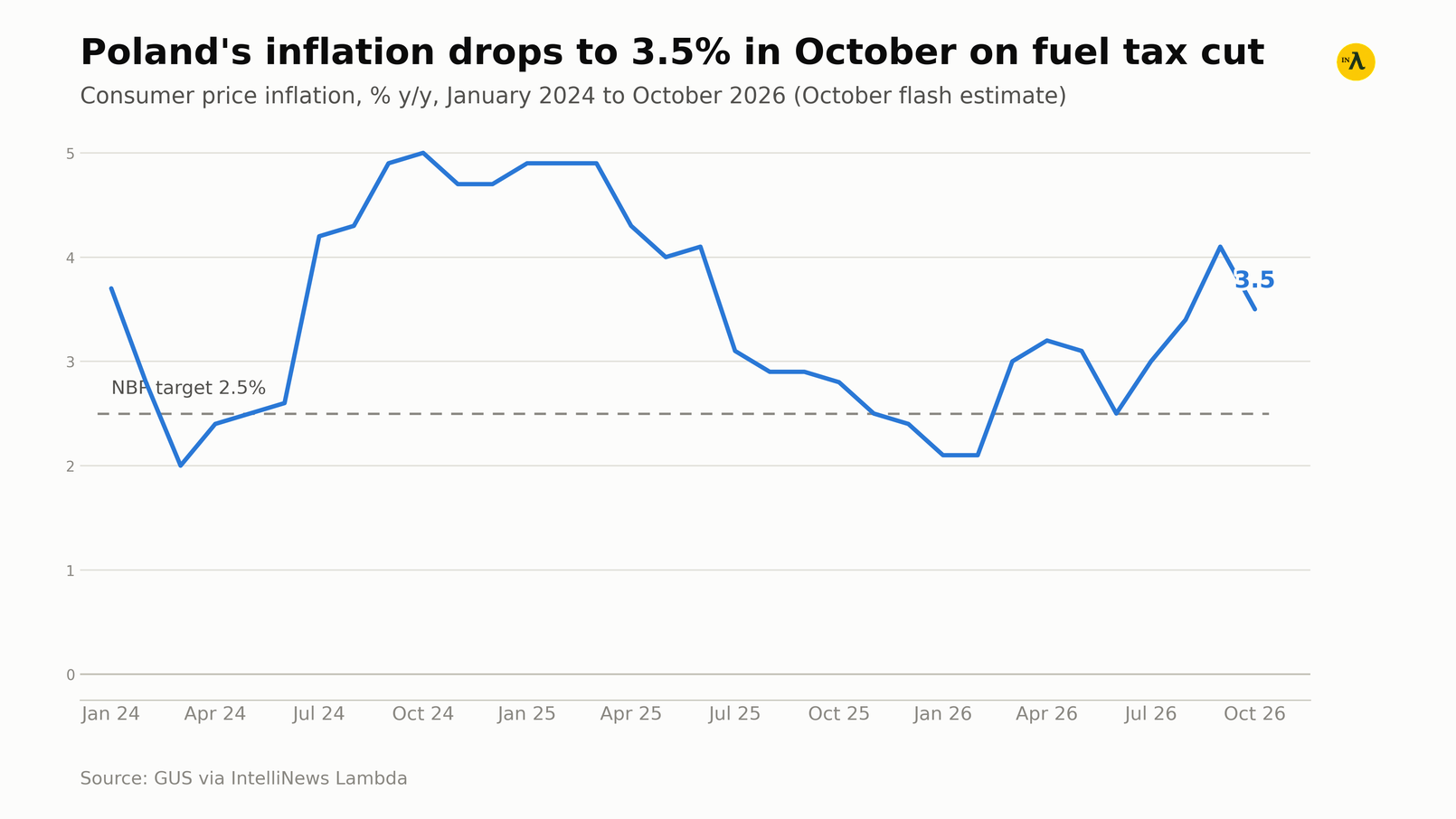
Poland's consumer price inflation, % y/y, January 2024 to October 2026; the October figure is the GUS flash estimate. Source: GUS via IntelliNews Lambda
Growth in both economies should pick up in the coming quarters as the drag from agriculture unwinds in Hungary and fiscal policy is loosened in the Czech Republic, Capital Economics forecasts. The Czech outturn "keeps the door wide open" for the Czech National Bank (CNB) to raise its policy rate by 25 basis points to 4.00% at its meeting in early November, the note says. The CNB has held the rate at 3.75%, and inflation accelerated to 2.5% in September.
In Hungary, where the central bank left its base rate at 5.5% on October 20, Capital Economics expects a prolonged pause, although with inflation low a near-term cut cannot be ruled out.
Poland's inflation surprised on the downside. Consumer prices rose 3.5% y/y in October, according to the flash estimate from statistics office GUS, below both Capital Economics' forecast and the consensus of 3.7%, and down from 4.1% in September. Prices fell 0.4% month on month.
Most of the drop came from a fuel tax cut that pulled down vehicle fuel inflation. Core inflation appears to have held steady at around 3%, which will reassure the National Bank of Poland (NBP). Capital Economics now expects the NBP to keep its rate at 3.75% at its November meeting rather than hike, and sees any increase as more likely in 2027 than this year.
Poland's inflation is still a percentage point above the NBP's 2.5% target, and the October dip owes more to fiscal intervention than to a cooling of underlying price pressure.
This article was produced with the help of IntelliNews Lambda analytical tool
Unlock premium news, Start your free trial today.


