
COMMENT: Poland's court war could split its central bank in two - The Peg


Poland's fight over its Constitutional Tribunal has pushed onto the verge of a constitutional crisis and could leave the country with two rival claims on its central bank, Izabella Kaminska wrote in a note for The Peg on October 16.
The fight over the court has already spilled into the National Bank of Poland (NBP), where the ruling coalition is trying to send governor Adam Glapinski, an ally of the former Law and Justice (PiS) government, before the State Tribunal. Glapinski denies wrongdoing, and makes a good case, according to Kaminska, a former Financial Times journalist whose The Peg newsletter covers stablecoins and monetary plumbing. In the worst case scenario, Poland could end up like Libya - with two rival central banks.
The stakes went up again on October 30, when riot police deployed at the Constitutional Tribunal as government-backed judges tried to oust its PiS-era chief, and former prime minister Mateusz Morawiecki answered with a no-confidence bid against Prime Minister Donald Tusk. The same contested court has ruled on how many votes it takes to put Glapinski on trial, and a Sejm vote is pencilled in for November 5-6, so a domestic row over judges could turn into a question of who legally runs an EU central bank.
"The consequences could have graver implications for international monetary stability and the geopolitical order than many appreciate," Kaminska wrote.
Old enemies
Tusk's Civic Platform and PiS have been at war for a decade. PiS won power in 2015, captured the tribunal within a year, took control of the Supreme Court in 2017 and used the tribunal to issue an anti-EU ruling in 2021, as Brussels froze billions of euros in funds. Tusk returned in December 2023 and won the release of €137bn of EU money on a promise to restore the courts.
That promise ran into the presidential veto. First Andrzej Duda and then Karol Nawrocki, who won in 2025 and has since vetoed the EU's SAFE arms loans, have blocked the coalition's judicial fixes, while Tusk's majority has filled the tribunal with its own picks, including a former minister. PiS leader Jaroslaw Kaczynski has now floated EU exit talks as a bargaining chip.
"PiS are best thought of as Poland's equivalent of MAGA: nationalist capitalists who distrust both the EU and Russia," according to Kaminska.
Echoes of 1989
The tribunal was created in 1982 by the communist regime as a conciliatory gesture to the rising Solidarity trade union. Before communism fell, the regime stacked the court with appointees sympathetic to its interests, according to Kaminska, and the claim that it was never purged underpins the right's case that by 2015 it needed reform and lustration.
Poland's communist regime was not swept away by revolution. It negotiated its exit at the 1989 Round Table talks with Solidarity, which avoided violence but left much of the state apparatus in place, and former communists Aleksander Kwasniewski and Leszek Miller were back in power within a few years.
The judiciary was the hardest part to change. Judges need security of tenure and protection from political removal to be independent of the politicians, but the same protections make it hard to replace a bench inherited from the old regime. The tribunal is one of the last holdovers from the collapse of the socialist model, and despite three decades of rapid catching-up, Poland is still living with echoes of that transition: the liberals see 1989 as a historic achievement that gave Poland an independent judiciary, while conservatives see a revolution left half-finished.
"Everything makes considerably more sense when viewed not simply as a struggle between democracy and authoritarianism, but as a conflict between two different understandings of what happened when Poland emerged from communism in 1989," Kaminska wrote.
Pathway to monetary chaos
The case against Glapinski accuses him of misleading the finance ministry over the NBP's 2023 profit and of indirectly financing budget deficits through pandemic bond purchases. Tusk has been pushing for a trial since 2024, dropped the effort in February over investor concerns and revived it in October, when a Sejm committee recommended a trial.
The tribunal ruled in 2024 that a referral needs a three-fifths majority, or 276 votes in the 460-seat Sejm, rather than an absolute majority of 231, and rejected the automatic suspension of the governor. The government does not recognise the tribunal, so a referral passed by the lower threshold would leave Glapinski arguing that it is void and the government insisting he is suspended. Neither side is likely to recognise the other.
"The relevant questions cease to concern only whether Glapinski should remain in office. They begin to concern who can convene the Monetary Policy Council, who can authorise operations, who can move reserves, and whose instructions foreign financial institutions should accept," Kaminska wrote.
The dates that matter
The term of Adam Lipinski, the NBP's remaining deputy governor, expires on November 4, the same day the Monetary Policy Council (MPC) announces its next rate decision. Without a new appointment the management board falls from seven members to six, below the minimum set by Article 17 of the NBP Act, and the law does not say what a short-handed board can do. The vacancies are political: Tusk is rejecting the bank's candidates until Nawrocki stops vetoing the government's judicial appointments.
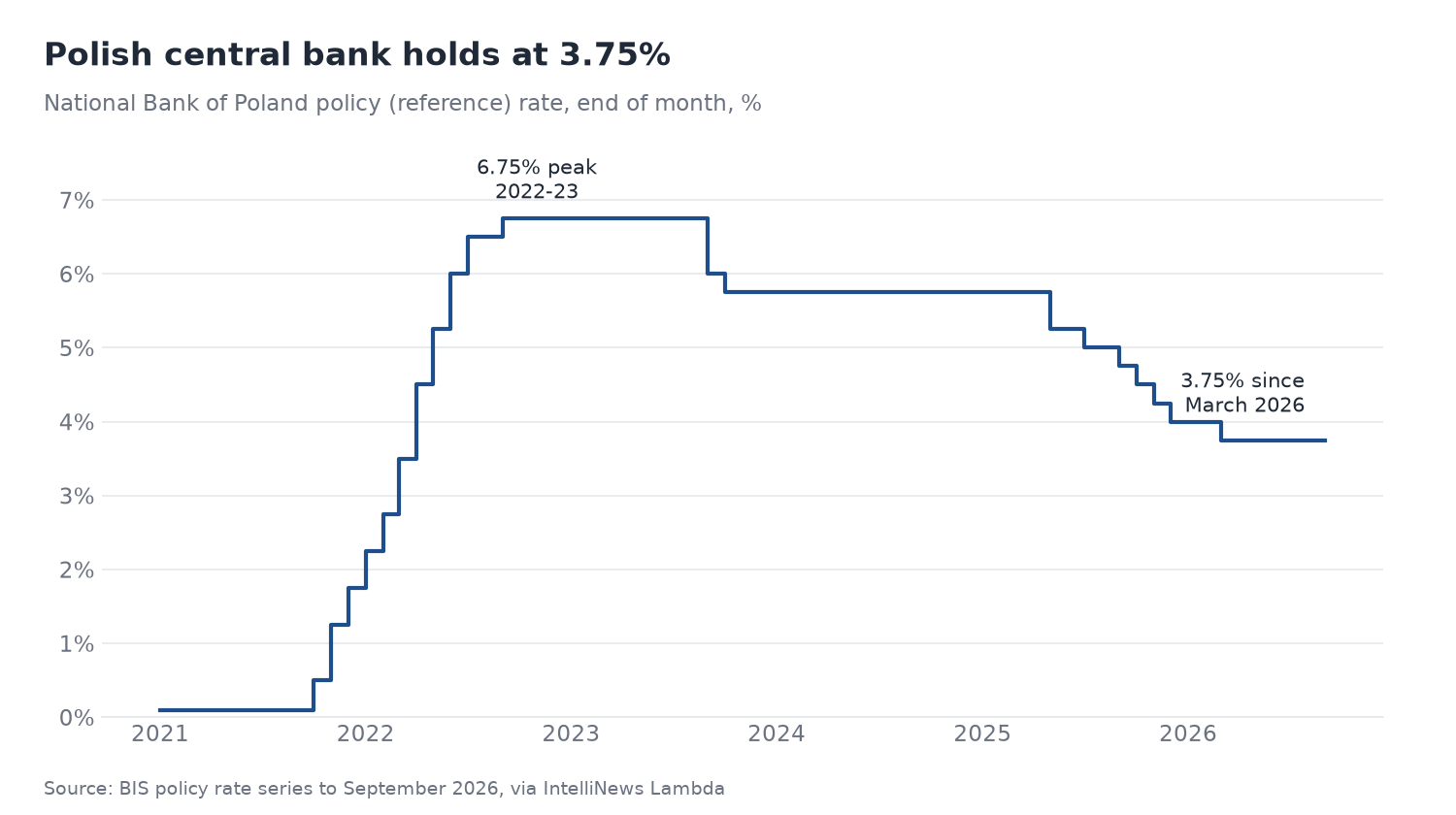
The NBP has held its reference rate at 3.75% since March 2026. Source: BIS, via IntelliNews Lambda.
The council has held rates at 3.75% since March and Glapinski has ruled out cuts until mid-2027. MPC member Ludwik Kotecki told PAP the NBP would keep working without Glapinski and that the council could set rates on its own analysis, with Ireneusz Dabrowski presiding, though convening meetings could be hard. Kotecki is a coalition appointee and not a neutral figure, according to Kaminska.
Setting rates is the easy part. Carrying out policy still needs board approval, which raises the question of whether an undersized board could validly approve an extraordinary liquidity measure or a big FX intervention, and whether counterparties would accept it without extra legal cover. A contested suspension voted after November 5-6 would land on a board already below its legal minimum.
"Given the Glapinski case is centred on claims he failed to follow due process, the optics of subsequently breaking the rules would not be great," Kaminska wrote.
Five scenarios
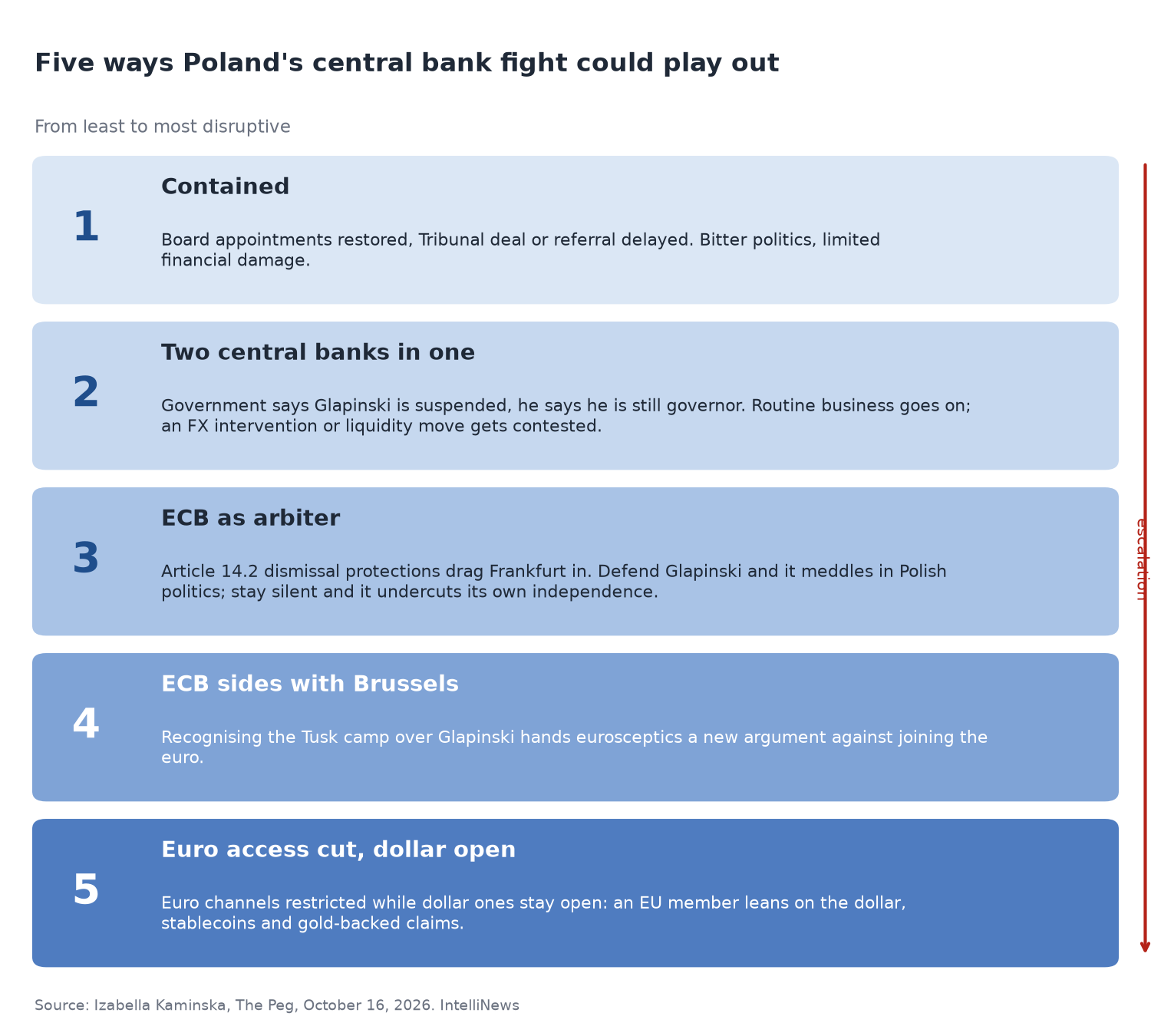
Five ways the fight over the National Bank of Poland could play out. Source: The Peg. IntelliNews.
1. The dispute is contained. The government restores the NBP board, Nawrocki yields on tribunal appointments, or the Sejm delays the referral, fails to muster the votes or proceeds without an immediate suspension. The central bank keeps working and the financial damage stays limited. This is not very likely, according to Kaminska, who pointed to clashes between police and right-wing protesters ringing the tribunal on October 14; the stand-off has escalated since, with police deployed at the court on October 30.
2. Two rival versions of the central bank. The government says Glapinski is suspended, Glapinski says he is still governor, and the bank runs on its existing staff while any decision needing new legal authority is contested. Routine business could carry on, but Polish bonds are already the worst performers in the EU after France's and the zloty is sliding. If the zloty needed support while the board sat below its legal minimum, a foreign counterparty could receive instructions from an official whose authority one side disputes. Would it execute the trade, seek a legal opinion or wait for the courts?
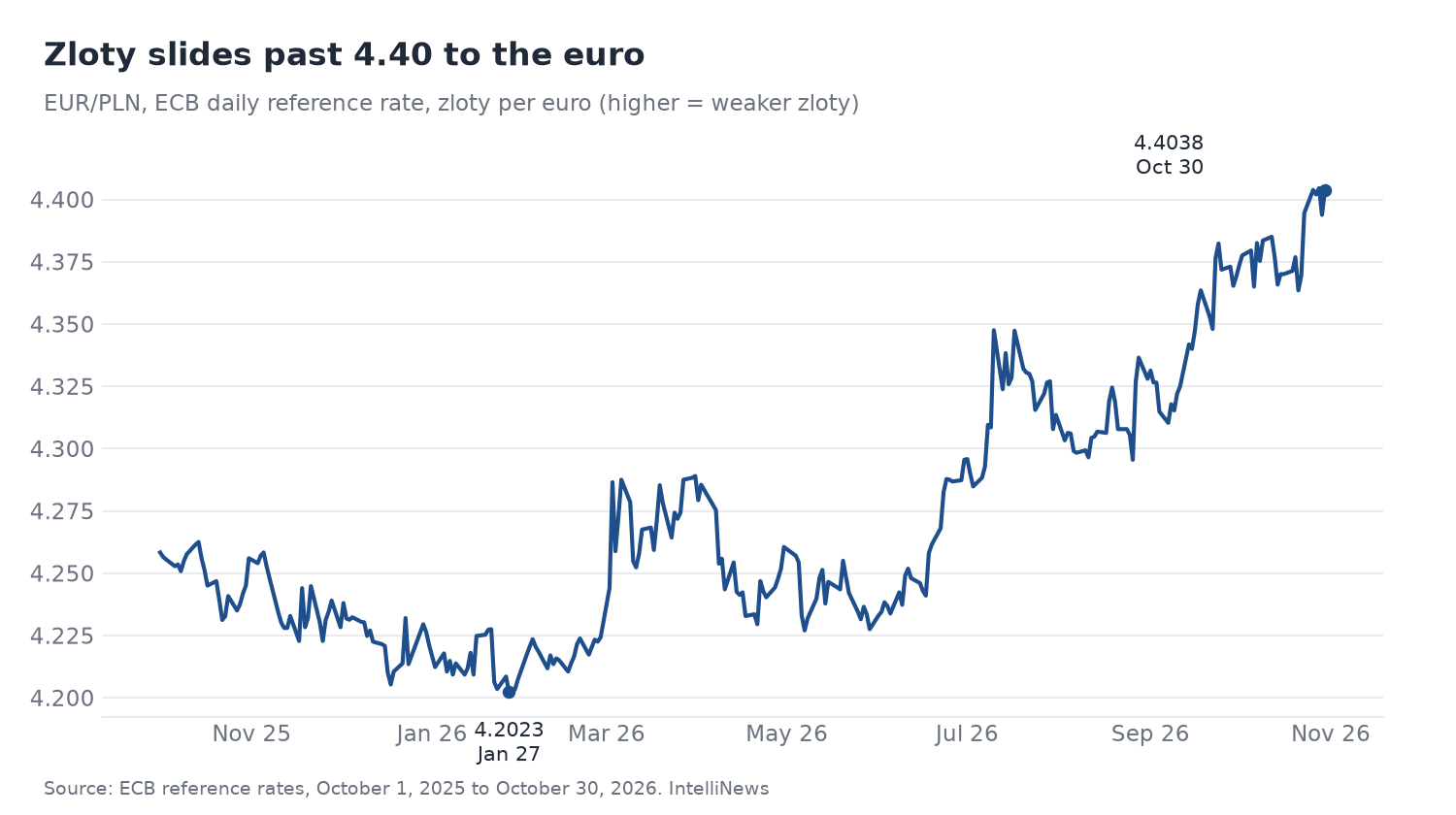
The zloty has weakened past 4.40 to the euro. Source: ECB. IntelliNews.
3. The ECB becomes the arbiter. Poland is outside the euro but the NBP belongs to the European System of Central Banks, and the ECB has already warned about the case's implications for central-bank independence. Article 14.2 of the ESCB statute protects governors against arbitrary dismissal and gives them a route to the EU Court of Justice. Having spoken out against US President Donald Trump's pursuit of Federal Reserve chair Jerome Powell, the ECB would logically have to defend Glapinski too, according to Kaminska, setting it against the EU's political institutions. Accepting a contested suspension instead would undercut the independence its own legitimacy rests on, since many of the charges against Glapinski could be levelled at other EU central bankers.
4. The ECB sides with Brussels. If Frankfurt recognised the Tusk camp over Glapinski, much of Poland's political class could conclude that it had put the wishes of Brussels above central-bank independence. A ruling grounded in a court decision would differ from a political endorsement, but perception would count. Poland is committed to adopting the euro with no timetable, and the episode would hand eurosceptics a new argument against it.
5. Euro access breaks, dollar access holds. In the most extreme case, a Glapinski-led NBP keeps asserting its authority, European institutions recognise someone else and some euro settlement or liquidity channels are restricted. There is no single ECB switch to turn off every euro transaction involving Poland, and such a move would amount to declaring war on Poland, according to Kaminska. But if euro channels became unreliable while dollar ones stayed open, Polish institutions could reroute through dollar correspondent banks, leaving an EU member more reliant on the dollar because of a breakdown with Europe's own monetary plumbing, and opening the door to stablecoins.
Gold is the wildcard. The NBP holds a record 632 tonnes and is aiming for 700 tonnes, which could back gold-denominated claims or dollar instruments in a severe stand-off. Glapinski and Nawrocki have already floated using unrealised gold gains of about PLN197bn (€44.7bn) for a "Polish SAFE 0%" defence programme focused on US arms, an idea that died without the government's sign-off. A formal split between the government and the president, who commands the armed forces, could revive it.
The Libya scenario
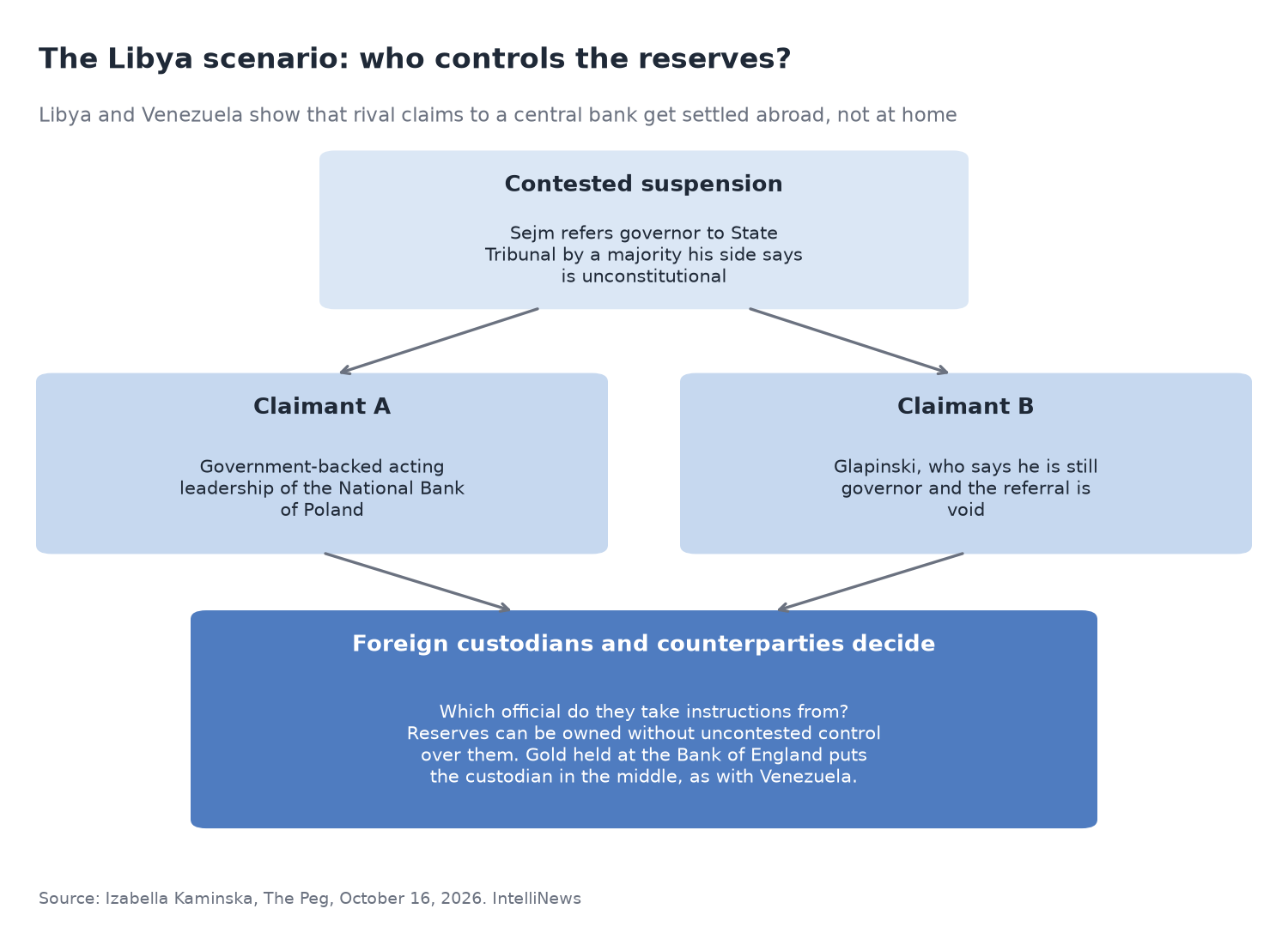
In a contested suspension, foreign custodians would decide whose instructions count. Source: The Peg. IntelliNews.
Libya is the uncomfortable precedent. After its old order collapsed, rival centres of power fought over the legitimacy of state institutions and their money. Poland is nothing like Libya in stability or institutional capacity, but rival claims to monetary authority are a problem that cannot always be settled inside the country concerned, because foreign counterparties have to choose which authority to recognise.
"A country can possess monetary reserves without enjoying uncontested operational control over them," Kaminska wrote.
Venezuela is the closer case. Access to its central bank's gold at the Bank of England became entangled in British recognition policy and litigation over who could represent the bank. Poland keeps most of its gold at home but holds a significant chunk in the Bank of England's vaults, so the custodian could end up with real influence over the NBP's fate.
The wider stakes run through Paris and Washington. With France's public finances worrying investors, any sign that Frankfurt was tough on a Polish national institution while accommodating bigger euro area governments would be explosive. Poland's money is embedded in European institutions but its security ties run to Washington, where Nawrocki has close ties to Trump and Warsaw is negotiating a permanent US base, so a clash between Polish and European institutions could find the US and the EU on different sides.
The Sejm may not vote in November, the board may be restored and a deal may head off a contested suspension. But the weak point is now in plain sight. "It's worth being prepared for anything, including the previously unthinkable," Kaminska concluded.
Unlock premium news, Start your free trial today.


