
Turkey, Egypt remain most fragile emerging markets as Poland's debt risk hits decade high - Capital Economics


Turkey and Egypt remain the emerging markets most exposed to this year's energy shock, while Poland's sovereign debt risk has climbed to its highest level in more than a decade, Capital Economics said in its latest EM Financial Risk Monitor report on October 29.
Most emerging markets are still well placed to withstand rising energy prices and higher global bond yields, according to the consultancy's proprietary indicators. Its aggregate EM currency crisis risk indicator is well below its long-term average, banking risk has fallen to a two-year low and acute sovereign debt problems are concentrated in a small group of countries.
"That said, vulnerabilities are becoming more pronounced in some EMs," wrote Liam Peach, senior emerging markets economist at Capital Economics. Sovereign debt risk is rising across Emerging Europe, albeit from low levels, and the number of countries above the consultancy's "high" sovereign risk threshold has climbed back to eight.
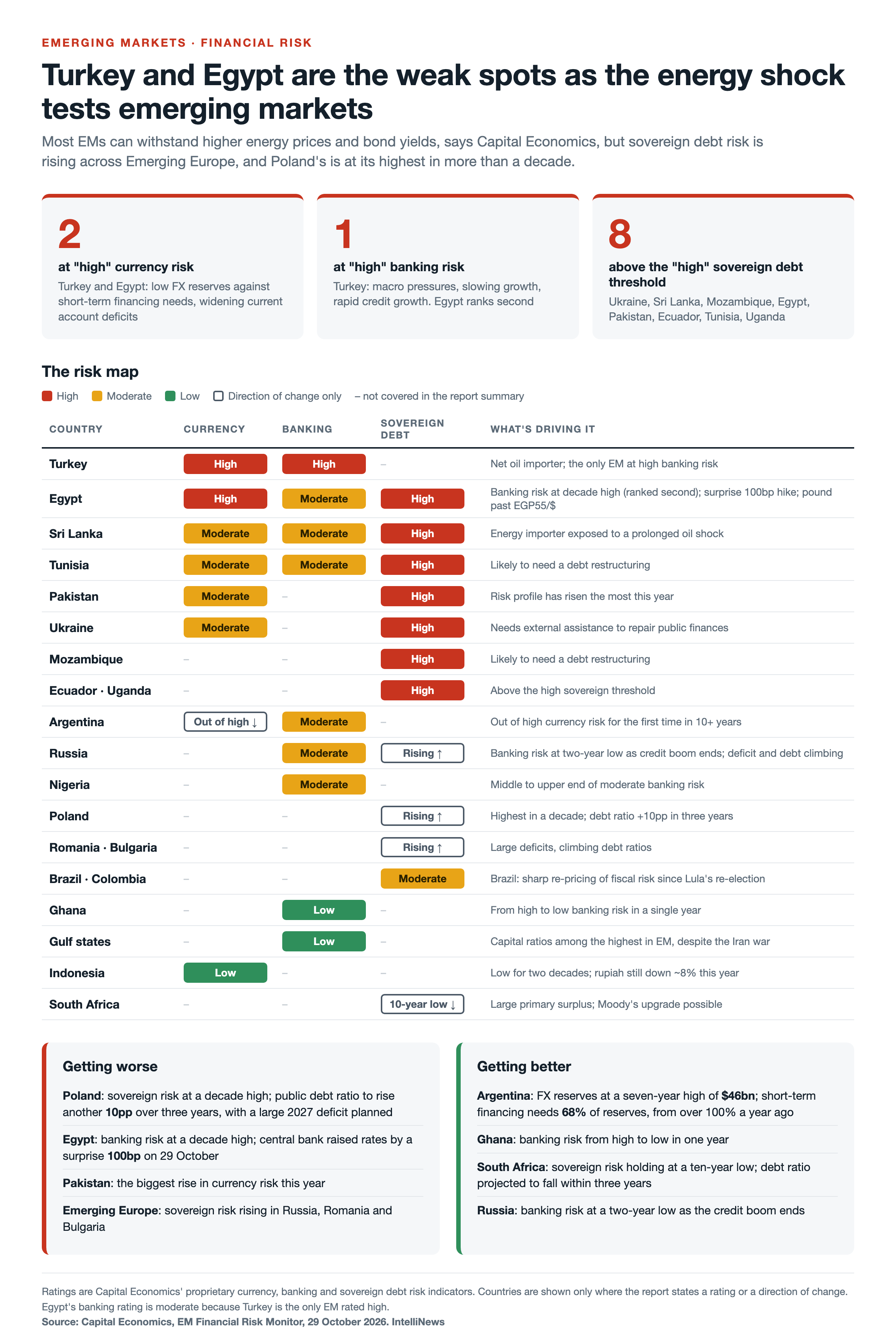
The Iran war has driven up energy prices for net importers just as global borrowing costs rise, and that is where the weak spots lie. Turkey and Egypt are the main net oil importers with high currency risk, even if better policymaking has cushioned them this year. Egypt's central bank raised rates by a surprise 100bp on the day the report came out, with the pound close to a record low after it breached EGP55 against the dollar on October 23.
Turkey is also the only emerging market at "high" risk of a banking crisis, on the back of broad macroeconomic pressures, softening GDP growth and continued rapid credit growth. Egypt ranks second, and its banking risk indicator is at a decade high on rapid lending growth and high real interest rates. Sri Lanka, Argentina, Tunisia, Nigeria and Russia sit at the middle to upper end of "moderate" risk.
Russia's banking crisis risk has dropped to a two-year low as the economy's credit boom has ended, though tight monetary conditions continue to push up private sector debt service costs and non-performing loans. Ghana has made the biggest improvement, moving from "high" to "low" banking risk in a single year. Gulf banks remain "low" risk despite the spillovers from the Iran conflict, with capital ratios among the highest in the emerging world.
On currencies, Turkey and Egypt are again the only countries at "high" risk. In both, FX reserves are low relative to short-term external financing needs, and high energy prices are widening current account deficits. "A larger or more persistent energy shock would add to currency pressure," the report said. Tunisia, Sri Lanka, Ukraine and Pakistan are the "moderate" risk energy importers most exposed to a prolonged oil price shock, and Pakistan's risk profile has risen the most this year.
Argentina has moved out of "high" currency risk for the first time in more than a decade. Its current account has returned to surplus, FX reserves hit a seven-year high of $46bn at the end of 3Q26, and short-term external financing needs have fallen to 68% of gross reserves from more than 100% a year ago. The improvement follows Fitch's first rating upgrade of Argentina in eight years in May.
Indonesia's currency risk indicator has stayed "low" for two decades. The rupiah has still lost around 8% against the dollar this year, which the consultancy puts down to policy worries and the threat to Indonesia's market classification rather than weak balance sheets. The fall would have been larger without a strong external position.
The eight countries now above the "high" sovereign debt threshold are Ukraine, Sri Lanka, Mozambique, Egypt, Pakistan, Ecuador, Tunisia and Uganda. Mozambique and Tunisia will probably need a debt restructuring and Ukraine external assistance to repair their public finances, according to the report.
Some of the sharpest increases came in countries that began the year at "low" risk. Poland's public debt ratio will rise by another 10 percentage points over the next three years, Capital Economics estimates, and there is little prospect of fiscal tightening before next year's election, after the government adopted a 2027 budget draft with another large deficit. "Poland's investment grade credit rating is not under imminent threat, but we think the risks are increasingly skewed towards a re-pricing of risk premia and wider bond spreads from current low levels," the report said. Sovereign risk is also rising in Russia, Romania and Bulgaria, where deficits are large and debt ratios are climbing.
Brazil and Colombia remain within "moderate" sovereign risk, though Brazil has seen a sharp re-pricing of fiscal risk since President Luiz Inacio Lula da Silva's re-election. EM public finances have become more vulnerable to higher bond yields than in the recent past, which could worsen debt dynamics, according to the consultancy.
South Africa is the standout improver. Its sovereign debt risk indicator has held at a ten-year low, the government is running a large primary surplus and the public debt ratio is projected to fall within three years. Recent comments from Moody's suggest a credit rating upgrade may be on the cards if the fiscal gains hold, Capital Economics said.
Unlock premium news, Start your free trial today.


