
Why global population collapse will keep the wars coming


Across Europe, Asia and the Americas, declining states are reaching for the gun. The pattern is older than it looks, and the demographers have seen it before.
The polite version of the story is that the world is getting older. The honest version is darker with increased competition from fewer actors. Three-quarters of the planet's countries will, by 2050, no longer be producing enough children to replace themselves. Britain itself is now set for "Reform party-backed" birth collapse, the BBC reported, with deaths now outnumbering births for the foreseeable future. The rest of Europe is no better, and Germany, Italy, and others are ahead of the United Kingdom.
By 2100, according to the projections of the Institute for Health Metrics and Evaluation at the University of Washington, that figure rises to 97% of countries, including India and the majority of burgeoning Africa. The Lancet study that delivered those numbers in March 2024 framed them in the cool prose of public health. Readers should not be deceived. What is being described is the slow unmaking of the human population, and the wars now lighting up from Ukraine to Iran are early symptoms and not exceptions.
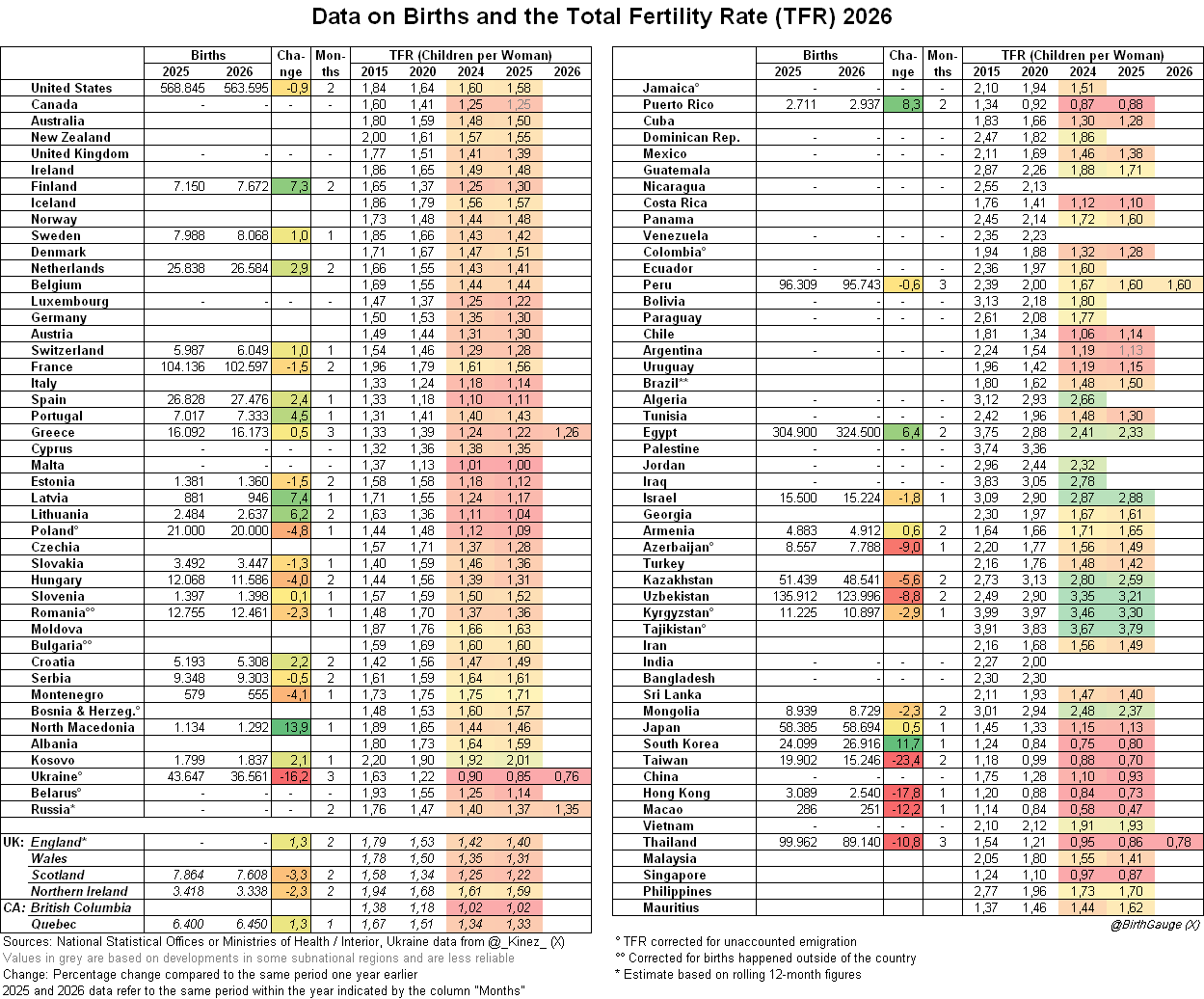
Russia's full-scale war on Ukraine has, according to Carnegie Russia Eurasia Centre estimates, killed at least 219,000 Russians, the majority of them men of working and reproductive age. Ukraine, according to demographer Ella Libanova, has lost roughly 10mn people in three years through death, displacement and exile. Its fertility rate has collapsed to one child per woman, the lowest in Europe. Russia's own rate, at 1.37, is the worst since 2000.
Births in 2024 fell to 1.22mn, a whisker above the all-time low of 1999. Many more young Russian men have fled to countries such as Kazakhstan, Uzbekistan, and, in some curious cases, Argentina. The Carnegie commentary by demographer Salavat Abylkalikov last September concluded that births will now decline by 3-5% annually until at least 2030, with only a few regions bucking that trend across the wider Federation. The ageing leadership in the Kremlin, which seeks to restore the glory days of Russia's (the USSR) recent past, is stuck in the same trap as several other countries, rose-tinted glasses. This is what a country at war with its own future looks like. And it is not unique to the post-Soviet space. No, this is coming for the West. The US government, led by the geriatric leadership of Trump 2.0 and other Western countries alike, is at the mercy of the impending potential wartime collapse.
The thesis that demographic stress drives political violence is not new, and it is not the property of any one school. Jack Goldstone, the political demographer at George Mason University whose 1991 book Revolution and Rebellion in the Early Modern World set the modern terms of the debate, has spent three decades arguing that the timing of upheavals in early-modern France, China and the Ottoman Empire correlates with shifts in age structure rather than ideology. Richard Cincotta, longtime adviser to the US National Intelligence Council, gave the same observation a sharper edge: societies in which more than half the population is aged 15 to 24 are markedly more likely to experience internal civil conflict. The Arab Spring (Syria) and the Iranian Revolution show that youthful populations can tip the apple cart, but the same goes for a gerontocracy.
This geriatric corollary, which has received less attention, is what happens at the other end of the curve. Hal Brands of Johns Hopkins and Michael Beckley of Tufts, writing in Foreign Affairs and later in their book Danger Zone, argued that ageing, slowing powers are not pacified by their decline. They are radicalised by it. Imperial Japan in the late 1930s and Wilhelmine Germany in 1914, on this reading, were not rising challengers but stalling ones. Both gambled on a war of choice (see US-Israeli war on Iran today) because the alternative was watching the window close (see Ukraine war).
Brookings Institution scholar Michael O'Hanlon, in a 2023 essay on China's shrinking workforce, accepted the same logic: a Chinese leadership confronting a working-age population set to fall by a quarter to 700mn by 2050 may, he wrote, conclude that its window for taking Taiwan is closing. In October 2025, the Foreign Policy Research Institute gave the phenomenon a name: strategic compression.
The intellectual lineage matters, because it is what separates serious analysis from the demographic alarmism that fills American op-ed pages. The argument is not that fewer babies cause war in any direct mechanical sense. It is that demographic decline corrodes the legitimacy of states whose narratives depend on growth, expansion and youth. Russia is the obvious case. Vladimir Putin's annual press conferences now feature laments about a fertility rate of 1.4 and calls to make "the happiness of motherhood and fatherhood fashionable", as he put it in December 2025. The Institut Montaigne, in a February 2025 paper, described the Kremlin's invasion of Ukraine in part as "demographic engineering", an attempt to seize territory and population to plug the hole at home. The abducted Ukrainian children are not collateral damage. They are the policy.
China's situation is structurally similar, whilst also quantitatively worse. Its population peaked in 2022 and has now been overtaken by rival India. Its fertility rate has fallen below 1.1 officially, with some exiled Chinese academics suggesting the CCP is still inflating the figures. Its working-age cohort is shrinking by millions a year. The 2025 white paper China's National Security in the New Era, in subordinating economic growth to security priorities, made explicit what observers had been inferring: that Beijing now sees Taiwan not as an ambition but as a precondition for regime survival. The FPRI's reading is bleak enough. China's choices, in this framing, are limited to either delaying or gambling. Both paths are dangerous, but the second is the one that states facing the kind of compression Beijing now confronts have historically taken. Now we see why the race to have a competent Robotic AI is taking precedence in Beijing, and it is not just little robots doing a marathon for kicks.
Iran offers a slightly more nuanced situation, but one that follows a similar pattern, although dressed in a cleric's outfit. Its fertility rate has collapsed from over 6 in the 1980s to roughly 1.6 due to the system's own too successful birth-reduction policies in the 1980s, which were commended by the UN. The new Islamist-military leadership, like the Kremlin's, treats this as an existential question, offering increasingly smaller benefits and tax reductions to nudge people into having more babies against a backdrop of failing economic conditions and a US blockade. The combination of a shrinking domestic base and an expanding regional commitment, from Lebanon to Yemen to Iraq, is no coincidence. It stems from the mind of a geriatric clerical class, until recently led by the Khamenei senior, who was killed on February 28 at 86 years old. One in which, over his long life saw foreign actors as aggressors and ultimately was proven right when the US and Israel attempted to collapse the regime.
The deeper problem is that there is no obvious exit, or even an off-ramp, from these escalating wars and a shrinking youthful base. Pro-natalist policy, the favoured prescription of Western capitals as much as Asian ones, has a poor record. Japan's 1989 "1.57 shock" produced 35 years of generous parental leave and free childcare, and a fertility rate that has gone on falling. South Korea, Taiwan and Singapore have tried matchmaking, housing subsidies and cash bonuses to no avail. Russia's 2024 crackdown on so-called "childfree ideology", accompanied by restrictions on abortion access and a proposed revival of the Soviet-era childlessness tax, is unlikely to fare any better. The Iranian policy of offering tax reductions has done nothing to nudge people, with Hungary's Orban's much-vaunted policies also flailing and consigned to the history bin. The IHME's modelling shows that even the most aggressive pro-natal scenarios stabilise the global fertility rate at 1.93 in 2050 and 1.68 in 2100, well below the 2.1 needed to maintain a population. This, in turn, will ultimately cause the collapse of the economy, consumption will disperse, and the global property sector will then echo that of Japan today, where some 9mn homes sit empty.
What follows from this is the uncomfortable conclusion that the wars are not the prelude to a stable settlement. They are the settlement. As fewer states can credibly claim to be expanding, more will reach for the gun to forestall the moment of reckoning. The coming demographic shifts will completely reconfigure the global economy and the international balance of power. That is the polite formulation. The blunter one is that the post-1945 assumption, that prosperity and demographic momentum would carry liberal states past their authoritarian rivals, has expired. What replaces it is a contest between societies that are all in decline, fought over an ever-smaller pool of working-age men and women, with the prize going not to the largest or the richest but to whichever can sustain the loss the longest.
The wars in Ukraine, in Gaza, Iran and in the South China Sea look, from the inside, like crises with their own causes. Viewed from the demographer's chair afar, they look like something else. They look like the opening engagements of a long argument about who, in the second half of this century, will still be standing when the dust settles.
Unlock premium news, Start your free trial today.


