
Inconsistent messaging on Turkey shows EU cannot pretend to be geopolitical power, says analyst


The EU cannot pretend to be a geopolitical power without better, more consistent messaging than was on show with Ursula von der Leyen’s gaffe equating Turkey to Russia and China.
That’s the warning from Sinan Ulgen – a senior fellow at the Carnegie Europe think tank in Brussels – following a controversial remark from the European Commission president that equated Turkey with Russia and China.
In a commentary, Ulgen writes: “The importance of consistency in foreign policy has rarely been demonstrated as vividly as when two top European Commission officials adopted radically different language on the EU’s relationship with Turkey.
“One, President Ursula von der Leyen, positioned Turkey squarely as a member of a malign axis alongside China and Russia. She claimed that the construction of Europe should be completed so that ‘it does not fall under Russian, Turkish, or Chinese influence.’ She added for good measure that ‘we must think bigger and more geopolitically,’ insinuating that Ankara was actually a geopolitical rival.
“The other, EU enlargement chief Marta Kos, adopted a radically different narrative in an address to the European Parliament, stating that ‘we need Turkey in light of the changing geopolitical realities in Europe and the Middle East.’ She prefaced her remarks by underlining Ankara’s importance as a trade and security partner.”
Ulgen observes that in foreign policy, the long-term effectiveness of a state actor in shaping the nature of its bilateral ties hinges on its credibility. “And,” he says, “consistency is an essential component of credibility. Appearing to be consistent and credible will be a critical success factor in the EU’s transformation as a stronger and more effective foreign policy entity.
“That is why this public demonstration of an internal schism between top EU officials is so detrimental to the union’s ambitions to be a dependable foreign policy actor. Constructive ambiguity has its place in international diplomacy. But publicly rehashing the geopolitical cleavages on Turkey goes further. It underlines a severe and detrimental lack of a cohesive vision. Such egregious inconsistency should trigger a reexamination of how the EU can become a genuinely geopolitical actor. It should justify the creation of a more streamlined and thorough process of internal consensus-building in foreign and security policy. In the absence of this, the EU will forever remain at a disadvantage in a power-driven geopolitical contest.”
Von der Leyen’s comments on Turkey, made at an event hosted by German newspaper Die Zeit, brought heavy criticism from former European Council President Charles Michel. He took to X, asserting that Turkey is “a core #NATO ally, a key migration partner, an energy corridor, a major defense actor on Europe’s flank, and a serious regional power”.
“Europe doesn’t get stronger by applying double standards or simplifying reality,” he added.
As all eyes turned to Ankara for an expected furious reaction, a European Commission spokesperson swiftly backtracked on von der Leyen’s behalf, telling Turkey’s state-run news provider Anadolu Agency that in her remarks she had meant to acknowledge the country’s “geopolitical clout, size and ambition.”
The hasty retreat appeared to quell the potential storm, with Middle East Eye reporting on April 23 that Turkey’s Erdogan administration had opted to stay silent over the gaffe.
"There will likely be no formal statement of criticism or condemnation since the Commission has released an official clarification," a Turkish official told the publication.
With Turkish President Recep Tayyip Erdogan not one to duck a tempestuous exchange, observers cast around for explanations as to the muted response. Oguz Arikboga, a Netherlands-based Turkish academic experienced in working for EU agencies, told Middle East Eye: "Ankara is currently in a position where it wants to tread carefully on the international stage and avoid escalation, having solidified its role as a mediator and regional player.
"In the current international climate, it is seeking deeper cooperation on different files with all actors – not least with the EU. With the upcoming Nato summit in Ankara and COP31 in Antalya, it is not keen on escalating the situation."
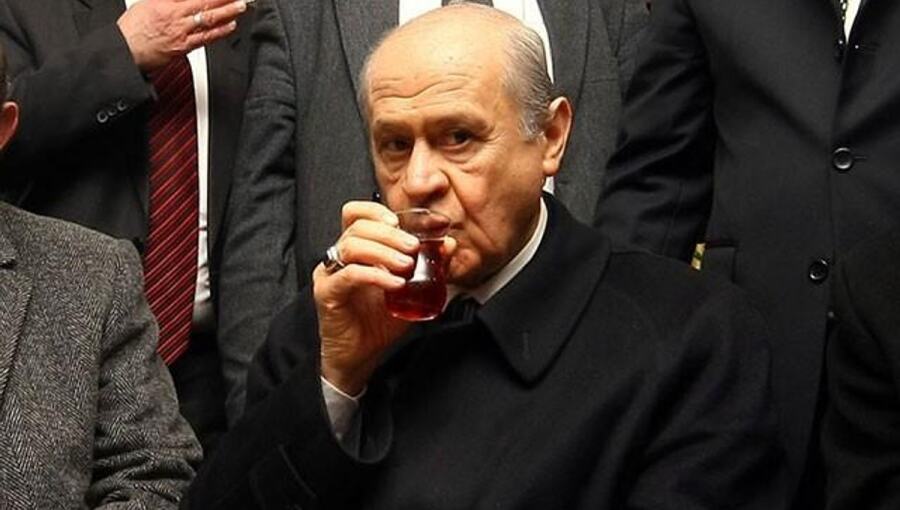
Silence was not the preferred response of Turkish nationalist leader Devlet Bahceli, who talked of the EU's "arrogance" and "double standards" (Credit: Onedio).
Silence, however, was not the approach favoured by Devlet Bahceli, leader of the nationalist MHP party that serves as the junior partner in the Erdogan-led ruling coalition in Turkey.
At a party parliamentary group meeting, reported by pro-government Daily Sabah, Bahceli, exclaimed: “These words are not a blunder. It is a reflection of arrogance and double standards toward Türkiye hidden in this mindset.”
He added: "This is not a basic polemic. We see that Europe does not have a mental grasp of understanding Türkiye. For years, the European Union has distanced itself from Türkiye in terms of membership. They wagged their fingers at Türkiye under the pretext of teaching it norms and harmony, and as soon as their geopolitical needs emerged, they sought to treat Türkiye as a buffer in terms of an energy corridor, transportation line and security partnership.
“Yet, while speaking on equality, they reverted to their arrogant ways. This is politically immoral and lacks strategic thinking. This rhetoric will not lead to partnership, sincerity or a climate of trust.”
Protesting that “Türkiye is a friend, but its friendship is not something open to humiliation”, Bahceli warned: “Europe cannot do without Türkiye, neither in security, energy, migration management, transportation, nor in establishing a regional balance, but Türkiye is history, a state, memory, geography, a centre, and a reality even without Europe.
"We hope that Europe will confront this ingrained arrogance embedded in its mindset. It should conduct its self-assessment not with slogans, but with reality. It should renew its language toward Türkiye not based on interests, but on rationality.”
Carnegie’s Ulgen concluded that von der Leyen’s remarks have been read by many in Turkey as proof that the EU “is indeed a geopolitical rival”.
“Those who hold this view in Ankara hence posit that Turkish foreign policy can never depend on a lasting and deep partnership with Brussels, and accordingly that it should develop its foreign and security policy not only to hedge against the EU but also to work actively to harm the EU’s interests in the neighborhood—including in the Balkans, the Middle East, and even Africa,” said Ulgen, adding: “They also advocate against any compromise on prevailing political disagreements, including in Cyprus.
“A concomitant conclusion is the need to establish closer relations with non-Western powers like China and Russia. Calculated or not, this is exactly the type of thinking that the commission president’s statements have bolstered.”
Unlock premium news, Start your free trial today.


