
TCHAKAROV: Inside the seductive complexity of Armenia's election maths


At first glance, Armenia's upcoming elections may seem easy to dissect. They are anything but. Below the surface is a tangle of thresholds, partnerships and swing voters that makes this race a conundrum of political maths – one that, at least for now, is still tilting toward the incumbent. Two new polls released in recent weeks provide a fresh and updated look at where things stand. Crucially, they follow a two-month hiatus since the previous batch of surveys was produced, thus allowing sufficient time for alliances to harden and preferences amongst voters to coalesce.
A subtle shift toward the incumbent
The latest EVN poll is particularly useful as it uses the same methodology as its February edition, and it shows that Civil Contract is gaining ground. Support for Prime Minister Nikol Pashiyan’s party has risen from 26.1% to 33.6%, while opposition numbers have barely nudged. Importantly, the share of undecided voters has declined somewhat, from 42% in February to (a still large) 37% in April, but remains uncomfortably high.
This combination matters. The slight increase in backing for the incumbent indicates some consolidation of power rather than erosion of attraction. Crucially, the still-large share of undecided voters keeps the race open, suggesting a positive trend for Civil Contract, but also an outcome that is not locked in.
The three diverse simulations with final seat assignments
The most under-appreciated factor in this election is not voter sentiment, but the opaqueness of the electoral system. Armenia’s rules create a structural advantage for larger, more cohesive players. Thresholds matter. Single parties need just 4% to enter parliament while alliances face higher barriers — 8% or even 10%, depending on their size. That’s a problem for the opposition, which remains fragmented across several blocks. While three forces are almost certain to make it into parliament — Civil Contract (party), Strong Armenia (alliance), and Prosperous Armenia (party) — a fourth, the Armenia Alliance (alliance), is hovering right on the edge. Moreover, the stable majority rule dictates that 52% of seats are required for the formation of a stable government. There is still another rule that says that at least a third of parliament seats must be held by the opposition.
And this is where things start to get interesting.
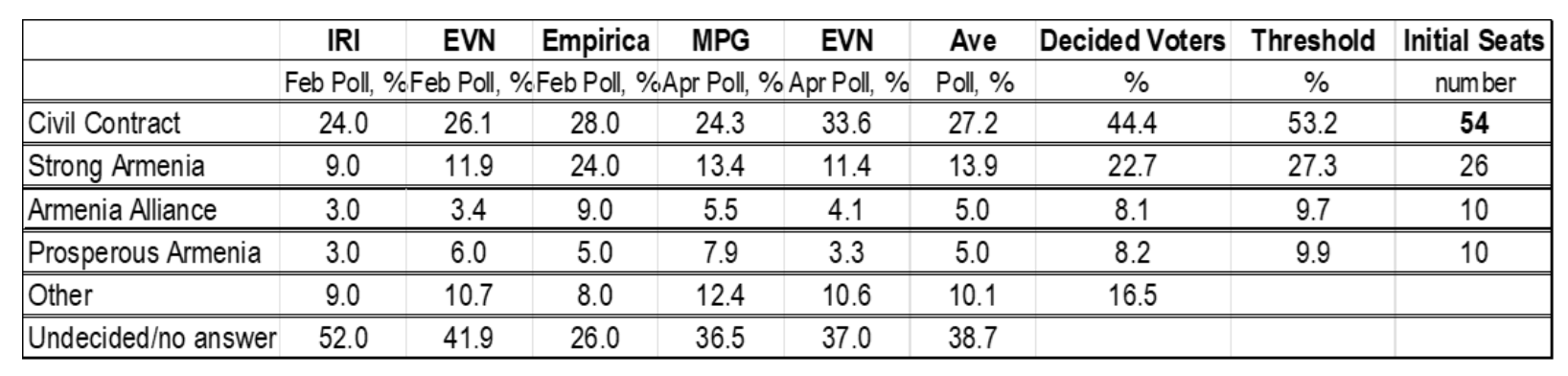
In the baseline simulation, which I centre on the average of released 2026 polls, Civil Contract and the three main opposition forces make it through to the National Assembly. The exact figures indicate that, while it may not be a perfectly even split, it certainly favours the incumbent (Table 1). Civil Contract would be expected to win 54 out of the total 101 parliamentary seats — a clear majority, yet a far cry from its dominance in 2021 when it won 71 seats.
Table 1: Simulation based on average of 2026 polls suggests that four entities will enter parliament
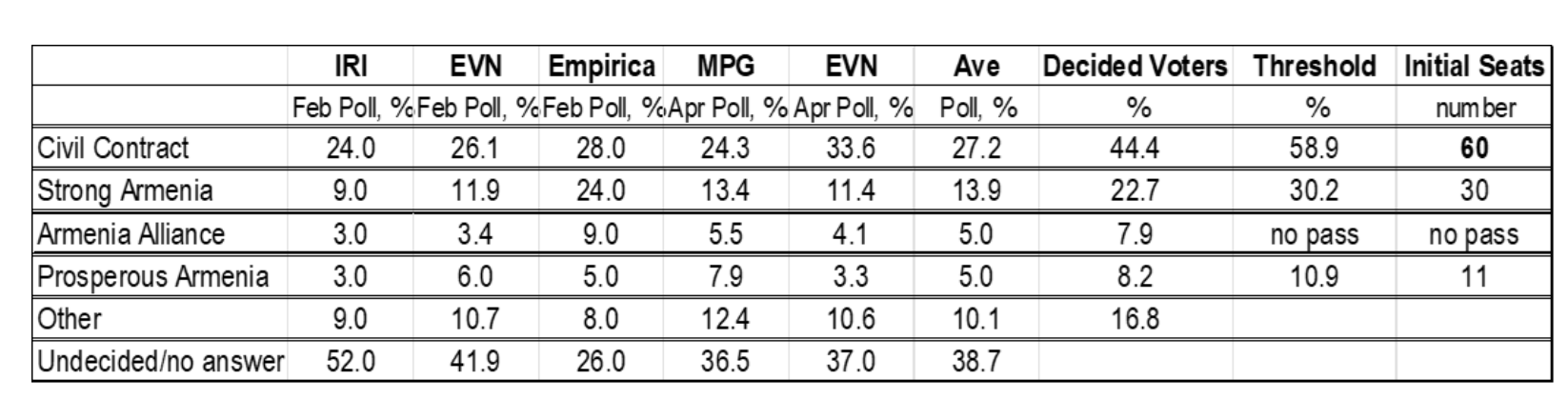
But if Armenia Alliance slips below the threshold in a second scenario, which I generate mechanically by removing a mere 0.3% off its showing in the baseline and assigning it to the “Other” category, the maths shifts, albeit not dramatically (Table 2). Civil Contract’s seat count jumps to 60, strengthening its majority in a single-party government.
Table 2: Simulation assumes that borderline Armenia Alliance does not enter parliament
The wild card in the elections are the undecided voters, and there are many of them — roughly 35-40% of the electorate. In theory, undecided voters could swing the election. In practice, the bar for doing so might be prohibitively high.
Hence, I calculate the break-even point for the undecided voters that would allow the united opposition to claim just enough seats for a majority. Assuming a 90% voter turnout (the April EVN poll suggests that many people intend to vote), I infer what percentage of undecided voters would need to cast their lot with the opposition, so that, if united, it would get the law-mandated 52% of parliament seats. Table 3 shows that, if 73% of the undecided voters who intend to vote end up siding with the opposition, the ultimate distribution of seats will be the following: 48 for Civil Contract and 53 in total for Strong Armenia, Prosperous Armenia and Armenia Alliance.
Table 3: 73% of undecided voters need to lean to the opposition for it to stand a chance of forming a government
This strikes me as unlikely, albeit not impossible. It may also be structurally difficult. Even if such a shift were to occur, there is no guarantee that a government can be formed as the three opposition forces may not be able to coalesce around a single programme to lead Armenia. In this case, a runoff may be necessary between the two leading contenders, Civil Contract and Strong Armenia, to determine the final winner.
What this means for policy and investors
For markets and policymakers, the message is relatively clear: continuity remains the base case, although with less political comfort and room for manoeuvre. A Civil Contract-led government is still the most likely outcome, and this would imply broad policy continuity, continued engagement with the EU and Western partners, and gradual reform rather than abrupt shifts.
Even the alternative, as unlikely as it might appear at this stage, may not be as disruptive as generally feared. Armenia’s course is pretty clear for anyone who follows the geopolitics of the region. The country is now facing a fait-accompli in the necessity of completely normalising its relations with Turkey and Azerbaijan even at conditions that it deems unjust and unfair. Losing the 2020 war, the emptying of Artsakh, and the weakening of its ally Russia may have essentially taken any suspense out of the elections. Even if the opposition wins, it will have to more or less continue the policy of this government. The 4th republic and Real Armenia slogans represent the varnished and well packaged submission of Armenia to its eastern and western neighbours, and one should not necessarily be critical of it as it has little other choice. This is arguably best Armenians can get (if they are lucky) at this point in history.
Ivan Tchakarov is partner for the Caucasus and Central Asia at GlobalSource Partners.
Unlock premium news, Start your free trial today.


