
Which straits will close next?


A long line of tankers is sailing towards the Red Sea in order to pick up oil being exported by Saudi Arabia through its westward pipelines. However, the choke point at the bottom of the Red Sea is vulnerable to attack by Iran-linked Houthi rebels that could quickly off access and expand the current oil flow crisis if the regional war escalates. If that happens then a total of at least 25mn b/d of oil would be removed from the market and the 2026 oil shock would deepen.
A VLCC oil tanker was heading northwest to load crude at Ras Tanura in the Kingdom of Saudi Arabia (KSA) in the Persian Gulf. When the strait closed, the vessel turned around and headed instead to the Al Muajjiz terminal on the Red Sea, where Saudi Arabia had already pumped the oil though its westward pipelines. Now this VLCC is loaded with 2mn barrels of Arab light and heading to East Asia.
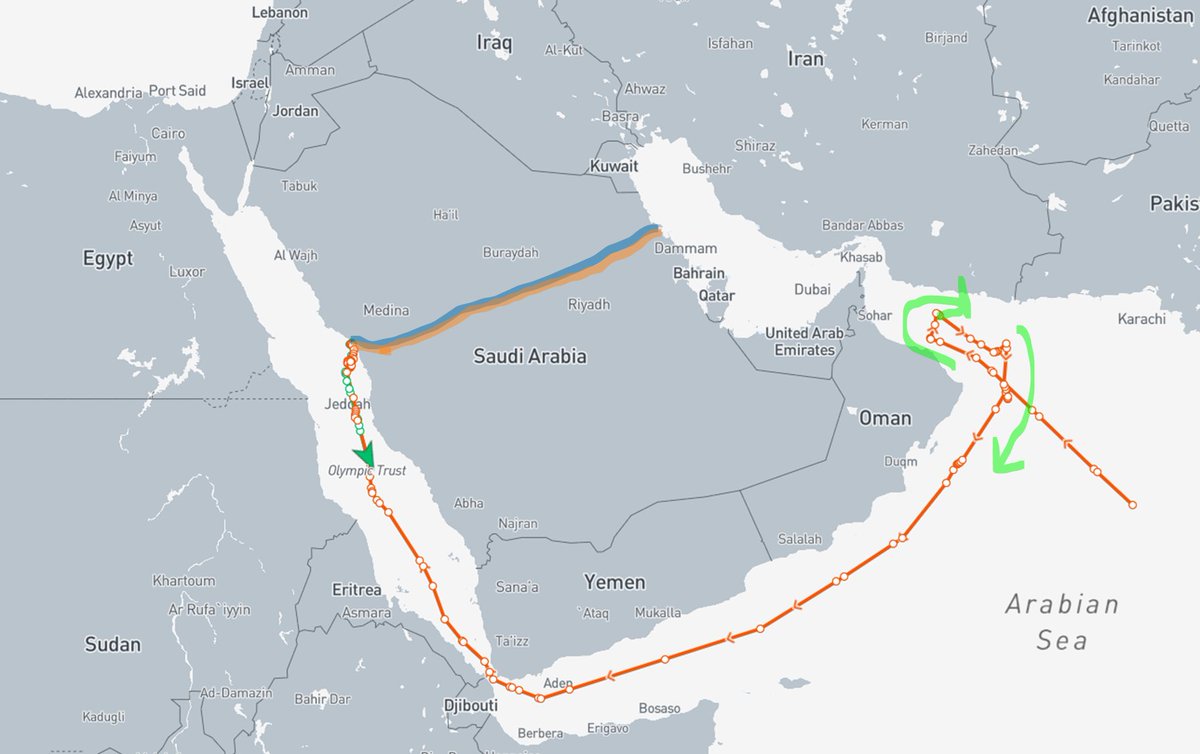
The westward pipeline has taken some of the pressure off the oil crisis and can carry up to 7mn b/d of oil from the other bottled-up Persian Gulf to ships passing through the Red Sea. Added together with uninterrupted Iranian oil exports of around 1.5mn b/d and the growing volume of Indian, Chinese, Greek and Bangladeshi oil exports that have IRGC permits-for-passage, then the total Gulf oil reaching markets, almost exclusively in Asia, is about half the 20mn b/d that used to traverse the Straits of Hormuz.
That may change. Iran's Fars News Agency reported on March 12 Houthis rebels in Yemen and other “resistance groups” may soon join the war against the US and Israel.
Reports emerged on March 15 of Houthi rebels in Yemen demanding bribes from tankers passing through another key strait: the Bab el-Mandeb Strait. It's another chokepoint that controls access to the Red Sea and on to Europe via the Suez canal. Houthis are backed by Iran and if the war in the Middle East escalates, they could close their strait too, causing fresh shocks to the already giddy energy markets.
Yemen's Houthis have already been striking ships in the Red Sea, resulting in a major drop in shipping activity. Currently, 12% of global seaborne oil passes through Bab al-Mandab, making it the world’s fourth-largest shipping chokepoint. If this passage is closed, another 6mn barrels of daily Saudi oil supply would be halted. Total offline capacity between the two Straits would be near 25mn b/d, or 25% of global supply. In addition, the Red Sea–Suez Canal route handles about 10–12% of global seaborne trade.
Tanker traffic jams have become a new feature of the business that is all about mobility. Vessels diverted from the Strait of Hormuz are converging on alternative ports across Asia and the Middle East, driving congestion at sea and stretching inland transport networks. There is a limit to how much cargo these routes can absorb.
As bne IntelliNews reported, Bab al-Mandab is not the only global chokepoint. Iran can reach out to its allies and close several more key natural passageways to cause even more damage. The real nightmare is if the informal CRINK alliance (China, Russia, Iran, and North Korea) gets drawn into the war. The mooted twentieth sanctions package has already caused Russian President Vladimir Putin to turn the tables on Europe and order an end to Russian oil and gas exports to Europe. And this week, China has reportedly sent 72 battleships to the waters off Taiwan. If Beijing wants to forcibly retake control of the island state, now is the time to do it.
Which straits are in danger if the conflict expands
The Strait of Hormuz remains the most immediate vulnerability. Despite US President Donald Trump’s bluster in the first week of the war that the US navy would reopen the straits, the navy itself has ruled that out, saying it's “too dangerous to traverse.”
The Bab al-Mandab Strait represents a second major risk if the conflict spreads through Iranian proxy networks. The corridor, located at the southern entrance to the Red Sea and the Suez Canal route, carries between 10% and 12% of global seaborne trade and about 9% of global oil shipments.
Iranian-aligned Houthi forces in Yemen have already targeted commercial vessels last year, reducing the flow of goods and putting the Red Sea largely off limits to LNG tankers in particular. Sustained attacks could force Europe–Asia shipping to take the long way round via the Cape of Good Hope, adding weeks to transit times and multiplying freight costs, feeding into the global inflation shock that is already making itself felt.
Iran is under attack by the US, but so is Russia in the form of increased sanctions pressure. So far, both Moscow and Beijing have taken an asymmetrical approach to their push back and support for Tehran, but if tensions continue to rise, they could choose to become more proactive.
Another potential pressure point is the Bosphorus Strait, which handles large volumes of Russian and Kazakh oil exports from Black Sea ports as well as Ukrainian grain shipments. Turkey controls passage under the Montreux Convention that bans military activity, but Nato ships have been active in the Black Sea as part of the Ukraine conflict. Russia fired warning shots over the bows of a UK frigate in June 2021 in the run up to the war and military tensions in the region have been high for years.
The other major chokepoints are in less danger of a flare up but are exposed to open hostilities between the US and China. The Malacca and Singapore straits together handle some of the largest volumes of global maritime trade, serving as a critical transit route for energy shipments to China, Japan and South Korea. And the US maintains a heavy military and naval presence in the Indo-Pacific region.
Among Trump’s as yet unstated foreign policy goals is to restrict, or at least control, China’s access to energy as China is a big importer of both Venezuelan and Gulf oil and gas.
The Straits of Gibraltar is also the main exit route for Russian and Kazakh oil to international waters. Following the collapse of the Soviet Union Russia had no military assets in the region, but thanks to Russian President Vladimir Putin’s backing of the Assad regime, it took control of the Tartus port in Syria and as bne IntelliNews reported, has returned as a major naval force in the Mediterranean.
To the north Danish Straits are a major chokepoint for Russian oil exports from its Baltic ports and the EU has already suggested on several occasions stopping passing Russian tankers for inspections – which would be an act of war if the threat is ever carried out.
The Bering Strait between Alaska and eastern Russia is another pinch point that Russia could block as a critical Arctic passage for both military and commercial vessels.
Even more than Russia, China has been investing heavily in expanding its navy and has overtaken the US in the size of its fleet. It is now capable of shutting down cargo through the Taiwan Strait that separates Taiwan from China’s Fujian province, if the Iran war becomes a global clash between the US and the CRINK alliance.
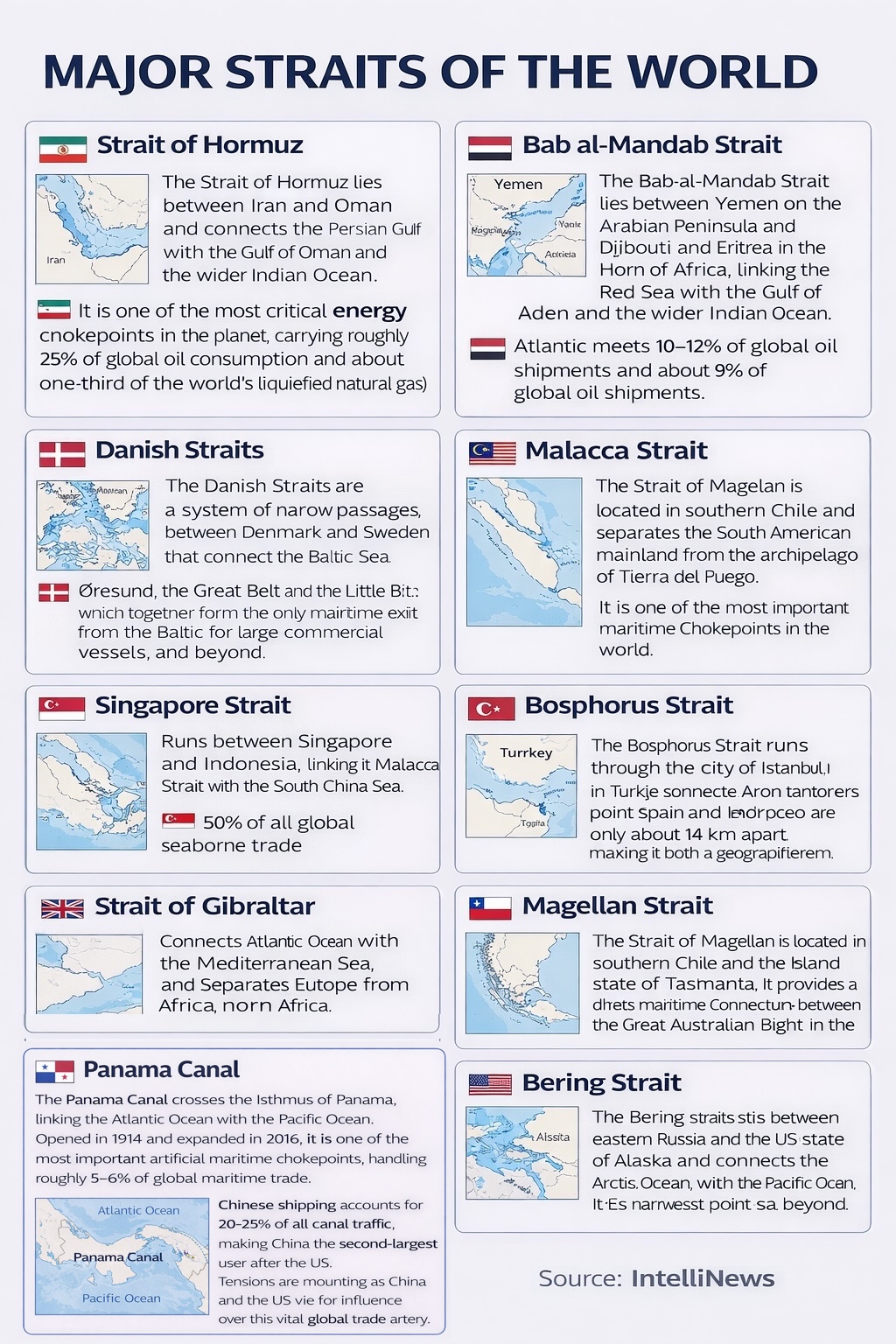
Selected major maritime straits of the world
Strait of Hormuz: The Strait of Hormuz lies between Iran and Oman and connects the Persian Gulf with the Gulf of Oman and the wider Indian Ocean. It is one of the most critical energy chokepoints on the planet, carrying roughly 25% of global oil consumption and about one-third of the world’s LNG.
Bab al-Mandab Strait: The Bab al-Mandab Strait lies between Yemen on the Arabian Peninsula and Djibouti and Eritrea in the Horn of Africa, linking the Red Sea with the Gulf of Aden and the wider Indian Ocean. Notably, China maintains its only foreign military base in Djibouti. Last year, Sudan and Russia reached a final agreement on establishing a Russian naval base in the Sudanese Red Sea coast. The strait forms the southern gateway to the Suez Canal trade route, making it one of the most strategically important maritime chokepoints in global shipping. A large share of traffic moving between Europe and Asia passes through this narrow corridor, including roughly 10–12% of global seaborne trade and about 9% of global oil shipments.
Danish Straits: The Danish Straits are a system of narrow waterways between Denmark and Sweden that connect the Baltic Sea with the North Sea via the Kattegat and Skagerrak. The three main passages are the Øresund, the Great Belt and the Little Belt, which together form the only maritime exit from the Baltic for large commercial vessels. These routes are strategically important for energy flows because Russian oil exports from Baltic ports such as Primorsk and Ust-Luga must pass through the Danish Straits to reach global markets.
Malacca Strait: The Malacca Strait, between the Malay Peninsula and the Indonesian island of Sumatra, connects the Indian Ocean with the Pacific Ocean and is another key maritime chokepoint. Around 60% of global maritime transport passes through this narrow corridor, which also carries approximately 25% of all globally traded goods. Its strategic position makes it the primary shipping route between East Asia, Europe and the Middle East.
Singapore Strait: The Singapore Strait runs between Singapore and Indonesia and links the Malacca Strait with the South China Sea. It forms a key continuation of the shipping corridor that connects the Indian Ocean to East Asia and is among the busiest maritime routes in the world. Together with the Malacca passage it handles roughly 50% of global seaborne trade.
Bosphorus Strait: The Bosphorus Strait runs through the city of Istanbul in Türkiye and connects the Black Sea to the Sea of Marmara, and ultimately to the Mediterranean via the Dardanelles. It is one of the narrowest natural straits used for international navigation and forms a major geopolitical boundary, physically separating Europe from Asia. The waterway is vital for shipping from Black Sea ports, including Russian and Ukrainian grain and energy exports.
Strait of Gibraltar
The Strait of Gibraltar links the Atlantic Ocean with the Mediterranean Sea and separates southern Europe from northern Africa. At its narrowest point Spain and Morocco are only about 14 km apart, making it both a geographical and strategic gateway between two continents.
Magellan Strait: The Strait of Magellan is located in southern Chile and separates the South American mainland from the archipelago of Tierra del Fuego. It forms a natural maritime passage between the Atlantic and Pacific Oceans, historically serving as an important alternative route before the opening of the Panama Canal. Although less heavily used today, it remains strategically important for regional navigation.
Bass Strait: The Bass Strait lies between mainland Australia and the island state of Tasmania. It provides a direct maritime connection between the Great Australian Bight in the Southern Ocean and the Tasman Sea. The strait is significant for coastal shipping, fisheries and offshore energy infrastructure linking Tasmania to the Australian mainland.
Bering Strait: The Bering Strait sits between eastern Russia and the US state of Alaska and connects the Arctic Ocean with the Pacific Ocean. It is the only natural maritime passage between the Arctic and the Pacific and also forms the geographical boundary between Asia and North America. Despite its narrow width of about 85 km, it has growing strategic importance as Arctic shipping routes gradually become more accessible.
Panama Canal: The Panama Canal crosses the Isthmus of Panama in Central America and links the Atlantic Ocean with the Pacific Ocean. Opened in 1914 and expanded in 2016 with a new set of larger locks, it is one of the most important artificial maritime chokepoints in the world. The canal handles roughly 5–6% of global maritime trade, with around 14,000 ships transiting each year, carrying cargo ranging from containerised goods and grain to oil and liquefied natural gas. Chinese shipping accounts for roughly 20–25% of all canal traffic, making China the second-largest user after the United States. A battle for control of the canal between the US and China is already running high as the two battle for control of the vital global trade artery.
Unlock premium news, Start your free trial today.


