
Ukraine's public debt dips to $212.6bn as Fitch sees it hitting 134% of GDP


Ukraine's state and state-guaranteed debt fell by 0.67% in September to UAH9.54 trillion ($212.6bn), its first monthly decline since May, the Ministry of Finance said on October 27.
Fitch Ratings, which affirmed Ukraine at 'CCC' on October 23, expects the recovery in the numbers to be brief, with general government debt rising from 101.2% of GDP at the end of 2025 to 134.3% in 2028, driven by large deficits and a gradual depreciation of the hryvnia. That path is much steeper than the IMF's: the Fund's World Economic Outlook of October has the ratio peaking at 111.8% this year and easing to 109.6% in 2028.
Fitch's steeper path rests on the war: it now assumes the fighting continues into 2027 and has cut its growth call sharply since April, when it expected growth of 1.6% this year and 2.7% next. It now sees a slight contraction in 2026, after output stagnated in January-August, and growth of only 0.2% in 2027, with Russian attacks, restrictions on Black Sea exports and access to foreign money setting the pace.
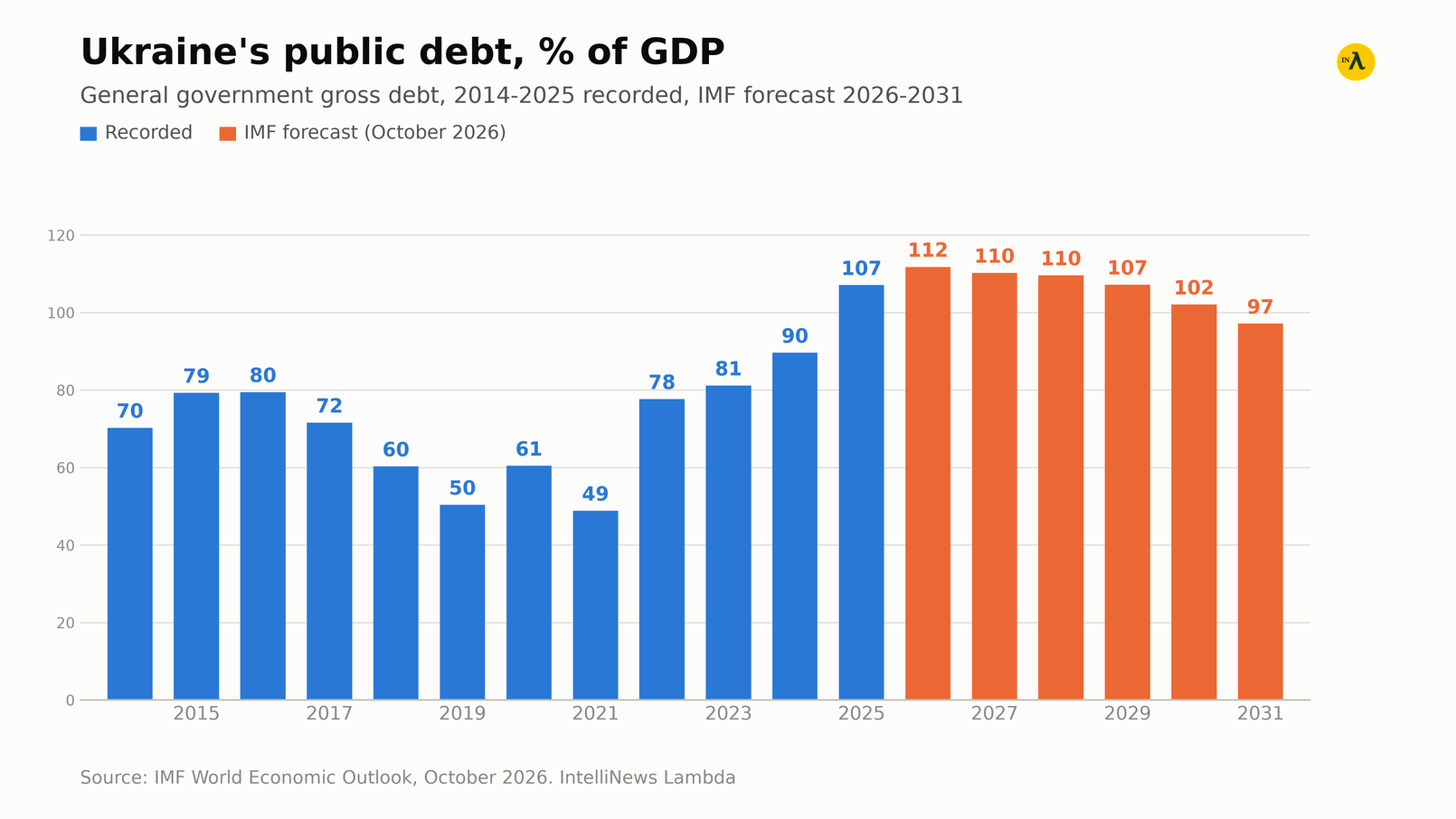
Ukraine's general government gross debt, % of GDP, 2014-2025 recorded and IMF forecast for 2026-2031. Source: IMF World Economic Outlook, October 2026; IntelliNews Lambda
Most of September's fall came in external debt, which dropped by UAH50.50bn ($1.1bn), while domestic debt fell by UAH7.43bn ($163mn) and guaranteed debt by UAH6.75bn ($148mn), the ministry said. Measured in dollars the stock fell by $2.94bn. External debt made up UAH7.29 trillion ($162.5bn), or 76.44% of the total, domestic debt UAH1.99 trillion ($44.4bn), or 20.93%, and state guarantees UAH251.2bn ($5.6bn), or 2.63%.
Concessional loans from international financial institutions and foreign governments account for about 66.4% of the portfolio, and the EU is the largest single creditor with a 38.44% share. The euro is the main currency of the debt at 44.18%, ahead of the dollar at 23.66%, the hryvnia at 20.03% and the IMF's special drawing rights at 8.91%.
The weighted average cost of state debt rose to 4.44% at the end of September from 4.37% in August, though it remains below the 4.55% of December 2025. Average time to maturity was 12.87 years, against 13.37 years at the end of last year.
"Ukraine continues to maintain controlled debt dynamics in the conditions of full-scale war," the ministry said.
| Ukraine state and state-guaranteed debt | Dec 31, 2025 | Aug 31, 2026 | Sep 30, 2026 |
| Total, UAH bn | 9,042.7 | 9,602.9 | 9,538.4 |
| Total, $bn | 213.3 | 215.6 | 212.6 |
| Weighted average cost, % | 4.55 | 4.37 | 4.44 |
| Average time to maturity, years | 13.37 | n/a | 12.87 |
Source: Ministry of Finance of Ukraine
Fitch's forecasts put the budget deficit at 18% of GDP in 2026, or 28% excluding grants, narrowing to 15.6% by 2028. The current account deficit is expected to reach 24% of GDP this year. The intensifying war has opened additional external financing needs of $27bn, or 12.4% of GDP, in 2026 and $33bn, or 14.5% of GDP, in 2027, and the sources to fill them have not yet been fully identified.
The EU's Ukraine Support Loan, the €90bn loan agreed last December on top of the earlier Ukraine Facility, covers a substantial share of the needs. Kyiv also plans to reallocate civilian spending and has asked for some funding scheduled for 2027 to be brought forward to 2026. Help from beyond the bloc is shrinking: non-EU donors have pledged only €4bn for 2027, down from €19bn this year, and the IMF puts next year's uncovered gap at $30bn-35bn.
| Forecasts, % of GDP unless stated | 2025 | 2026 | 2027 | 2028 |
| Public debt (Fitch) | 101.2 | - | - | 134.3 |
| Public debt (IMF) | 107.1 | 111.8 | 110.3 | 109.6 |
| Budget deficit (Fitch) | - | 18.0 | - | 15.6 |
| Real GDP growth, % (Fitch) | - | slight contraction | 0.2 | - |
| Additional external financing need, $bn (Fitch) | - | 27 | 33 | - |
Sources: Fitch Ratings, October 23, 2026; IMF World Economic Outlook, October 2026
Fitch rates Ukraine's long-term foreign-currency debt 'CCC' and its local-currency debt 'CCC+', and assigns no outlook, as is its practice for sovereigns at 'CCC+' or below. It counts international support, above all from the EU, as the main factor keeping Ukraine able to service its debt, with repayments on the restructured Eurobonds not due to start until 2029. A prolonged war and financing needs on this scale could raise the risk of donor fatigue, the agency warned.
This article was produced with the help of IntelliNews Lambda analytical tool
Unlock premium news, Start your free trial today.


