
Serbia’s cluster-three talks stalled over democratic backsliding, Kos says


Serbia has fulfilled the opening benchmarks for the EU’s cluster-three accession talks, but member states are blocking the next step over democratic backsliding, Enlargement Commissioner Marta Kos said.
"Serbia is fulfilling all the criteria for opening cluster three, but because it was backsliding on the cluster one fundamentals, the member states have said no, it cannot move forward," Kos told TVP World in an interview published on October 28.
The Commission said in its 2025 report that Serbia had fulfilled cluster three's opening benchmarks; Kos's remarks now set the conditions for moving talks forward. The Student List won 52.54% of the vote on October 25 and will form the first government in 14 years not run by Aleksandar Vucic's Serbian Progressive Party (SNS). Serbia opened talks in 2014 and has 22 of 35 chapters open, but it has not opened a new cluster since 2021, The incoming leadership says it wants European integration, yet its programme never names membership as a goal and rules out sanctions on Russia, the condition Brussels presses hardest.
Progress under the next government will depend on an independent judiciary, free media, democracy and the fight against corruption, Kos said, priorities she said the Student List representative she spoke to had also named. Brussels has not yet started talks with the new government, which has to be formed first, she added. The Commission publishes its annual enlargement reports on November 4.
Kos also said that a country that does not line up with the EU on foreign and security policy, including joint action against Russia over its war in Ukraine, would probably not be able to join, and that Serbia would find progress very difficult on that basis. Serbia's alignment with the EU's common foreign and security policy stood at 63% as of October 24, 2025, and it has not joined any EU restrictive measures against Russia, according to the Commission's Serbia 2025 Report.
The Student List does not advocate sanctions on Russia, as its programme states, and problems must be solved through dialogue, negotiations and agreements rather than sanctions, Radomir Saicic, a chemistry professor on the list who is one of the names mentioned for prime minister, told RIA Novosti.
European Council President Antonio Costa told the list's leader Ilija Srdanovic in a call on October 27 that Serbia's place is in the EU and the bloc is ready to back its European path, with a clear focus on the reforms Serbian voters had demanded: the rule of law, the fight against corruption and media freedom, the Slovenian news agency STA reported. Srdanovic has said Serbia remains committed to European integration and named chapters 23 and 24, on the judiciary, fundamental rights and security, as the main obstacle.
The Commission's 2025 report found that Serbia had met the opening benchmarks for cluster 3, which covers competitiveness and inclusive growth, and that the cluster was technically ready to open. The same report recorded backsliding on freedom of expression as the environment for journalists "seriously worsened", and noted that the media regulator REM had been without its decision-making council since November 2024 because parliament missed the deadline to elect one. The government had set itself the end of 2026 to meet all EU criteria but was "yet to show genuine political will" to deliver, it said, and anti-EU narratives were used by office holders "including at highest levels".
The Commission renewed its recommendation to open cluster 3 in July, but EU ambassadors refused to back it, with the Netherlands ready to veto over judicial independence, Serbia's democratic record and its ties with Russia, Politico reported at the time. Belgrade's last step forward was the opening of cluster 4 on the green agenda - transport, energy, trans-European networks and the environment - at the 13th accession conference on December 14, 2021. Only two chapters have been provisionally closed.
Slovenian Prime Minister Janez Jansa said Ljubljana would welcome faster talks but would veto any progress until Belgrade hands over Yugoslav-era secret service files.
"We will not give consent for any progress until Serbia hands over to Slovenia all the archives of the UDBA, SDV, YPA, ZSNZ and other former SFRY services that relate to Slovenia," Jansa wrote on X on October 26.
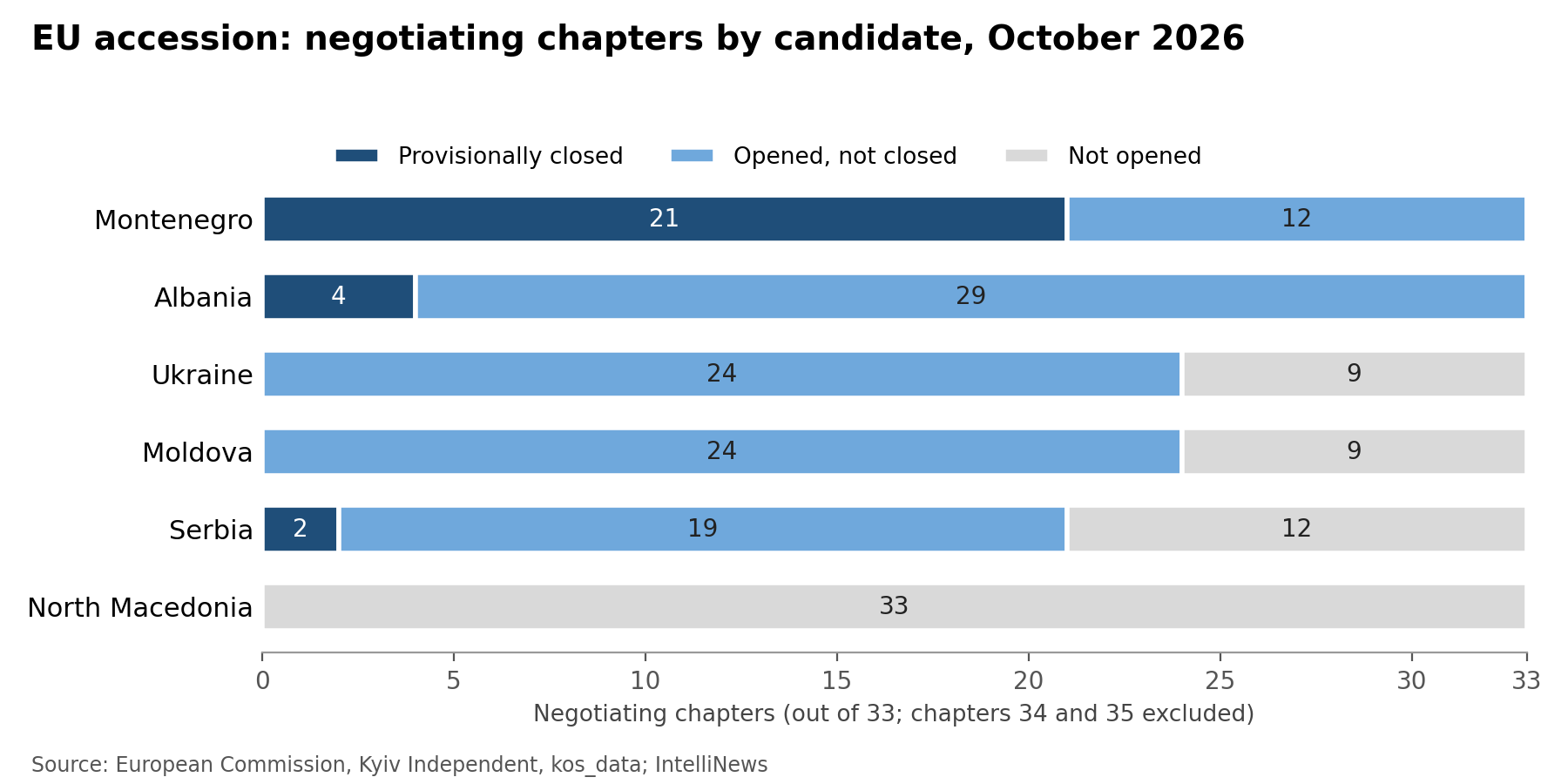
EU accession: negotiating chapters by candidate, October 2026 (out of 33; chapters 34 and 35 excluded). Source: European Commission, Kyiv Independent, kos_data; IntelliNews
Ukraine and Moldova opened two more clusters in October, and the working assumption in Brussels is still that they will open clusters 4 and 5 by the end of 2026, Rikard Jozwiak, Europe editor at Radio Free Europe/Radio Liberty, wrote on X on October 28. Hungary never gave a green light to open all the clusters at once, and some other member states want to take more time on these two because they cover transport and agriculture, he wrote. Budapest blocked a procedural step towards them on October 20.
Montenegro, the front-runner, has opened every chapter and provisionally closed 21 of them, and Albania has opened all and closed four. North Macedonia has yet to open any.
Unlock premium news, Start your free trial today.


