
Poland, Romania outpace Germany on investment as China pulls away from the West


Poland and Romania are building new productive capacity faster than the rest of Europe while German investment has all but stopped, according to the McKinsey Global Institute.
Net productive investment - spending on infrastructure, machinery, commercial buildings, software and R&D, minus what it takes to replace worn-out assets - runs at 6% to more than 8% of GDP in Poland and Romania, against just 0.2% in Germany in 2024, the consultancy's research arm found in its report "Catalyzing competitiveness: Where investment happens and why", published on June 30. Denmark and Sweden run at about 5% to 6%.
Central Europe's numbers are one of the few bright spots in a 163-page study that finds the West falling far behind China. China now adds about three times as much to its productive capital stock each year as the US and the EU combined at market exchange rates, and about five times as much once local prices are taken into account. Europe as a whole would need to invest an extra €750bn-€800bn a year, about 4.5 percentage points of GDP, to close its gap.
That is the same amount suggested in the influential Draghi report in 2024 to fix the increasingly dysfunctional European economy. However, what spare money the EU has is being sucked away by the €800bn promised to European Commission President Ursula von der Leyen’s ReArm defence sector modernisation programme, with little left over for badly needed infrastructure and innovation investments. Mario Draghi, a former Italian Prime Minister, complained that Europe had fallen badly behind the US and China and needs investments across the board to simple catch up with its rivals.
The region's investment boom also runs into its exposure to China: Poland, Romania, the Czech Republic, Hungary and Slovakia are among the economies most exposed to Chinese competition because their exports overlap with China's in cars, batteries and machinery.
"Investment has stalled in Europe, shifted in the United States, and pulled away from the pack in China," the authors wrote.
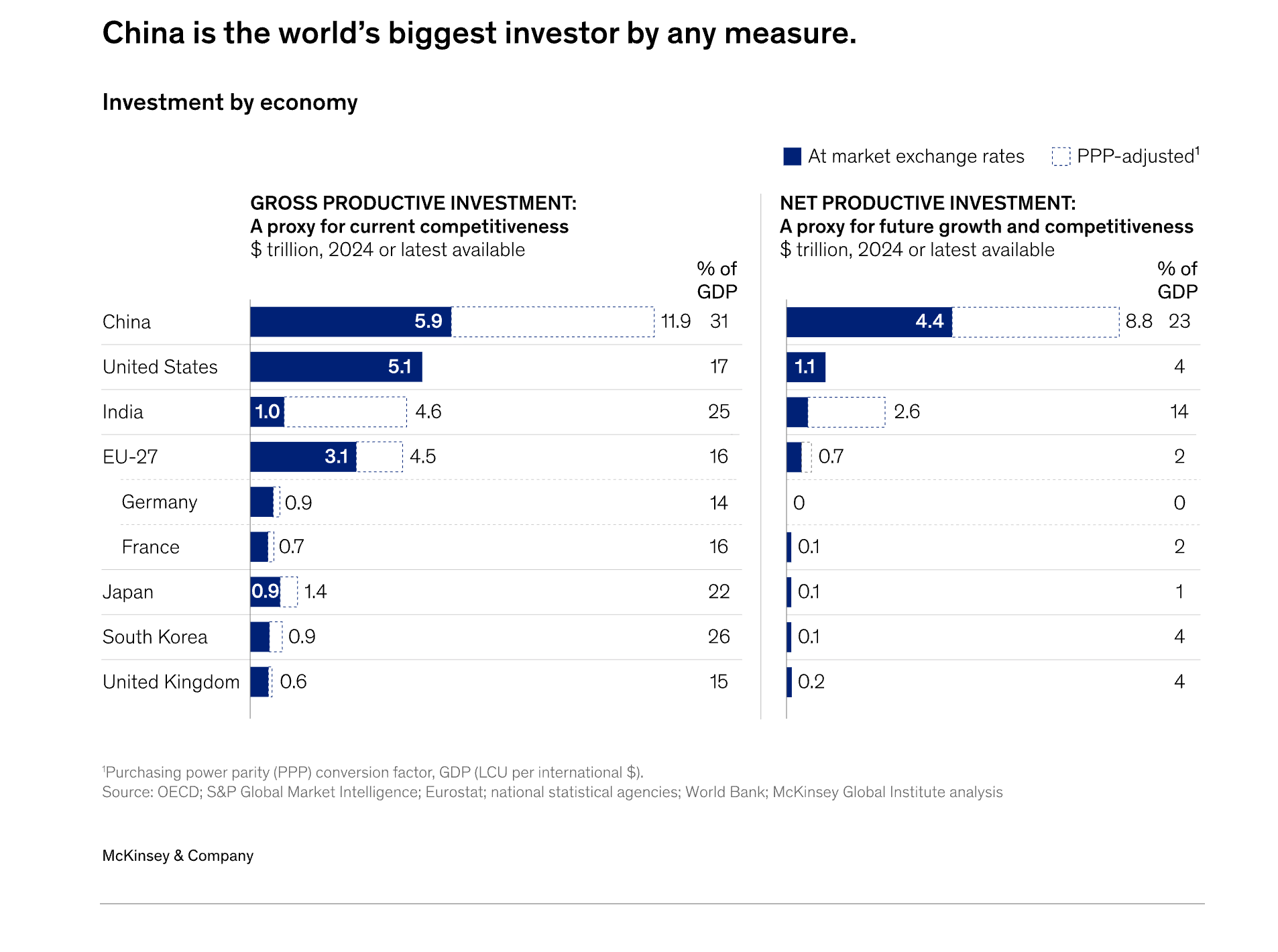
Gross and net productive investment by economy, $ trillion and % of GDP, 2024 or latest available. Source: McKinsey Global Institute
The report uses productive investment as its yardstick for competitiveness on the grounds that companies put money where they expect to succeed. Investment in tangible and intangible assets together accounts for up to 80% of productivity growth, according to earlier McKinsey research, and the authors argue that a country's competitiveness shows in its ability to unlock domestic investment and attract it from abroad.
Europe at two speeds
The EU invests $3.1 trillion a year, or 16% of GDP, but so much of that goes on replacing ageing assets that only about $400bn, or 2% of GDP, adds to the capital stock. Net investment across the bloc has fallen from just below 4% of GDP before the 2008 financial crisis to just over 2% in 2024.
The lack of investment comes as Europe shifts from manufacturing to a service economy and its accelerating deindustrialisation thanks to energy prices that have doubled since the start of the Ukraine war, while China and Russia emerge as global manufacturing powerhouses.
Germany has fared worst. Its net productive investment fell from about 2% of GDP before the financial crisis to 0.2% in 2024, as the policy response to successive crises centred on the constitutional debt brake, the Schuldenbremse. Growth in capital per worker has virtually ground to a halt, and on McKinsey's rough rule of thumb Germany is investing at a rate consistent with GDP growth of about 0.5% a year, against about 1% for the EU and about 2% for the US.
The southern economies hit hardest by the eurozone debt crisis now invest more than Germany, with net rates above 2% in France, Italy and Spain and above 4% in Greece and Portugal. Romania also carries one of the lightest payroll burdens in Europe, with non-wage costs and payroll taxes below 5% of labour costs, against more than 30% in France.
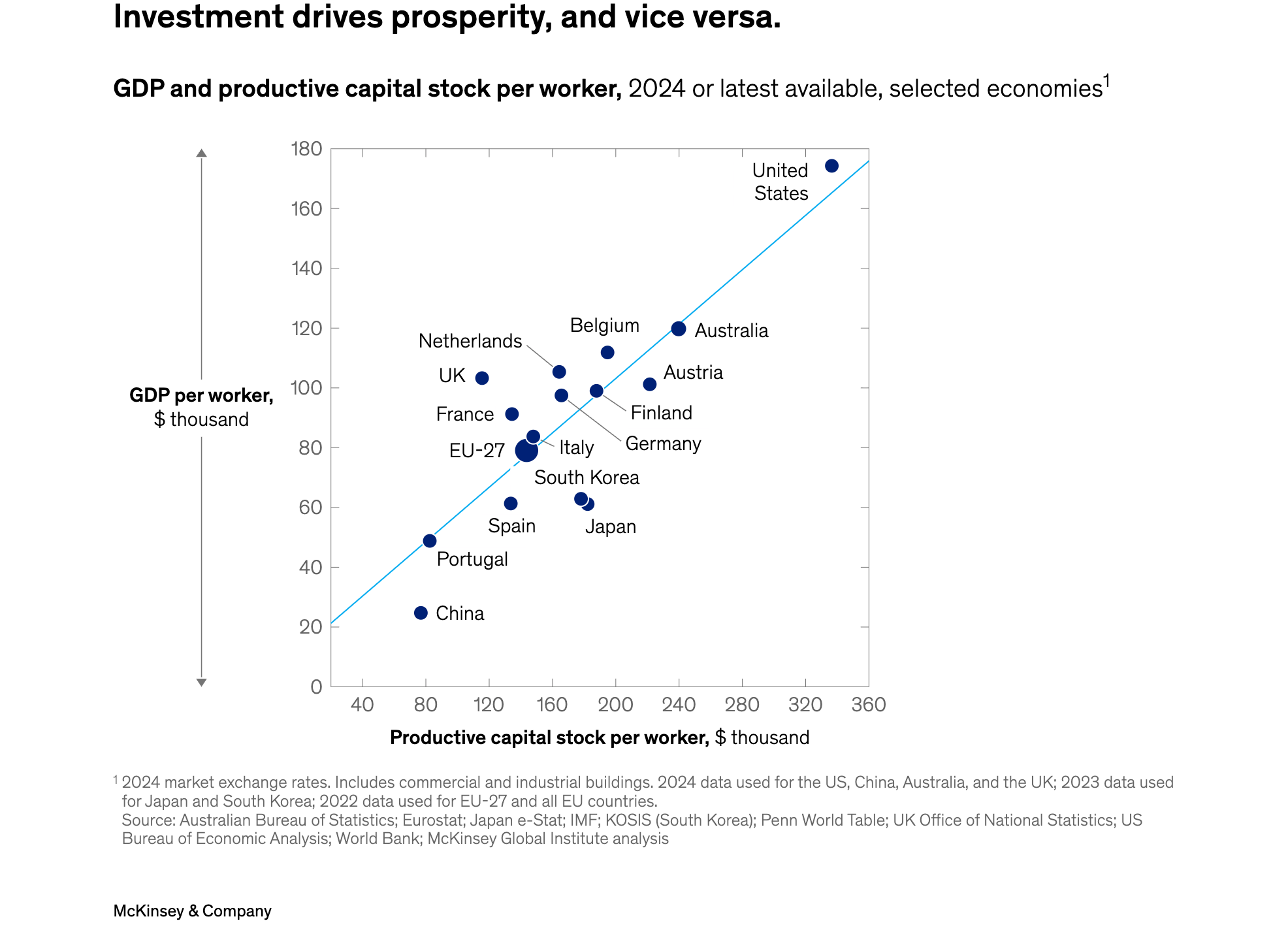
GDP and productive capital stock per worker, $ thousand, 2024 or latest available. Source: McKinsey Global Institute
Europe does not lead global investment in any of the 14 sectors McKinsey tracks. It was overtaken by China in automotive and by the US in professional services, and its investment in most manufacturing sectors runs at between half and three-quarters of the global average rate, which puts its share of output in automotive, pharmaceuticals and machinery at risk.
China builds at three times the pace
China's gross productive investment of $5.9 trillion a year, equal to 31% of GDP, exceeds the $5.1 trillion invested in the US, where the rate is 17% of GDP. Adjusted for purchasing power, China's figure rises to $11.9 trillion. Its net investment rate of 23% of GDP, about $4.4 trillion, is roughly six times the US rate.
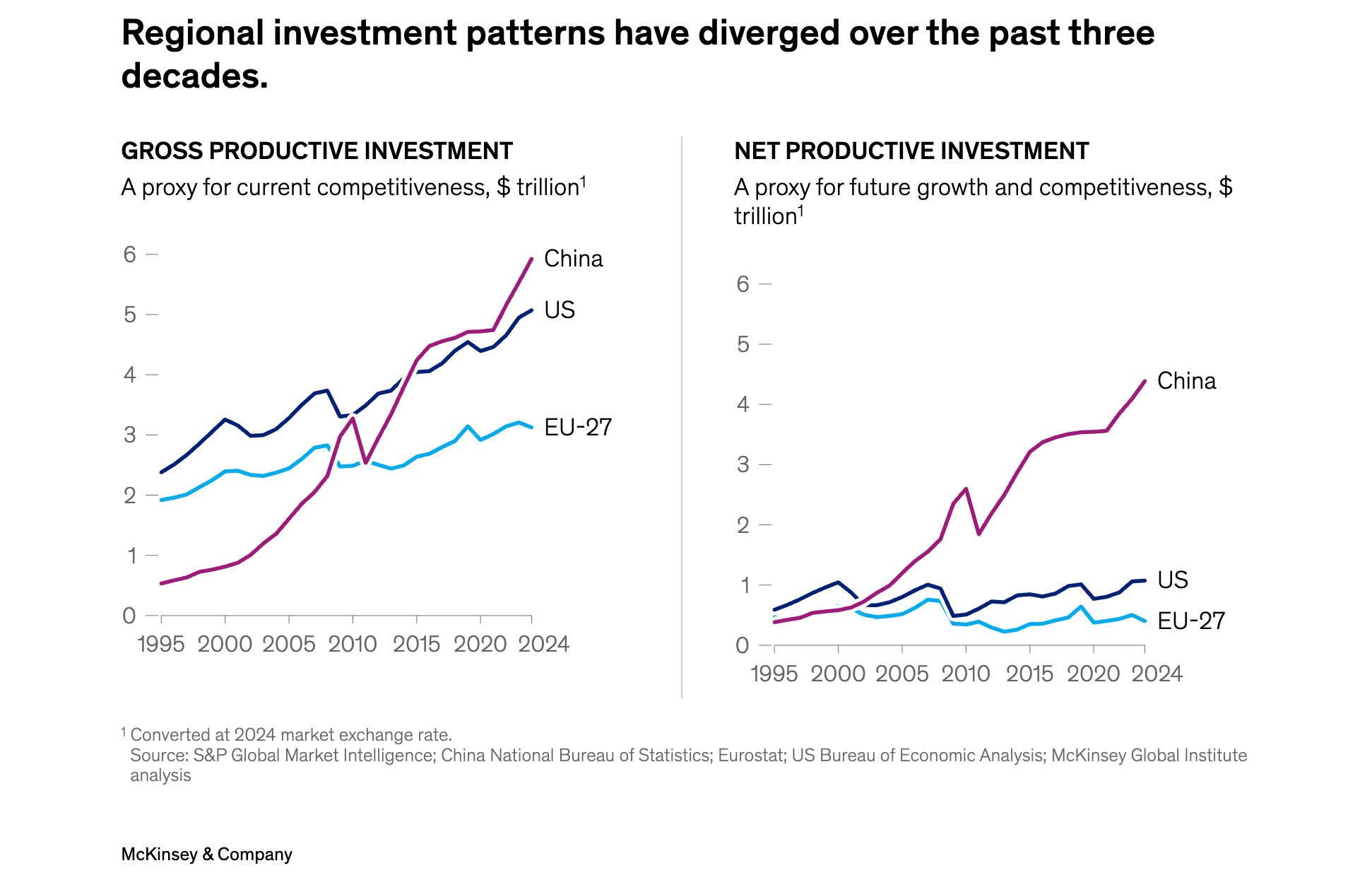
Gross and net productive investment, China, US and EU-27, 1995-2024, $ trillion at 2024 exchange rates. Source: McKinsey Global Institute
The three regions invested roughly equal net amounts in 1995. China now generates just under a fifth of global gross value added but takes more than a quarter of global productive investment, including about three-fifths of all money invested in machinery worldwide, close to half in electronics such as batteries and chips, and 44% in basic manufacturing such as steel. Most of it is funded from domestic savings rather than global markets, and it is laying the ground for the second export shock now hitting Western industry.
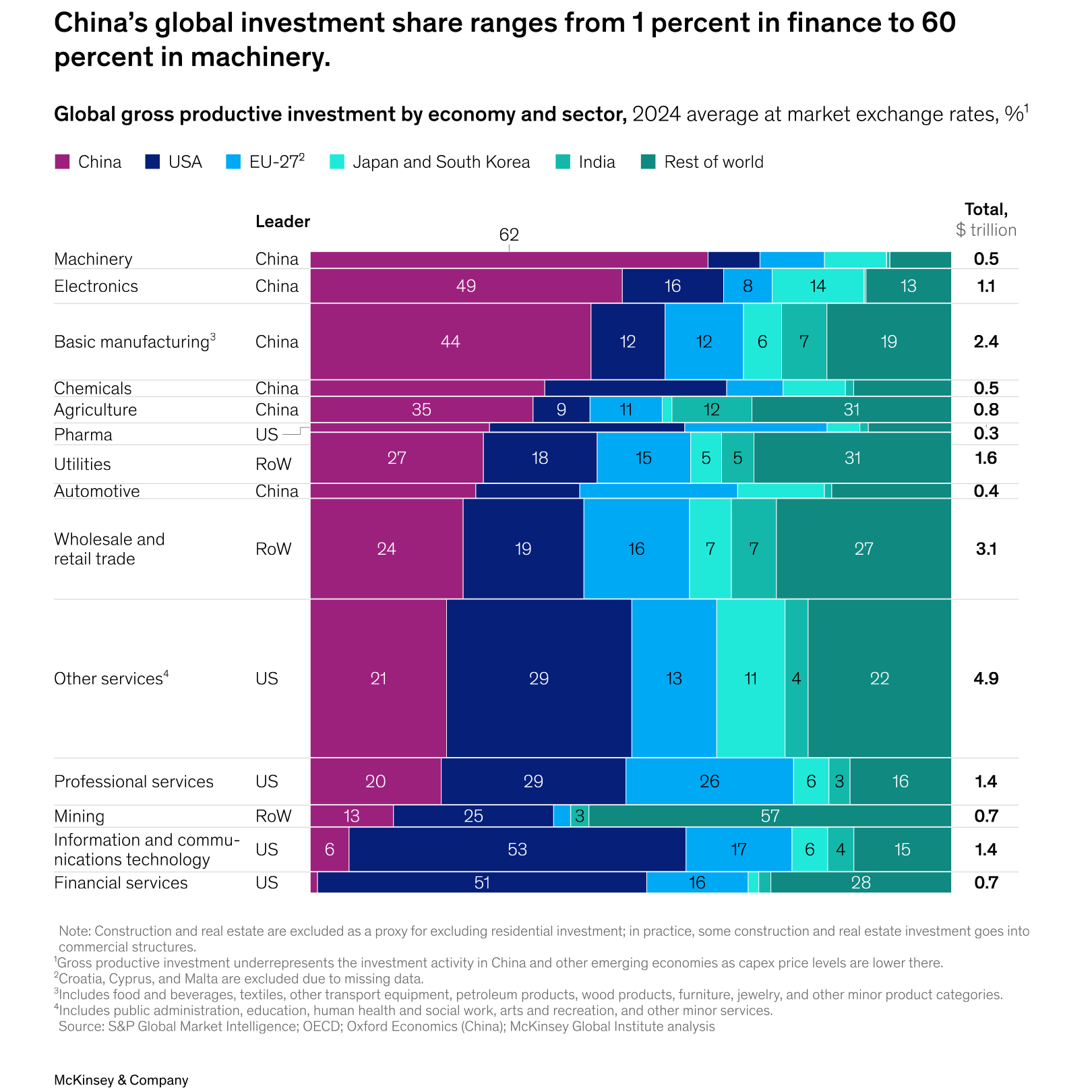
Global gross productive investment by economy and sector, 2024, % at market exchange rates. Source: McKinsey Global Institute
China holds 1.7 times as much productive capital relative to the size of its economy as the EU or the US, and gets about 40% less output from each dollar of it. Chinese battery makers complain they can no longer turn a profit, and Beijing has adopted policies against neijuan, or "involution", the term used in China for the diminishing returns of excess capacity.
Total productive investment in China stopped growing in 2025, though spending on energy and utilities rose by almost 10% and investment in high-tech industries such as cars, rail, aerospace and shipbuilding grew by about 15%. State-owned companies have taken over as the engine: they expanded investment by 9% a year in 2021-2024, against 1% for private enterprises, reversing the 2017-2021 pattern, when private investment grew by 7% a year and state investment by 4%.
China's capital stock per worker, at roughly $80,000, is still far below the $340,000 in the US and $150,000 in Europe. The authors point out that averages count for little at the level of individual factories, which are state-of-the-art wherever they are built.
America bets on AI
The US has shifted its investment into software, R&D and the AI value chain. Seven AI-related companies raised their combined capital spending and R&D 50-fold in two decades, from $15bn in 2005 to close to $750bn in 2025, and their investment could approach $1 trillion by the end of 2026. The US takes 53% of global investment in information and communications technology and 51% in financial services.
The AI boom has not yet spread to the rest of the economy. Investment in data centre structures has risen by 200% in the three years since ChatGPT launched at the end of 2022 and broader technology investment by 50%, but total US productive investment has stayed flat as a share of GDP because spending elsewhere fell. Addressing the most critical US import dependencies could take about $2 trillion of additional manufacturing investment, equivalent to about 6% of GDP.
The price of building in the West
The study traces the gap to the business cases behind ten types of project, from solar farms and steel mills to chip fabs and drug development. Levelised costs in Europe and the US are generally at least 50% higher than in the countries attracting the most investment. In manufacturing the gap with China is about 50%, driven mainly by wages that are not matched by higher productivity, and in R&D it is closer to 300%.
Labour costs in the US and western Europe are typically two to three times those in mainland China and Taiwan, and up to ten times higher for blue-collar steelworkers, while the output of a state-of-the-art plant is much the same wherever it stands. Developing a new electric-vehicle platform costs a German legacy carmaker about $1,600 per vehicle, against $445 for a Chinese EV maker, which takes 21 months to develop one rather than 48. A new nuclear reactor in France produces power at $190/MWh, triple the cost in China.
Speed counts too. Obtaining a non-residential construction permit takes about 200 days in Germany, against about 60 in the US, 40 in mainland China and 30 in India. Industrial electricity in Germany costs about $190/MWh including grid charges and taxes, against an average of $90 in China and $80 in the US, and LNG-dependent Europe paid three to four times US gas prices in 2022-2025. The gap widened to five times after the closure of the Strait of Hormuz in March 2026. Europe has lost close to 40mn tonnes of petrochemical production capacity since 2022.
Closing the gap
A what-if scenario in the report, combining a 30% productivity boost, convergence of equipment, energy and materials costs, and the adoption of "China speed", would close 50% to 70% of the cost gap for the US and 30% to 60% for Europe. The authors propose seven levers, from faster permitting and industrialised construction to cheaper energy, specialisation in less cost-sensitive industries and a rethink of industrial policy.
OECD research cited in the report finds that subsidies to European firms averaged less than 0.5% of revenue in 2005-2024, against about 1% in North America and about 2.5% in China, where chip fabs receive about 10% of revenue against 2% to 3% in the US and Europe. The IMF estimates that China's real effective exchange rate was undervalued by 12% to 21% in 2025, a finding Beijing contests.
"In a fracturing world, competitiveness matters more than ever. Restoring it where it is lacking will require real change from governments and companies on multiple fronts," the authors concluded.
Unlock premium news, Start your free trial today.


