
Tisza victory puts Hungary back on a European path, within limits


Chants of “Europe, Europe, Europe” rose from the banks of the Danube as the final results in Hungary’s historic election were released. Opposition leader Peter Magyar won by a landslide, putting Hungary on a new course that will bring it back closer to Europe, but under a still nationalistically orientated government.
Magyar stood in front of the Hungarian Parliament in Budapest to accept the adulation of the crowds that turned out in record numbers to elect his Tisza party. He promised the voters that change was coming.
"The Hungarian people said a firm and resounding yes today that whoever divides the people must leave power. The Hungarian people said yes to Europe, to a free Hungary, to putting the country in order."
"We want to make a country where no one is persecuted because they think differently or because someone loves in a different way to others," Magyar said in a victory speech.
Magyar says his first trip as prime minister will be to Warsaw. Then to Vienna. And then to Brussels. He promises that Hungary will join the European Public Prosecutor’s Office (EPPO), a key step to unblocking over €17bn in EU funds.
Magyar: “Hungary will once again be a strong ally in the European Union and with Nato. Hungary will once again be a strong ally representing Hungarian interests, because our country's place is in Europe.”
The two-thirds majority Magyar won not only brings outgoing Hungarian Prime Minister Viktor Orban 16-years rule to an end, it also gives Tisza the constitutional power to undo many of the laws Orban put in place and sacks his Fidesz cadres he placed in all levels of the bureaucracy to take back complete control of the government.
Peter Magyar's election promises:
- The Prime Minister position can be held for two terms, i.e., eight years.
- Orban will be considered to have exceeded this limit, and a political ban will be imposed on Orban.
- A Ministry of Anti-Corruption will be established.
- Past public procurement contracts will be investigated.
- Relations with the EU will be normalized.
- The European Public Prosecutor's Office will also be established in Hungary, which should release €17bn of frozen EU funds.
- Compliance with the rule of law will be restored with the EU.
- The state of emergency, first declared due to illegal migrants by the Orban government, then maintained on the grounds of the pandemic and the Ukraine war, will be lifted.
- The cadres of Fidesz (Hungarian Citizens' Union party), alleged to have been placed in state institutions, will be removed from their positions.
- Special tracking units and investigative prosecutor's offices will be established to recover the national assets alleged to have been transferred to Fidesz circles.
- The news department of the state television will be dissolved.
- State radio and television will be restructured for independent broadcasting.
Pro-Europe?
Well MEP's across Europe must be saying a deep breath of relief at the end of the Orban era, it's still not clear how pro-European the new Prime Minister will be.
Magyar will be forced to make some compromises with Brussels if he is to get the €17bn of frozen EU funds released, imposed for Hungary’s democratic backsliding on the judicial system.
“Tisza will bring home the EU funds. To unlock them, we will have a completed RRP [a plan that governs payments under the EU’s post-Covid recovery fund] by the end of August. We will discuss with EU partners how best to deliver it, also in light of the election results and what we find after Fidesz, once in government,” said Márton Hajdu, Tisza's EU affairs chief told Politico. More EU-inspired reforms will be needed to secure the €10bn allocated to Hungary under the EU’s post-Covid recovery funding before an August 31 deadline. EU's Commissioner for Budget, Anti-Fraud and Public Administration Piotr Serafin made it clear: no reforms, no money.
While Magyar has promised to normalise relationships with Brussels, and undo many of the laws that the previous administration put in place, Tisza remains a nationalist party with a “Hungary Frist” agenda.
Support for Ukraine?
Where Magyar stands on Ukraine is one of the key unanswered questions. Orban has blocked both Ukraine’s accelerated EU accession bid and also the release of the €90bn EU loan agreed last December. It is unclear where Tisza stands on these issues.
Ukrainian President Volodymyr Zelenskiy congratulated Magyar on his victory. He also announced that on April 13 the repairs on the Druzhba oil pipeline in Ukraine, which has been offline since the end of January after a drone attack, will be completed and oil flows will resume.
“Ukraine has always sought good-neighbourly relations with everyone in Europe, and we are ready to advance our cooperation with Hungary,” Zelenskiy wrote on his social media account. “Europe and every European nation must get stronger, and millions of Europeans seek cooperation and stability. We are ready for meetings and joint constructive work for the benefit of both nations, as well as peace, security, and stability in Europe.”
Orban blocking the €90bn EU money after the pipeline was shut down. “No oil, no money,” he told Kyiv, which has been dragging its heels on repairs as part of its effort to cut the Kremlin off from oil export revenues.
Magyar has also promised, as part of his campaign platform, to continue imports of Russian oil and gas as a question of Hungarian national security, which will put him on a collision course with Brussels that has already cut off oil imports and intends to ban imports of Russian gas completely by January 1 next year.
Magyar’s deputies have also voted against accelerated Ukrainian membership for the EU and is against sending more arms and money to Ukraine. And Tisza voted against the €90bn EU loan during the EU summit in December.
At this point it is not clear if these positions were pre-election posturing in order to defend against Orban’s virulently anti-Ukraine campaign strategy, or if they are genuine policy positions that Magyar will continue to hold.
For Ukraine, the question is existential. Orban has tied up the EU loan for months but without that money the government in Kyiv is looking at a macroeconomic collapse within only a few months. The government is running desperately short of cash. So far, it's only received $1.5bn from the IMF and the rest of the $8.1bn The IMF’s 48-month $8.1bn Extended Fund Facility (EFF) program is in doubt as a political crisis has riven Ukrainian lawmakers who are refusing to push through many of the reforms required by the IMF to continue its programme.
As a short stop solution, the Nordic countries have suggested issuing a €30bn loan on a bilateral basis to tide Kyiv over, which would take it to September. Brussels will have to haggle with Magyar, who can be expected to use his leverage in order to win more concessions for Budapest.
Overwhelming support in biggest cities
Magyar won thanks to overwhelming support in the biggest cities where voters turned out in their droves to vote for Tisza.
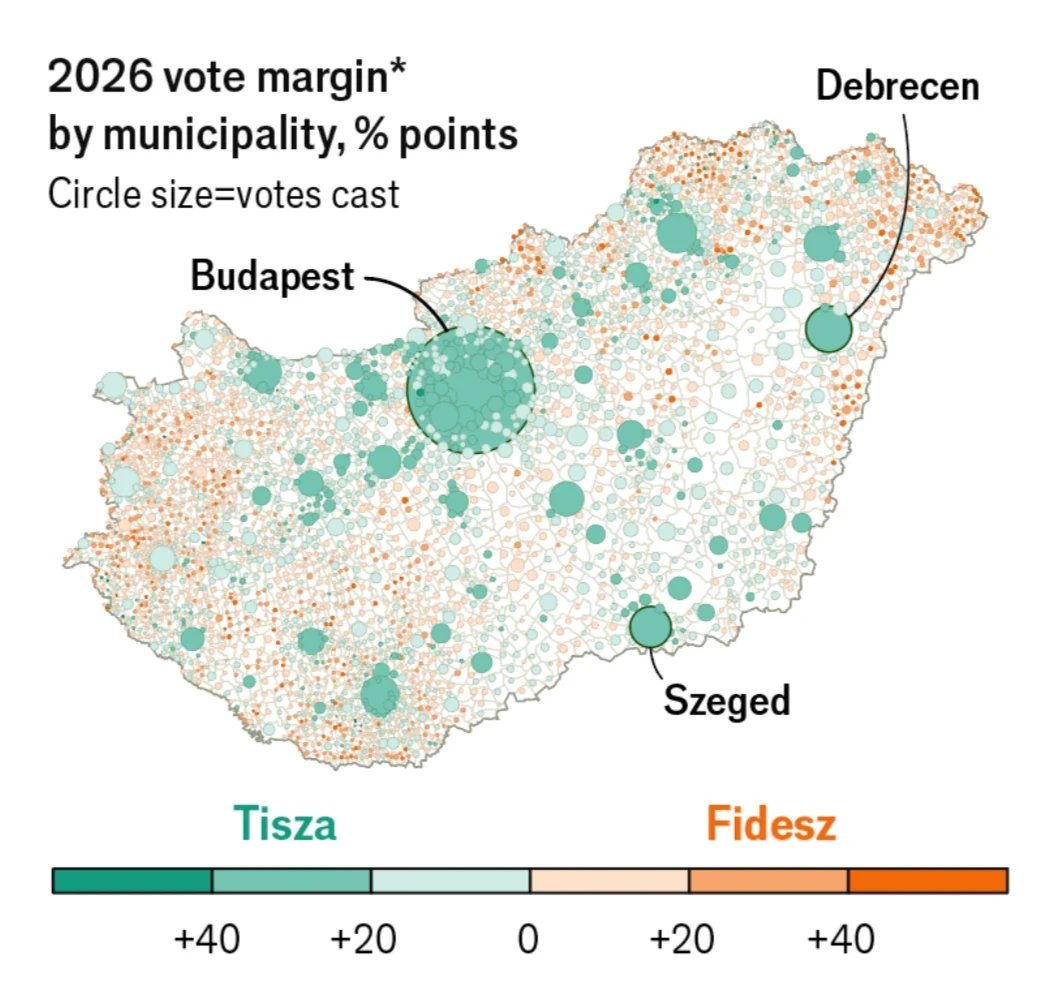
Voting in the biggest cities:
Budapest – Tisza 33%
Debrecen – Tisza 23%
Szeged – Tisza 39%
Miskolc – Tisza 29%
Pécs – Tisza 31%
Győr – Tisza 25%
Nyíregyháza – Tisza 31%
Kecskemét – Tisza 25%
Székesfehérvár – Tisza 22%
Szombathely – Tisza 19%
Érd – Tisza 26%
Szolnok – Tisza 29%
Unlock premium news, Start your free trial today.


