
The Greater Israel theory is a complete farce


As Israel approved a record number of West Bank settlements and the IDF ground operations in southern Lebanon persist, rumours have exploded into the public consciousness about a plan for Greater Israel, partly thanks to Elon Musk's X platform which, seems to be pushing the narrative.
This claim is rooted in the belief that Israel’s ground incursion into Lebanon, as well as its previous invasion of Gaza as part of the war sparked by the Hamas October 7 attacks, forms part of Prime Minister Benjamin Netanyahu’s plan to expand Israel’s borders and create a “Greater Israel.”
In order to determine whether there is any validity to this belief, two issues must be addressed. The first is what the concept of “Greater Israel” actually is. The second is whether or not Israel’s military actions do indeed indicate that the plan for a “Greater Israel” is being actively pursued.
What is Greater Israel?
The idea of Greater Israel is rooted in a biblical verse within the Old Testament, namely Genesis 15:18-21. In this verse, it is written that the land that was designated to Abraham (the father of the Jewish nation) expands “from the brook of Egypt to the Euphrates.”
Below is a map that indicates the size of Greater Israel as defined in the biblical passage:
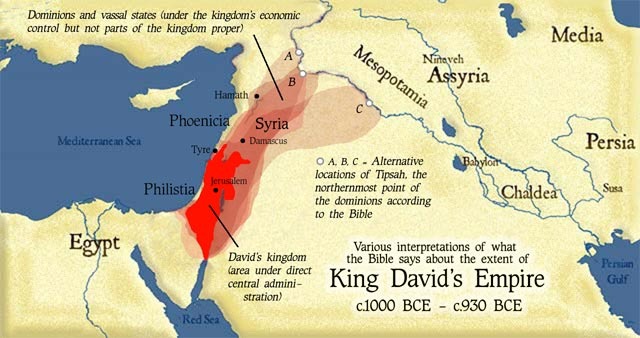
Electionworld (CC BY 2.0)
It is important to note that when the United Kingdom of Israel (1047–931 BCE) was established, its borders differed significantly from those of Greater Israel. See the map below for reference:
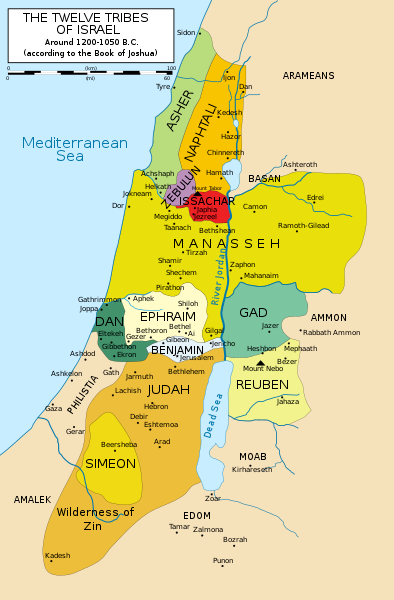
Janz (CC BY-SA)
In approximately 930 BCE, the unified Kingdom was split into two due to political infighting. Yet even during the existence of the Kingdom of Judah (the southern kingdom) and the Kingdom of Israel (the northern kingdom), neither occupied all of the lands as described in the initial Greater Israel biblical passage. Instead, the previously unified Kingdom of Israel was split into two.
Now that the land encompassing Greater Israel has been defined, it’s time to determine whether the Israeli military’s actions constitute a plan to establish a Greater Israel.
Is the IDF trying to establish Greater Israel?
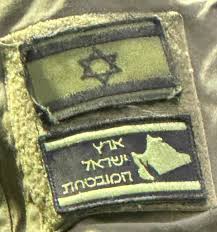
What about that badge floated on X and other social media platforms in recent months? It says in Hebrew, "The Land of Israel is guaranteed." Yes, it is true that it is a real badge, but it doesn't mean that because of a historical map, Israel is hell-bent on wiping out Jordan and Iraq. See it as a power projection. Probably nothing more than that.
During the ongoing Lebanon war with Hezbollah, troops in the Israel Defense Forces (IDF) have taken up positions in southern Lebanon.
This appears to be a repetition of the Israeli military’s decision to establish a security zone near the Israel-Lebanon border during the previous Israel-Hezbollah clashes, which ended with a ceasefire in November 2024.
While Israel consequently performed a partial withdrawal, specifically pulling out of populated villages in southern Lebanon, the Israeli government confirmed that it would retain a presence in five strategic areas along the Israel-Lebanon border.
They included the Hasullam, Hashaked, Hatzivoni, Jabal Blat, and Hamamis mountain ranges, as depicted in the map below.
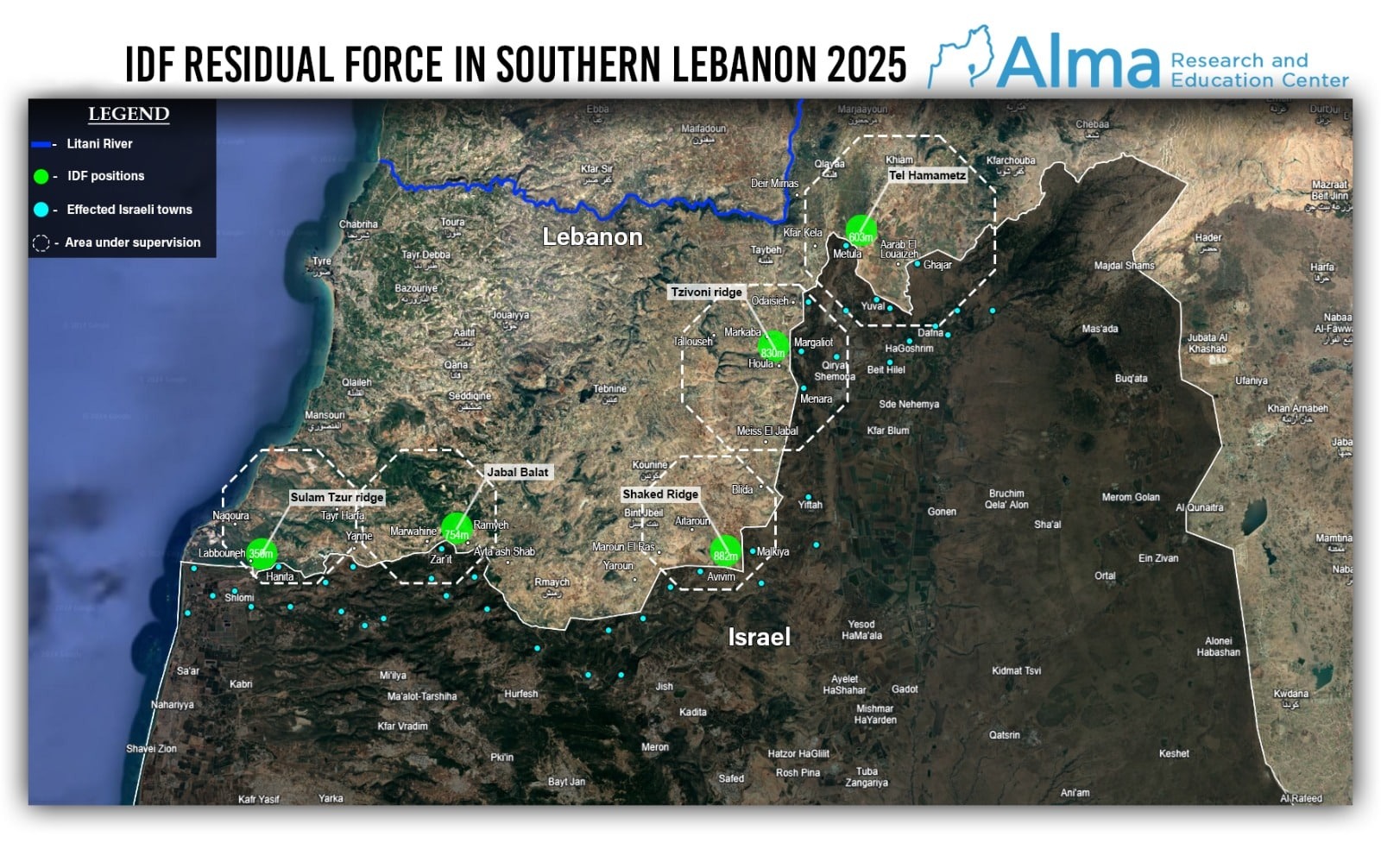
CC: Alma Research and Education Center
This approach closely mirrors the IDF's activities in Syria one month later, after the toppling of the Assad regime. As explained in a separate IntelliNews article, the IDF created a buffer zone within Syria, particularly within the disputed territory of the Golan Heights. To this day, an IDF presence remains within the UN-monitored buffer zone within the Golan Heights.
But while sceptics may view Israel’s actions in Syria and Lebanon as a potential land grab (even though it holds small, strategic territories), the IDF’s track record disproves this theory.
History indicates Israel’s intentions
Perhaps the greatest example of the Israeli military’s occupation of foreign territory came in the Six-Day War in 1967. During the conflict, Israel successfully repelled Egypt’s forces in the south, with the IDF establishing control over Gaza as well as all of the Sinai Peninsula, up to the east bank of the Suez Canal.
On June 7, 1967, the UN Security Council called for a ceasefire, which Israel and Jordan, another adversary in that conflict, accepted. Egypt accepted the ceasefire the following day, after which Israel returned the Sinai to its neighbour in its entirety.
While Israel maintained security control over the Gaza Strip, it withdrew from the territory entirely in 2005.
During the Yom Kippur War in 1973, Israel seized an additional 165 m2 to what it already held in the disputed Golan Heights while taking an area on the western side of the Suez Canal, which was Egyptian territory, During the post-war negotiations which led to the 1979 Peace Treaty, Israel withdrew from the new territories it seized in the Yom Kippur war, returning them to Syria and Egypt.
Israel’s true agenda
With IDF troops currently on the ground in Lebanon, Israel currently finds itself in a similar position to what it was in following the 1967 and 1973 wars.
On April 14, Lebanon and Israel are preparing to engage in preliminary talks, during which they are expected to lay the groundwork for direct ceasefire negotiations.
It appears as if Israel’s strategy in Lebanon closely mirrors that of both the Six-Day War and the Yom Kippur War. If history is any indication, Israel appears to be holding territories in southern Lebanon as a bargaining chip, ready to secure a deal with the Lebanese government on favourable terms.
It’s important to remember that while the Lebanese government has expressed its opposition to Hezbollah, declaring the group’s activities illegal while seeking to establish state control over weapons, the Lebanese Armed Forces have been ineffective at diminishing the Shi’ite militia’s control.
By holding Lebanese territory and continuing its ground campaign against Hezbollah, Israel appears to be readying itself for negotiations aimed at securing peace with the Lebanese government while seeking to isolate and diminish Hezbollah, given that both the Israeli and Lebanese governments view the group as a common enemy.
So what is the story?
Israel is defending its borders due to bad actors around it, namely Hezbollah to the north and Hamas to the south, which has embedded itself as a little fiefdom on the northern border of the Jewish state.
The actual Lebanese state has weakened over the years of scuffles and infighting between internal and external actors. If Lebanon had a substantial army that could supersede the Iran-backed group and secure the southern border, it would be likely that Israel would return south.
Unlock premium news, Start your free trial today.


