
Tajik government finds that being party pooper is profitable


A court in northern Tajikistan recently fined a 29-year-old man over $12,000 for celebrating his birthday at his own café.
It’s the latest case of a prosecution under the country’s “regulation of traditions, celebrations and rites” law, Current Time TV, a service of Radio Free Europe/Radio Liberty, reported.
The law mandates that Tajiks can only celebrate their birthday with family members, with no non-relative guests allowed.
Fines under the law are common in Tajikistan, but Amirdjon Kholmatov’s case stands out due to the size of the 117,000-somoni fine, Current Time reported. The average Tajik would have to work for years to pay it off in a country where the average monthly salary is 3,136 somoni, or about $314. In the past, typical fines for excessive birthday celebrations have run around $500.
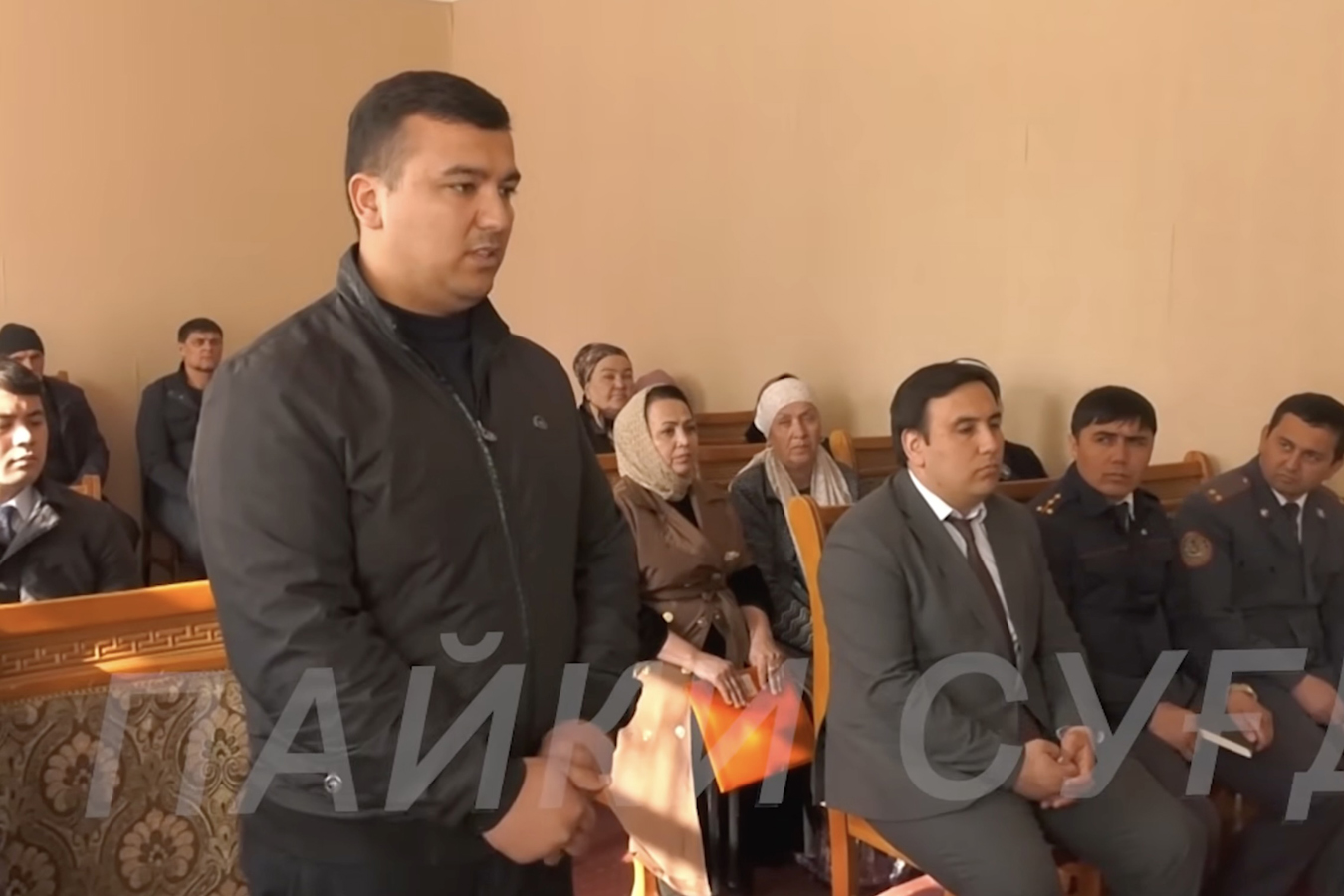
Amirdjon Kholmatov's trial late last month in a Sughd regional court over his "excessive" birthday party was swift and the ruling harsh, Current Time TV reported (Credit: Screenshot from Militsiya Khabar Medikhad/Ministry of Internal Affairs).
Kholmatov assembled several friends in his restaurant for a meal on February 1, but that’s not the offence for which the court fined him. Kholmatov livestreamed parts of the party on social media, where the videos accumulated about 1,500 views, Tajik news outlet Asia-Plus reported. The court fined Kholmatov about 78 somoni, or about $8.20, for each view, the paper said.
The law, adopted in 2007 at President Emomali Rahmon’s initiative, introduced restrictions on a range of celebratory occasions, including birthdays, weddings and funerals. It established steep fines for violations. Rahmon justified the law, arguing it was necessary to rein in out-of-control spending on lavish celebrations in a poor country.
“Some customs and traditions have acquired a negative character in society because of big expenses. They caused wastefulness and did injustice to underprivileged families,” Rahmon said during a speech marking the 10th anniversary of the law’s passage.
Official statistics suggest the average wedding in Tajikistan costs about $1,000, but the media outlet Kursiv estimated that total costs often run seven to 10 times that figure. That's an enormous sum in Tajikistan, and it falls overwhelmingly on the bride's family.
Authorities brought 1,268 cases under the law in 2025, and courts levied $1.16mn in fines, about $740,000 of which were collected, representatives of the Committee for Religious Affairs and Regulation of National Traditions, Celebrations and Rites said at a news briefing in February.
Well-known singer Firuza Hafizova wound up with a $500 fine for celebrating her birthday with friends in 2019, and in 2017, the director of the national library was removed from his post after a court found him guilty of violating the law, RFE/RL has reported.
Though the law, which Tajiks often refer to as the “Tanzim”, might be viewed as just another quirk of Tajikistan’s idiosyncratic governance, it plays a major role in Tajik social life.
“While people generally agreed with the government’s rhetoric, which portrayed ‘ostentatious’ weddings as a sign of backwardness and moral degradation, some illegalised practices persisted and people complained that rather than helping to save money, the tanzim caused them more trouble,” University of Sussex anthropologist Elena Borisova wrote in a 2020 paper.
The law aligns with Tajikistan’s heavy state intervention in citizens’ personal lives and fits a historical pattern. Authorities in Central Asia, from early 20th century Islamic reformers to post-1917 Soviet leaders, viewed lavish ceremonies and the conspicuous consumption that came with them as retrograde, according to Borisova.
The law significantly cut down wedding celebrations from week-long affairs to two events of three hours, capping attendees for most occasions at 150. Only four cars are allowed in the wedding cortège, and gift giving is significantly curtailed.
One of the more controversial aspects of the law are its restrictions on circumcision festivities, which were once comparable to weddings in the country, Borisova wrote. Now, circumcisions must be limited to a small family event.
In 2019, a man in a town west of Dushanbe was fined $567 for inviting 50 guests to a circumcision, Fergana News agency reported.
The fines may serve another purpose in Tajikistan, Central Asia’s poorest state.
“Fines have become quite a good way for the authorities to replenish the budget,” Sharofiddin Gadoev, an Amsterdam-based opposition leader, told Current Time TV.
The parliament passed a series of amendments in 2017 and 2024 that significantly strengthened the law’s scope and penalties.
Other countries in Central Asia have gotten in on the act too. In 2019, Uzbekistan capped the number of wedding attendees at 200 and confined the festivities to one day, ending at 11:00 p.m. Those rules were tightened again last year.
As for Kholmatov’s birthday bash, Current Time TV reported that he did not comment on whether he would appeal. The Ministry of Internal Affairs said the hefty fine was warranted as such “demonstrations could lead to imitation.”
Alexander Thompson is a journalist based in Bishkek, Kyrgyzstan, reporting on current events across Central Asia. He previously worked for American newspapers, including the Charleston, S.C., Post and Courier and The Boston Globe.
This article first appeared on Eurasianet here.
Unlock premium news, Start your free trial today.

.jpg)

