Romania’s retail sales up 0.9% y/y in August, driven by stronger fuel and non-food sales


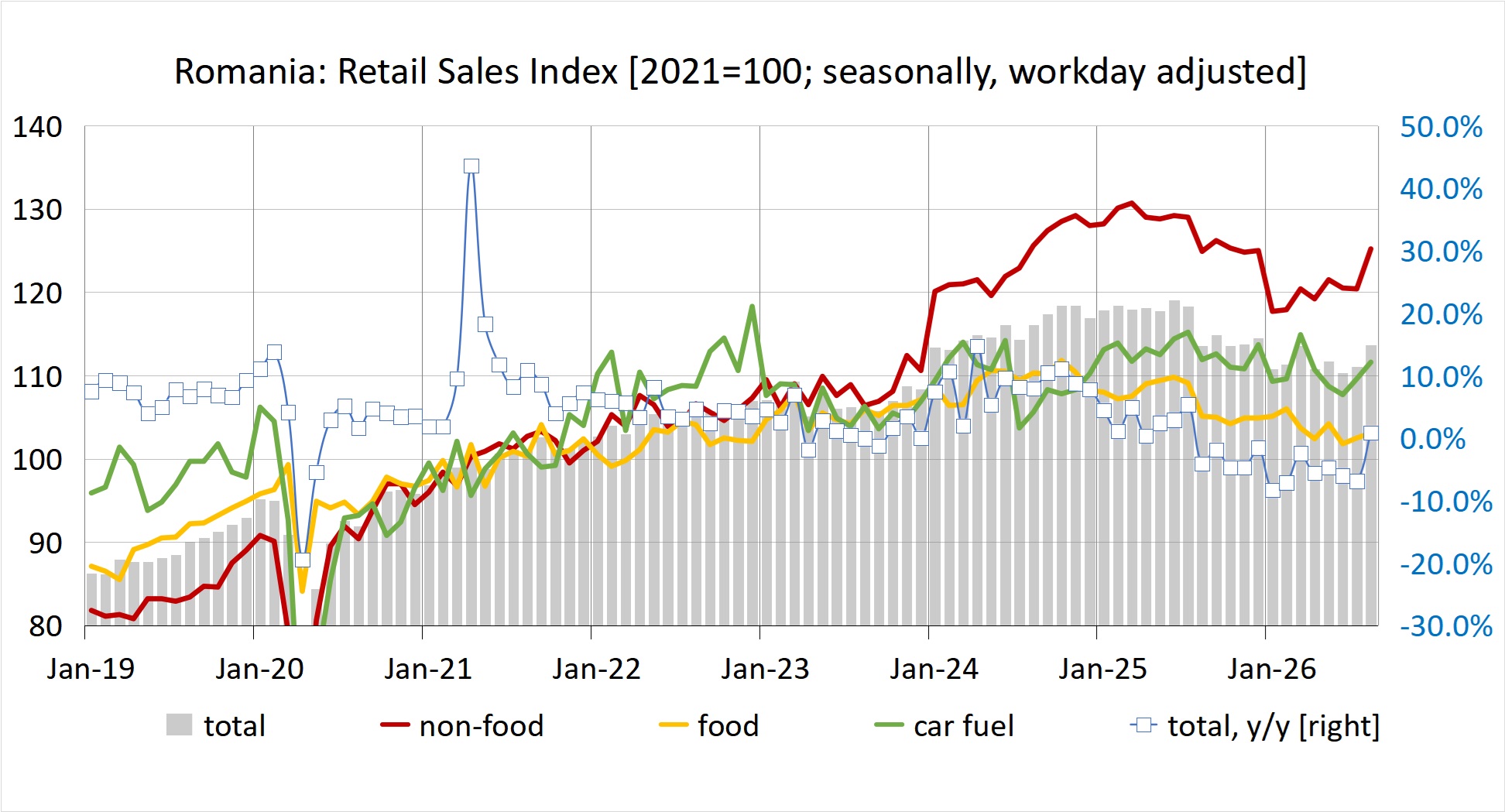
Romania’s retail sales rose 0.9% year on year in August (chart), supported by stronger fuel and non-food sales, according to data published by the National Institute of Statistics (INS) on October 6, pointing to a tentative stabilisation in private consumption more than a year after the VAT rate increase.
“Consumption is starting to show a clearer improvement in the third quarter, supporting our view that consumer spending should strengthen somewhat in the second half of the year,” according to a research note published by Erste Group.
Fuel sales increased 2.5% year on year in August, while non-food sales rose 2.7%. Food sales, which are more closely linked to household budgets, fell 2.3%.
Retail sales also increased 2.3% month on month in August, following a 0.7% advance in July. The two-month recovery was, again, concentrated in fuel and non-food sales -- which increased 3.6% and 3.9% respectively, while food sales rose 1.3%.
The monthly improvements in July and August could indicate some recovery in consumer spending, but the recent gains remain insufficient to establish a sustainable trend, particularly given the weakness recorded since the VAT rate increase in August 2025.
Retail sales were 4.7% lower in the 12 months to August 2026 than in the 12 months to July 2025, before the VAT increase. Food and non-food sales both declined by around 5%, while fuel sales fell 3%.
The correction in consumption is consistent with weaker household purchasing power. Real wages were 5.2% lower in the 12 months to July 2026 than in the 12 months preceding the VAT increase, according to the latest available wage data.
The high-frequency retail data also show divergent trends between spending categories. Non-food sales, which include a larger discretionary component, fell sharply after the VAT increase and again after the Christmas shopping period, before gradually recovering during 2026. Food sales have instead followed a more persistent downward trend, with the July-August improvement coming from a low base.
Car fuel sales have also followed a slow downward trend, with the high wages making an impact in June followed by subsequent recovery in July and August.
Private consumption is expected to strengthen in 2027, supported by the planned January indexation of public-sector wages and pensions and lower inflation. However, higher utility costs during the winter, elevated energy prices and uncertainty over economic growth could limit the scale of the recovery.
Base effects could produce relatively strong year-on-year consumption growth in the first half of 2027, although the underlying strength of household demand remains dependent on the evolution of real incomes.
Unlock premium news, Start your free trial today.


_1_1.jpg)