
Romania’s central bank tweaks inflation outlook


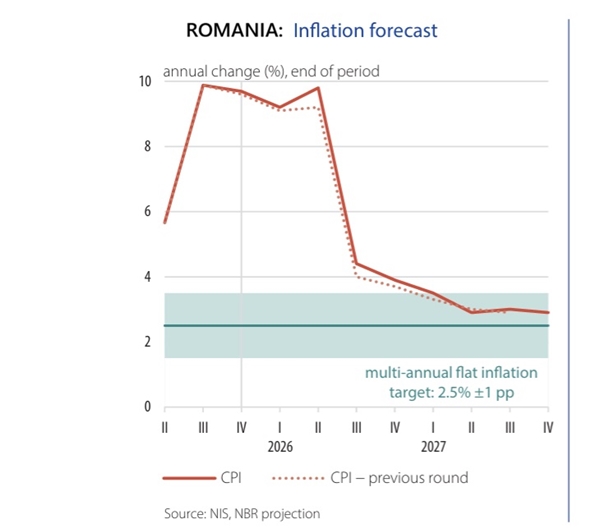
Romania’s central bank slightly revised its inflation forecast (chart) in the Inflation Outlook published on February 18, maintaining the overall projected trajectory while raising the year-end inflation estimate to 3.9%, from 3.7% previously.
Inflation in the second quarter is expected to come in somewhat higher than projected in the previous forecast round. However, the National Bank of Romania (BNR) anticipates that annual price growth will stabilise at around 3% during the final three quarters of the two-year forecast horizon.
With limited changes to the inflation path itself, BNR Governor Mugur Isărescu used the presentation of the report to address broader issues related to fiscal consolidation and the government’s economic relaunch plans.
Isărescu made remarks broadly favourable to the idea of progressive taxation, triggering a swift and negative reaction from Prime Minister Ilie Bolojan. At the same time, the governor voiced scepticism toward stimulus measures based on long-term subsidies, as envisaged by the government.
He said that experts from the International Monetary Fund (IMF), which he described as having an “almost permanent agreement” with Romania in terms of policy coordination, had recommended that fiscal correction focus on progressive taxation rather than increases in VAT, arguing that such an approach would have generated less inflationary pressure.
Bolojan, in line with the position of the National Liberal Party (PNL), reiterated that introducing progressive taxation is not an option in the short term. He argued that such a reform cannot be implemented in less than a year and that the government is currently focused on improving tax collection capacity, adding that multiple major reforms cannot be carried out simultaneously.
Opponents of progressive taxation also argue that it could discourage work and encourage tax avoidance. Supporters counter that ongoing digitalisation of the fiscal administration would, in fact, facilitate more complex income assessments and that clearer visibility of total household income could also enable more targeted and efficient social support schemes (currently distributed with no differentiation).
Isărescu was also critical of potential subsidy-driven economic stimulus.
“If economic growth means tax incentives again, [if it means] that we can only have economic growth with tax incentives and possibly perennial ones, for 10–20 years, I personally don’t support it,” he said at the press conference presenting the quarterly report.
His comments suggest that while the inflation outlook remains broadly stable, the debate over the mix of fiscal consolidation and growth policies is likely to intensify in the months ahead.
Unlock premium news, Start your free trial today.


