Romania’s economy grows 0.6% in 2025 after sharp Q4 contraction


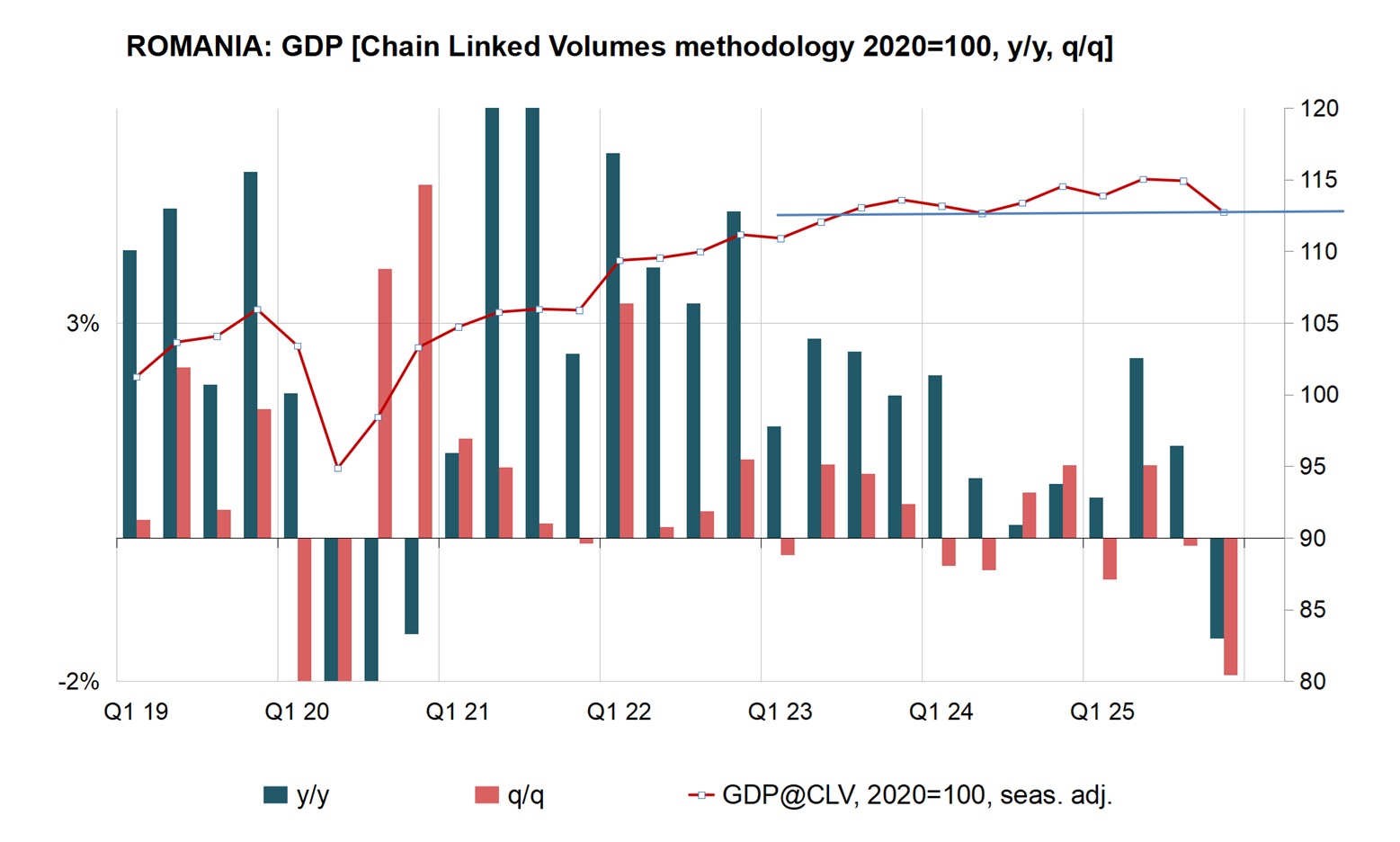
Romania’s economy contracted by 1.9% q/q and 1.4% y/y in Q4 2025, resulting in overall growth of just 0.6% for the full year (chart), according to flash estimates published by the National Institute of Statistics (INS) on February 13.
The fourth-quarter contraction was steeper than expected and has prompted analysts to revise down their forecasts for 2026. At the same time, INS revised Q1 2025 data from a previously reported +0.1% q/q to -0.6% q/q, dragging down the entire chain of seasonally adjusted quarterly readings.
With GDP shrinking for a second consecutive quarter in Q4, Romania formally entered a technical recession at the end of last year.
Following the data release, Erste cut its 2026 growth forecast from 2.1% to 1.0%, while ING lowered its projection from 1.4% to 0.6%. The government’s 2026 budget is based on a 0.8% growth assumption, which appeared cautious when drafted in January but now looks relatively optimistic.
The detailed breakdown of Q4 GDP will be published on March 6. Economists suspect the downturn was driven by weaker private consumption — affecting retail, household services and consumer goods manufacturing — as well as slower public investment, with knock-on effects in construction and capital goods industries.
In seasonally adjusted terms, GDP in Q4 fell to its lowest level in ten quarters.
Over the past two years, Romania’s modest economic expansion has been largely supported by transfers from the EU budget, a pattern expected to continue in 2026 but most likely not in 2027. The debt-generating fiscal deficits have also pushed up the country's economy, with the necessary consolidation generating downward pressures visible since H2 last year.
The economy could contract further in Q1 2026, as many of the headwinds that weighed on activity in the second half of 2025 persist. Higher winter heating bills are putting additional pressure on household budgets, while the public sector operated in January without an approved budget and continues to face expenditure constraints in February.
The latest data revisions have also reignited political debate. The updated seasonal adjustment pattern now shows a technical recession episode in H1 2024. Marcel Ciolacu, the prime minister at that time, publicly accused INS of data manipulation.
The revisions and the reporting methodology remain insufficiently explained, despite an INS statement claiming that all calculations were correct and backward revisions were common to all countries. Complicating matters is that the INS publishes quarterly GDP data using two methodologies: a national methodology based on previous-year prices and the Eurostat-compliant chained-linked series. For instance, under the national methodology, the annual growth rates remained positive in every quarter of 2025 (while turning deeply negative in Q4 under Eurostat methodology), but these figures are not seasonally adjusted. Furthermore, one-off elements — such as pandemic-related statistical effects — require special treatment and may introduce additional volatility into the data.
Unlock premium news, Start your free trial today.