Romania’s inflation remains elevated at 9.6% y/y in January


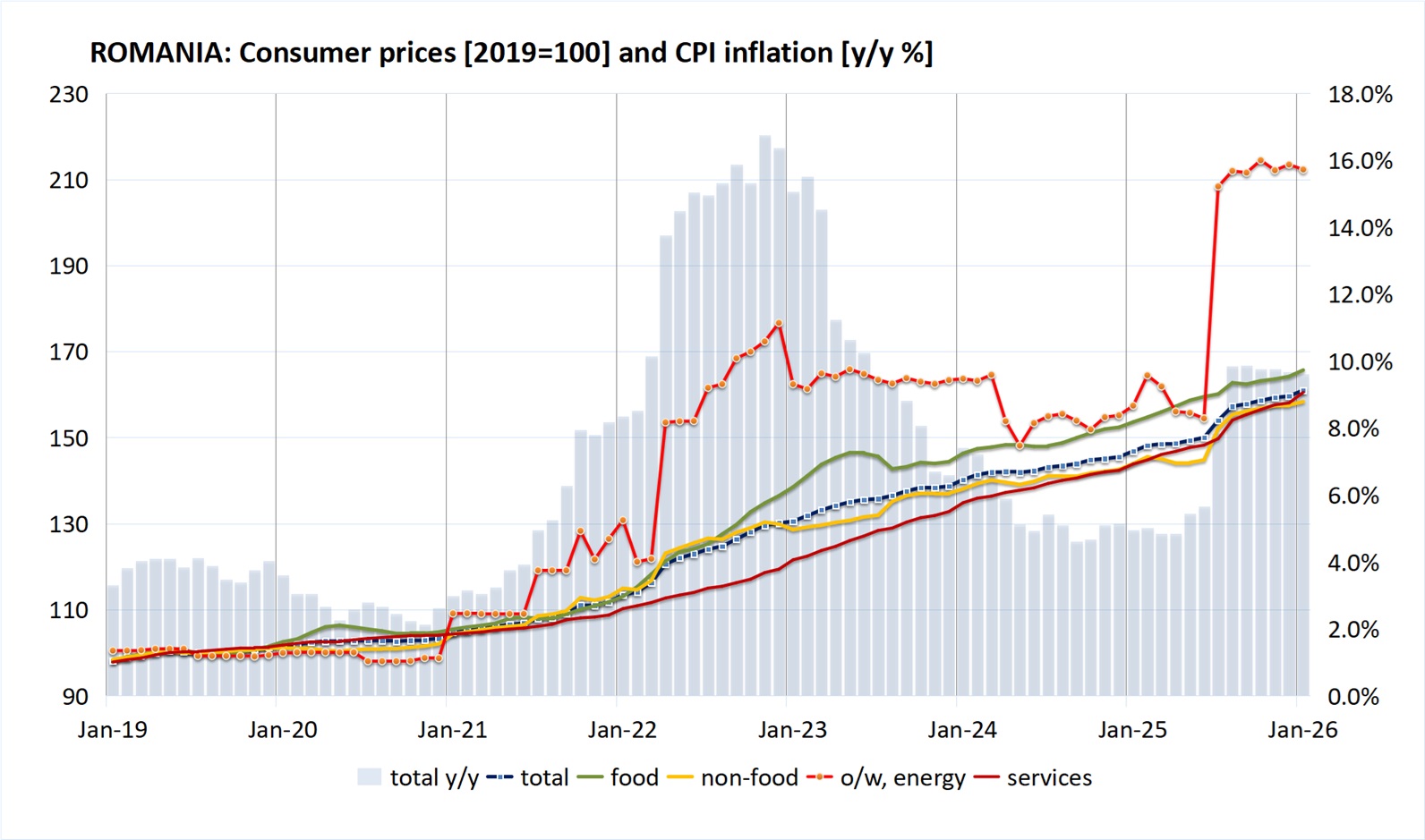
Romania’s annual inflation rate eased only marginally to 9.62% y/y in January (chart), from 9.67% in December, remaining above the Bloomberg survey median forecast of 9.4%, according to data released by the National Institute of Statistics (INS).
The persistent inflation is mentioned by the Fitch rating agency as a rating weakness for Romania. "Inflation has been above the National Bank of Romania's 2.5% +/- 1 percentage points target for five years, and three-year average inflation for 2024-2026 is double the current BBB median," according to the sovereign update this month.
On a monthly basis, consumer prices rose by a steep 0.86% m/m, with roughly 0.26 percentage points of the increase driven by a 9% m/m jump in water utility tariffs.
Core inflation (CORE2), which excludes volatile prices and administered tariffs, held steady at 8.5% y/y. The indicator had gradually climbed from 5.0% y/y in February 2025, when it matched the headline rate.
Food prices increased by 7.9% y/y (+0.91% m/m), while non-food goods were up 10.0% y/y (+0.51% m/m). Services posted the sharpest rise, at 11.6% y/y (+1.56% m/m).
Of the 9.62% annual inflation recorded in January, around 2 percentage points are attributable to the electricity price liberalisation introduced in July, 1.3 percentage points to the VAT rate hike in August, and approximately 0.5 percentage points to higher water service tariffs, which were up 17% y/y. This brings us back close to the 5.66% y/y inflation last June.
Inflation accelerated from 5.66% last June to nearly 10% following the energy market liberalisation and VAT increase. Economists had expected a gradual moderation driven by weaker demand, as real wages declined and consumer borrowing slowed. While retail sales and lending data point to softer consumption, inflation has so far proved stickier than anticipated.
Nevertheless, consensus forecasts still point to a sharp deceleration in the second half of the year due to favourable base effects in July-August. ING and Erste Group expect headline inflation to fall to around 4.4-4.5% by year-end.
The outlook for monetary policy remains cautious. The National Bank of Romania’s (BNR) key rate stands at 6.5%, and analysts broadly expect the first rate cut could come in May, depending on the updated inflation forecast due later this month. Some economists, including those at Libra Bank, believe the BNR may delay the move. Market expectations point to a policy rate of 5.25-5.5% by the end of the year.
Further inflationary risks stem from the planned liberalisation of natural gas prices on April 1, although a commercial markup ceiling mechanism is expected to cushion the impact. The expiry in April of a similar price cap mechanism for certain food products also poses upside risks. However, the Ministry of Agriculture has signalled a follow-up scheme that could effectively extend the current framework for several more quarters, to be triggered if inflation remains high.
Unlock premium news, Start your free trial today.