
Kazakhstan’s service sector suffers most marked decline in new orders in almost four years, shows February PMI


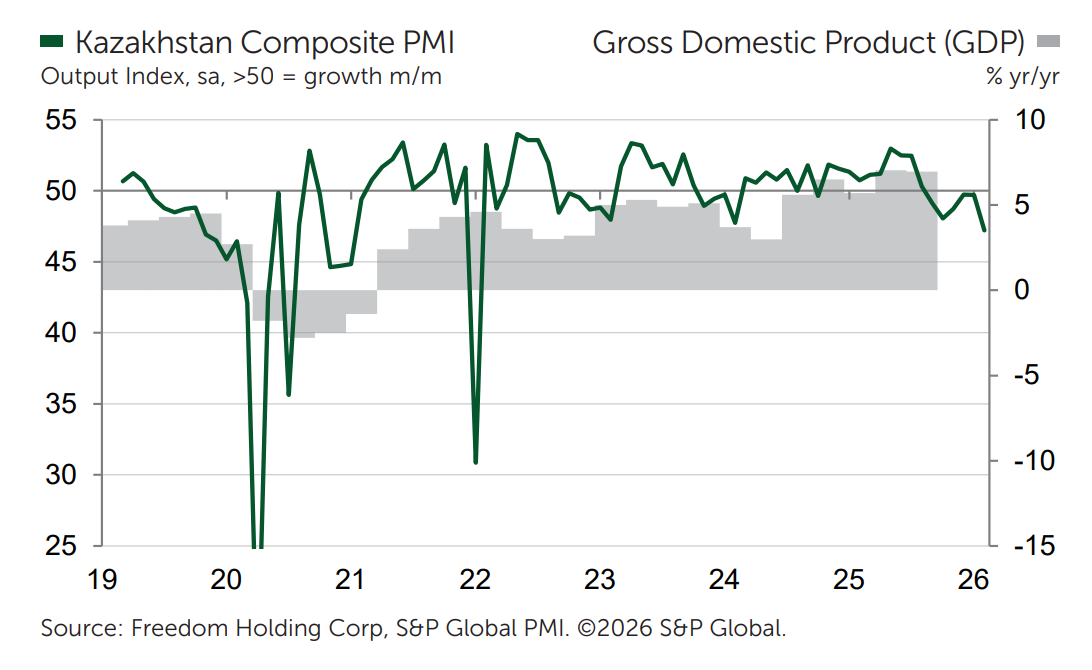
Kazakhstan’s service sector activity declined in February, with the decline in new orders the most marked in almost four years, according to the monthly Freedom Holding and S&P Global Purchasing Managers' Index (PMI) survey.
Companies reported weaker demand and rising costs linked to the January VAT increase.
The Business Activity Index fell to 48.0 in February from 50.5 in January, dropping below the 50.0 threshold that separates expansion from contraction. The reading indicated a modest decline in output, but marked the sharpest deterioration since February 2023. Activity has contracted in four of the past five survey periods.
New business decreased at a similar pace to overall activity.
Firms attributed weaker demand largely to the VAT rise introduced at the start of the year, which continued to drive sharp increases in both input costs and output prices in February, despite inflation easing slightly compared with the previous month.
In response to softer demand, service providers reduced staffing levels, reversing the marginal job creation recorded in January.
Despite the decline in activity and orders, business confidence improved further from the low recorded in December, although overall sentiment remained subdued, the statement noted.
Yerlan Abdikarimov, director of the financial analysis department at Freedom Finance Global, said: "Kazakhstan’s services sector registered the sharpest decline in demand in four years in February.
“While the industry sought to absorb the initial tax-driven shock through margin compression in January, the current reduction in employment and business activity suggests that this internal buffer is likely being exhausted.
"Despite a modest easing in headline inflation, price pressures remain elevated – the negative spread between output and input price growth in 2026 has more than tripled relative to the previous two-year average, underscoring intensifying margin pressures amid weak demand. Nevertheless, 12-month business expectations show moderately positive momentum, suggesting cautious optimism about stabilisation as firms adjust to the new fiscal environment."
Unlock premium news, Start your free trial today.


