
Bombing blitz on Iran has paralysed Russia-to-India sanctions-evading north-south trade corridor


The US-Israel bombing campaign against Iran has disrupted the International North–South Transport Corridor (INSTC).
INSTC primarily involves moving freight from Russia, Azerbaijan, Iran and India via ship, rail and road, but the multimodal infrastructure also plays a growing role in import and export flows dispatched to and from the five countries of Central Asia. Russia in particular has promoted INSTC as a sanctions-era alternative.
Moscow has also been pushing for Iran’s neighbour Pakistan to “join” INSTC, though ambitions to also integrate trade consignments running from and across Afghanistan into corridor use have been disrupted by the conflict that last week erupted between the Afghan Taliban and Pakistan.
Another worry for Russia is that the fierce US-Israeli air and naval campaign directed at Iran will disrupt the North-South trade network to the point that supplies required by the Kremlin war economy in relation to the conflict with Ukraine will become unobtainable.
Moscow, which has invested significant sums in developing INSTC, knows that Iran – like Russia, also skilled in evading sanctions – is critical in connecting Russia to India and other economies for the import of both civilian goods and dual-use items, in other words goods that have both civilian and military uses.
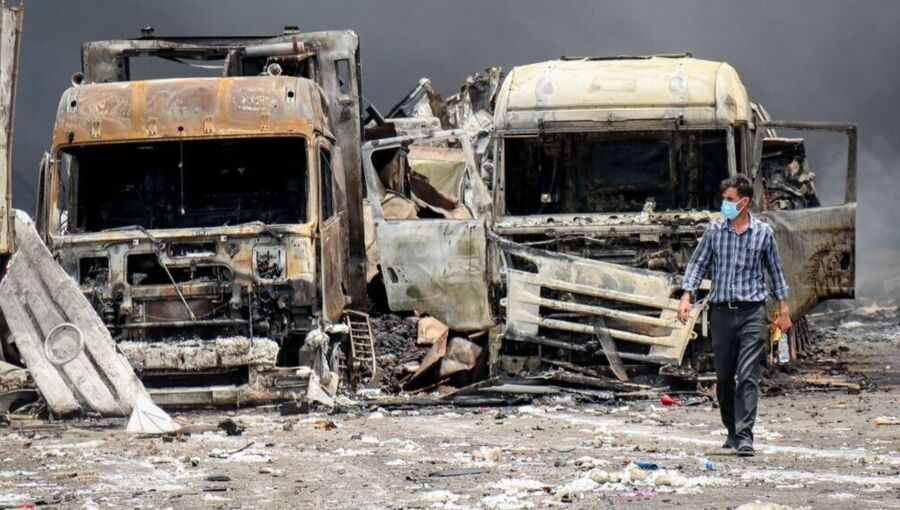
The war devastation in Iran threatens the viability of trucking, rail and maritime transit services that operate to form the INSTC (Credit: Iran Student News Agency).
The seriousness of the situation and the threat to the future viability of INSTC was brought home by Semyon Bagdasarov, a political scientist, who stated in the Russian parliament’s official newspaper: “We can already say that the North-South corridor isn't working,"
On March 2 in Baku, a Russian governmental delegation held talks with their Azerbaijani hosts on moves that can be made to ensure that trade along INSTC keeps flowing.
Eurasianet, meanwhile, noted how just days before the US-Israeli assault on Iran began on February 28, Russia and Iran agreed to start work on modernising an Iranian rail route that would mean a significant expansion of trade volumes between Russia, Iran and the outside world.
The publication also reported on how Kazakhstan’s transport minister, Nurlan Sauranbayev, has said shippers were holding back cargo bound for the Persian Gulf, while adding that the route would remain a strategic priority for Central Asia’s largest economy once the conflict eased.
Kazakhstan, for instance, has paused barley exports to Iran pending ongoing hostilities. Last year, Kazakhstan shipped around 1.2mn tonnes of Kazakh barley to the Iranian market, equivalent to 62% of Kazakhstan’s full-year barley exports.
In Uzbekistan, the investment and trade ministry has opened an emergency support channel for exporters facing route delays, customs problems and payment obstacles due to the Iran conflict.
Longer term, the consequences of the war with Iran could disrupt or even wreck China’s ambitions to develop a southern branch of the “New Silk Road” (also known as the Southern Corridor in contrast to the Middle Corridor running via the Caspian Sea to the north) that would take goods across Central Asia, through Iran and onwards to Turkey and Europe.
Part of this would rely on the $5bn China–Kyrgyzstan–Uzbekistan (CKU) railway that is currently under construction through mountainous Kyrgyz and Chinese territory. Cargo volumes sent along the route to Uzbekistan could transit neighbouring Turkmenistan to enter Iran.
One aspect of the extension of freight transportation would eliminate the need for ferry transport across Lake Van in Turkey. This currently constrains the smooth functioning of the southern transit network.
In 2025, Iran’s Ministry of Roads and Urban Development announced plans to build nine transit railway corridors with a total length of 17,000 kilometres (10,563 miles), at a rough cost exceeding $10bn. Upon completion, Iran’s rail network is expected to handle up to 60mn tonnes of cargo annually. Several of the projects, including the 200-kilometre Marand–Cheshmeh Soraya railway, would be aligned with the Southern Railway Corridor and would position China, Iran and the other countries on the route as offering the shortest trade passage between East and West.
Unlock premium news, Start your free trial today.


