
Iran's business leaders warn internet shutdowns costing up to $80mn a day


Iran's leading business chambers have warned that ongoing internet restrictions imposed during the conflict are inflicting daily losses of up to $80mn on the country's digital economy, with hundreds of thousands of small businesses at risk of collapse, the Iran Chamber of Commerce announced on April 13.
A joint session of the ICT and knowledge-based commissions of the Iran Chamber of Commerce and the digital transformation commission of the Tehran Chamber brought together private-sector figures, government officials, and members of parliament to discuss the damage caused by internet shutdowns.
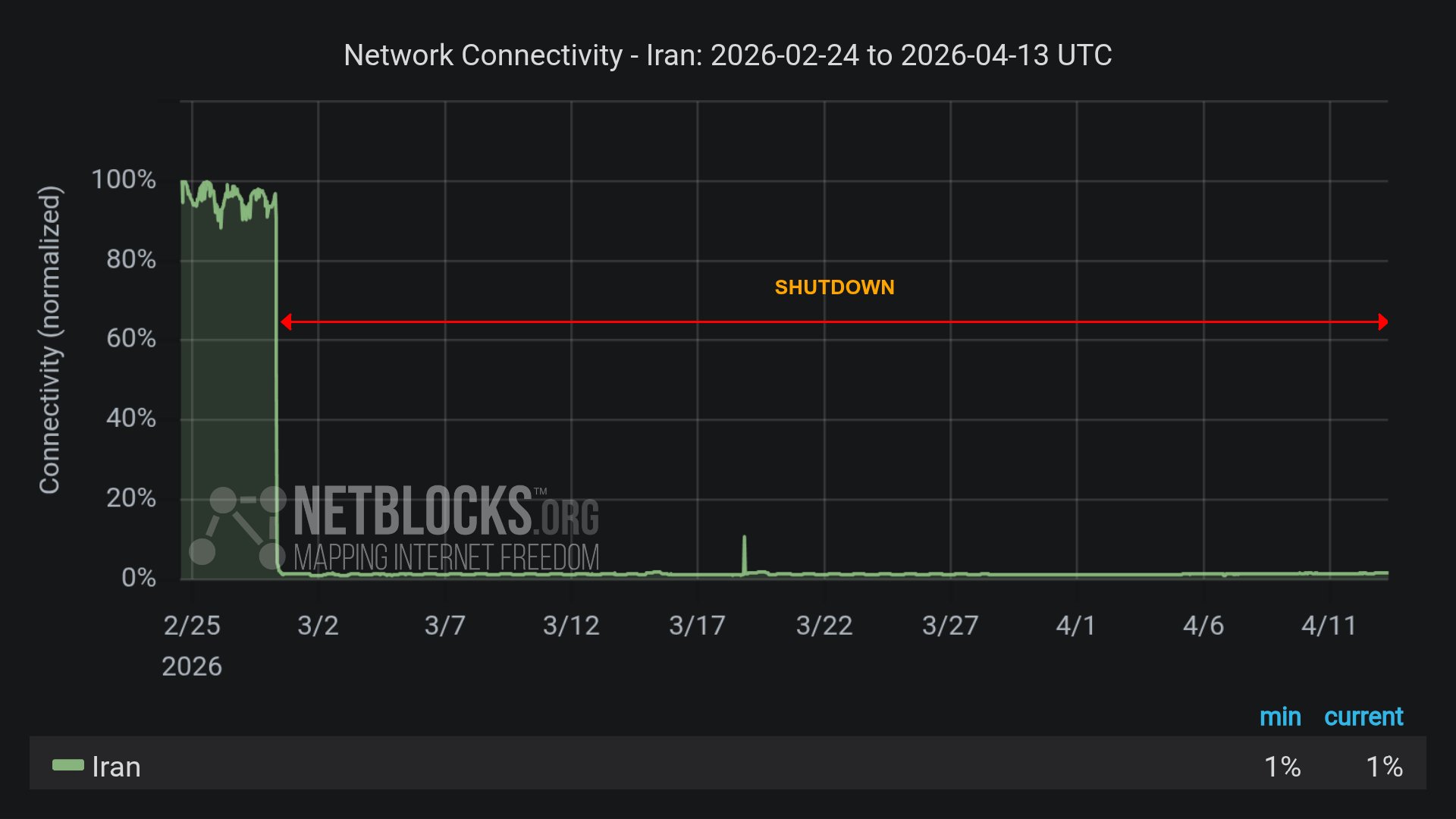
The announcement of damages to the economy comes as Western internet monitoring organisations said Iran has remained offline for 45 days, writing on social media platform X,
"It's now day 45 of #Iran's internet blackout, with international connectivity severed for over 1056 hours. Regime figures and whitelisted influencers post freely on social media while they silence a population of 90 million whom they claim to serve."
Afshin Kolahi, head of the Iran Chamber's knowledge-based commission, said direct losses from internet outages were estimated at $30mn to $40mn per day, with indirect costs reaching $80mn daily.
He compared the scale of destruction to physical infrastructure damage from the war, noting that the cost of rebuilding a destroyed bridge was around $20mn.
"We are witnessing the destruction of several large bridges and power plants every day in the digital economy, but because it cannot be seen, no one seems to care," Kolahi said.
He added that between 300,000 and 500,000 people working in small online businesses faced ruin, with only about 3% of the two to three million workers in the digital economy covered by insurance.
Payam Bagheri, vice president of the Iran Chamber, said the country's economic priorities needed to be reassessed in light of the war. He described the digital economy as the foundation of all other sectors and said recent internet restrictions had increased costs for businesses, reduced productivity and put Iran behind its competitors.
The session also saw sharp criticism of the government's dual approach to internet access. Nourbakhsh, head of the Tehran Chamber's digital transformation commission, questioned why restrictions had not been lifted following the ceasefire. He criticised the sale of so-called "pro" or "white" internet packages to some users while others remained cut off, calling it a form of class-based internet access.
Mohsen Pasha, deputy for security at the National Cyberspace Centre, said the shutdowns were driven by electronic security concerns and that enemy access to information posed a direct threat. He said a directive issued by the late secretary of the Supreme National Security Council, Ali Larijani, had established a process for the private sector to apply for internet access through three channels, including the Iran Chamber.
"The biggest component of Iran's security is its people and social cohesion, and this is even stronger than missile power," Pasha said.
Farshid Shokrkhodaei, head of the Iran Chamber's investment commission, warned that continued disruption would effectively end future private sector investment in IT, given that capital depreciation in the sector already runs at three to four years.
Farzin Ferdis, a board member of the Tehran Chamber, warned against creating "separate worlds" through unequal internet access, saying social cohesion was the country's greatest asset.
The Tehran Electronic Commerce Association called on April 12 for the immediate and full restoration of internet services, saying stable connectivity is "an essential prerequisite for the return of economic prosperity and hope to society", the group said in a strongly worded statement.
The continued disruption to internet services is hitting Iran's growing digital economy, which encompasses ride-hailing, food delivery, e-commerce and online banking.
Millions of Iranians depend on app-based services for daily transactions, and the restrictions have compounded the economic damage from the war itself.
Unlock premium news, Start your free trial today.


