
Four in ten Ukrainians now see a frozen front line as the most realistic end to the war


Some 41% of Ukrainians now consider a settlement in which Ukraine keeps its statehood and independence but suffers forced territorial losses to be the most realistic end to the war, up from 33% in February 2025, according to a survey by the Kyiv International Institute of Sociology (KIIS) published on October 6.
Respondents were asked to pick the scenario they thought possible in the current situation, not the one they wanted. KIIS said that, judging by its other surveys, most people who chose the territorial-loss option had in mind a "freeze" along the current front line, and stressed that the question did not concern formal recognition of the occupied territories as part of Russia.
A combined 53% chose scenarios involving the liberation of at least some territory, down from 60% in February 2025. Some 14% thought a return to the de facto borders of February 24, 2022 the most realistic outcome (16% previously), 4% the recovery of all of the Donetsk and Luhansk regions (5%), 23% the restoration of the 1991 borders including Crimea (25%), and 12% full territorial integrity with the fighting carried onto Russian territory (14%). Another 6% could not say.
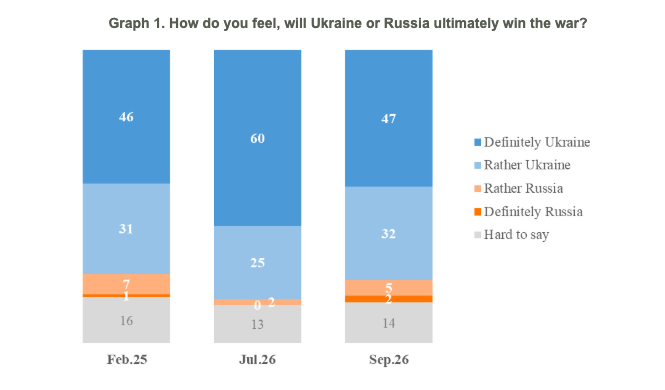
Belief in victory remains high but has become less certain. Some 79% said Ukraine would win the war, 47% of them definitely and 32% probably, while 7% expected Russia to win and 14% were undecided. In KIIS's late July to early August survey 85% believed Ukraine would win and 60% were certain of it.
Three-quarters of Ukrainians, 75%, would accept negotiations with Russia now to end the war, against 21% who would not, a result almost identical to February 2025. KIIS warned that the question covered only the holding of talks and should not be read as support for concessions to Moscow.
Some 69% would support an immediate and complete ceasefire along the current line of contact on condition that Ukraine does not legally recognise the occupied territories as Russian, keeps strengthening its army and continues its course towards the EU and Nato. Another 22% opposed the idea and 9% were undecided.
The conditions matter. In the July-August survey only 32% accepted a withdrawal of Ukrainian troops from Donbas in exchange for abstract US and European security guarantees, while 60% rejected it; when the scenario was a freeze on the current line backed by concrete guarantees in the form of more weapons and financial support, 59% approved. In May, 61% rejected a ceasefire on the current line without security guarantees, KIIS said.
Ukrainians' stated stamina has not changed. Some 62% said they were prepared to endure the war for as long as necessary, 4% for about a year and 23% for a few months to half a year, figures practically unchanged from late July and early August. In Kyiv the share ready to hold out as long as needed was 72%, against 69% in the previous survey, despite the start of Russia's jet-powered drone attacks on the capital.
KIIS noted that the fieldwork took place after the jet-drone campaign against civilian infrastructure had begun, but ended before the strikes on the bridges across the Dnipro.
"Ukrainians maintain a constructive approach and are open to difficult compromises," KIIS executive director Anton Hrushetskyi said. "However, these compromises should not be unilateral concessions and something that would resemble Ukraine's capitulation."
The poll is the second set of results from the same wave. Questions on corruption from the September survey found that graft worries Ukrainians more than Russia's missile strikes, and on October 5 KIIS reported that 53% think President Volodymyr Zelenskiy should not seek a second term.
KIIS interviewed 1,002 adults living in government-controlled territory by telephone between September 12 and 21, for the NGO Forum. The survey excluded residents of occupied areas and Ukrainians who left the country after February 24, 2022. The formal margin of error is up to 4.1 percentage points, and KIIS warned that wartime conditions add some systematic bias. The results were also reported by the Kyiv Post.
|
Which of these scenarios for the end of the war is the most realistic in your opinion? Not the one you would like, but the one that is possible in the current situation? |
Feb.25 |
Sep.26 |
|
The very fact of preserving Ukraine's statehood and independence, even with forced territorial losses |
33 |
41 |
|
Return of the actual borders of Ukraine as of the beginning of the invasion on February 24, 2022 |
16 |
14 |
|
Restoration of the territorial integrity of Ukraine, |
5 |
4 |
|
Full restoration of the territorial integrity of Ukraine, |
25 |
23 |
|
Full restoration of territorial integrity and transfer of hostilities to the territory of Russia |
14 |
12 |
|
Hard to say |
7 |
6 |
|
Source: KIIS |
||
Unlock premium news, Start your free trial today.

_Cropped.jpg)

