
EU gas price breaks €100 per MWh for first time since 2022

European gas prices broke through €100 per MWh on October 28 for the first time in almost four years on fears of a winter shortage of liquefied natural gas (LNG), The Bell reported.
The front-month November contract on the Dutch TTF hub rose 3% on the day to cross the threshold, equivalent to about €1,050 per 1,000 cubic metres. Prices have risen 38% since the start of October and have tripled since the US and Israel attacked Iran at the end of February, though they remain far below the peaks above €300 per MWh reached in 2022. The benchmark had already approached €100 earlier in the week.
The rally shows how far Europe has swapped one supplier for another rather than escaping dependence. Russia supplied 45% of Europe's gas five years ago; the US now provides about 30% of EU supply and its share is rising, while the rest of the marginal supply has to be bought on a global LNG market where Europe competes with Asia for every cargo. On the US domestic market gas is now about 10 times cheaper than in Europe.
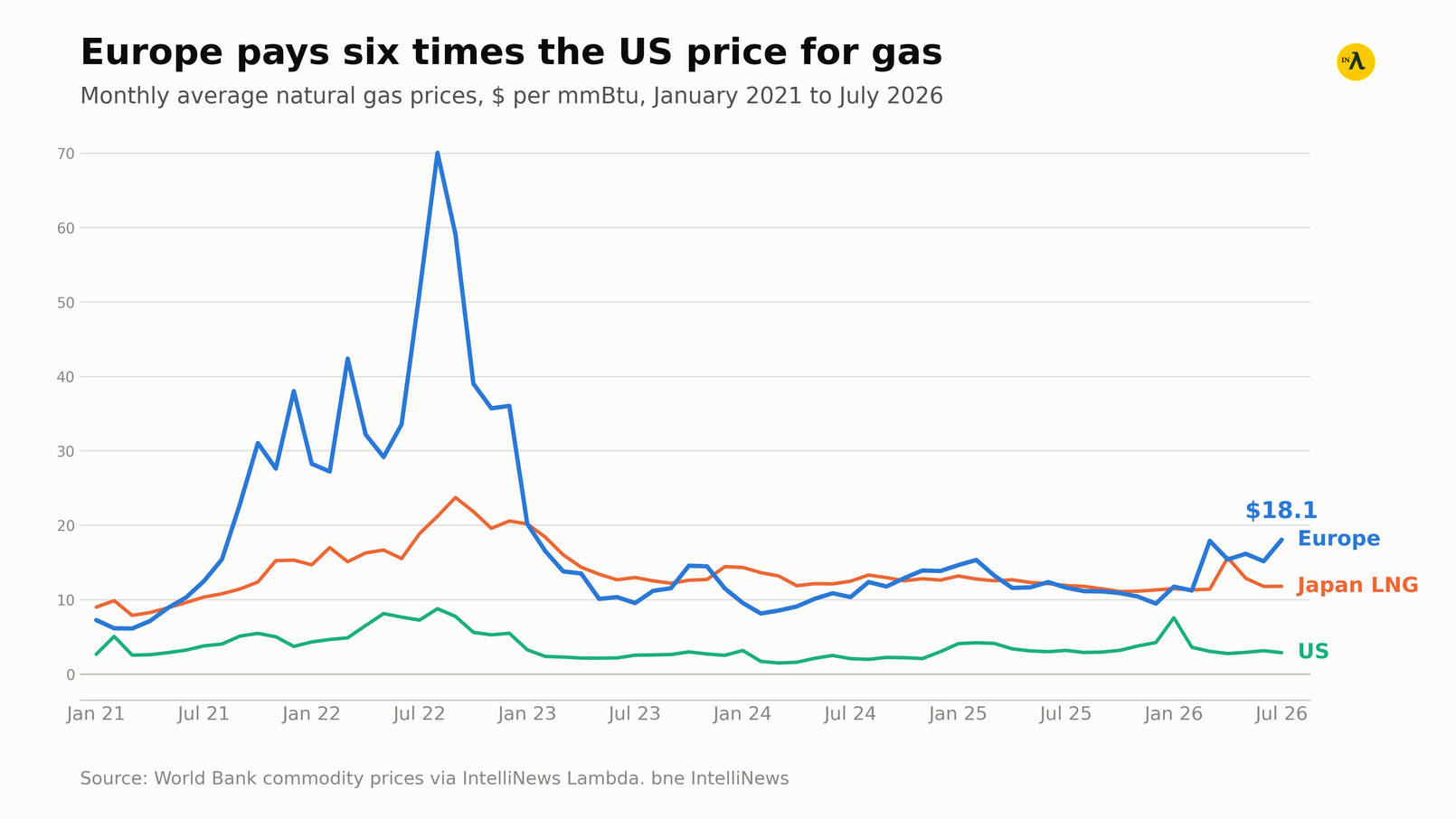
Monthly average natural gas prices in Europe, the US and Japan (LNG), $ per mmBtu, January 2021 to July 2026. Source: World Bank commodity prices via IntelliNews Lambda.
The latest leg up followed a Wall Street Journal report that US President Donald Trump has scheduled new US and Israeli strikes on Iran for after the November 3 midterm elections. The spread between December and November futures implies that traders have raised the probability of a shortage of Middle Eastern gas this winter from 51% to 73%, according to the Financial Times.
About a fifth of global LNG shipments passed through the Strait of Hormuz before the war, one of the world's most exposed chokepoints. Crude exports from the Gulf have partly been rerouted through pipelines and shuttle tankers, but LNG has no alternative to direct sailings by specialised carriers, and the EU has received no significant Qatari volumes since the summer, according to the EU energy regulators' agency ACER. QatarEnergy shut its 77mn tonne a year of liquefaction capacity as a precaution in March, has extended force majeure on deliveries to the end of the year, and says 12.8mn t/y of capacity damaged in the war could take up to five years to restore, Russia's Pivot to Asia reported.
Record low gas storage
As IntelliNews reported, EU gas storage has stalled at a record low as the heating season starts. Inflows have all but stopped with the tanks only 74.9%, a record low for late October, ahead of the November 1 deadline when they are mandated to be 90% by EU law. Austria, Slovakia and the Czechia have already begun to drawing gas out of storage for a second week as temperatures begin to fall.
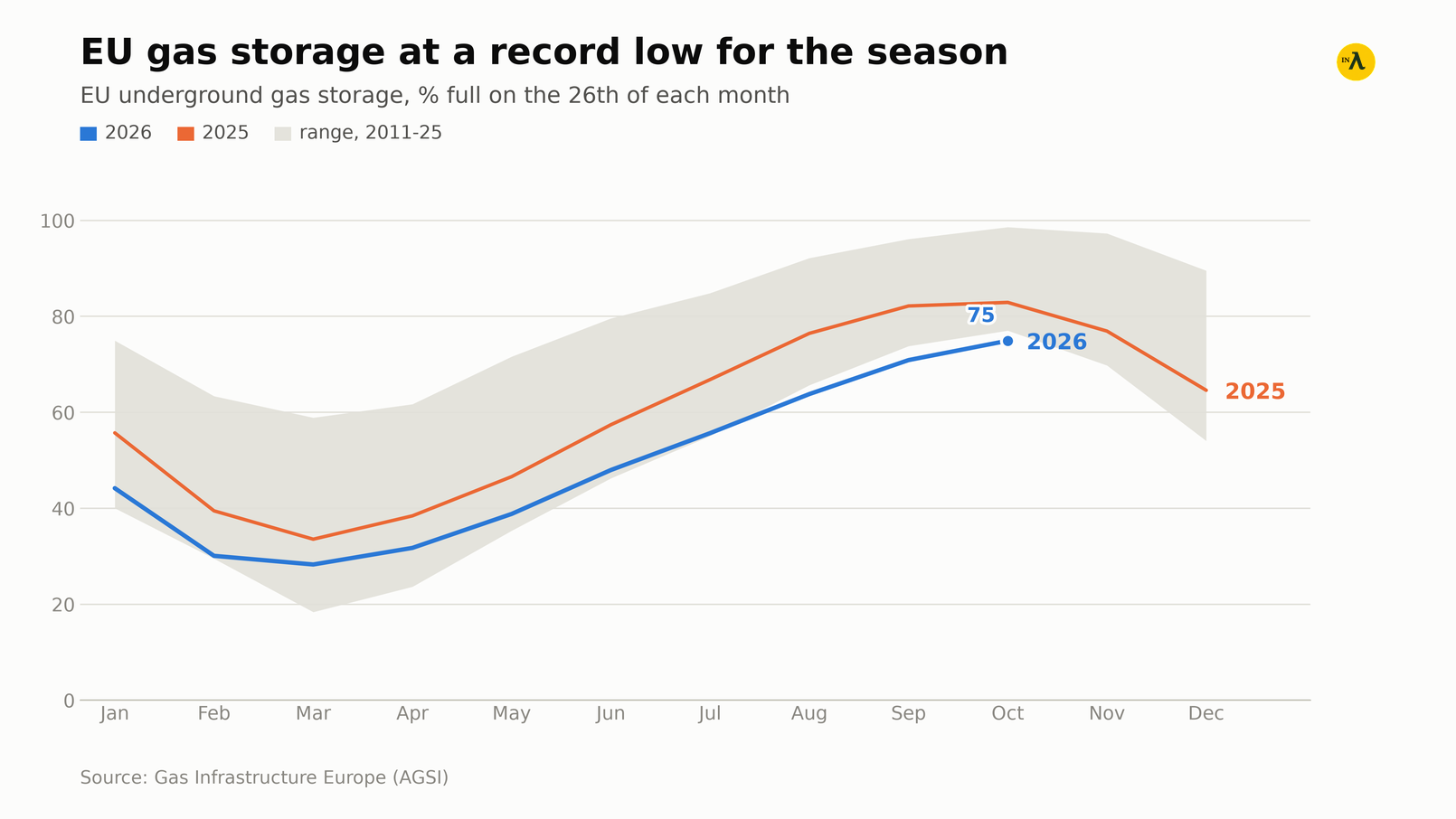
With EU storage tanks only three quarters full, against a long-term average of 86% for the time of year, the unfolding gas crisis began when the bloc ended last winter with reserves of just 28%. ACER puts the cost of refilling storage at €27bn. Maintenance and unplanned outages on Norway's transmission system have taken about 100mn cubic metres a day out of supply, and forecasters expect an early and cold winter.
Asian buyers are bidding for the same cargoes, with Northeast Asian LNG at about $30 per mmBtu, also a four-year high. Goldman Sachs has forecast €150 per MWh if a cold winter coincides with a continued blockade of the strait.
Higher fuel prices since the end of February have cost the EU €100bn, European Commission President Ursula von der Leyen has acknowledged, and ACER attributes €18bn-€33bn of that to gas. She confirmed that the EU will still stop buying Russian LNG from 2027. Russian LNG and gas through the last remaining TurkStream branch currently cover 11% of the bloc's consumption.
Moscow is using the squeeze to court buyers. President Vladimir Putin said on October 27 that Europe was "inflicting damage on its own industry and social sector by rejecting Russian energy resources and breaking long-term contracts", while Deputy Prime Minister Alexander Novak reminded China the same day that Russian pipeline gas would be considerably cheaper than LNG.
Novatek's chairman Leonid Mikhelson told the Verona Eurasian Economic Forum that the company is negotiating LNG supplies to Turkey, arguing that spot contracts tied to exchange prices had led to "huge overpayments" by Turkish buyers. "We always urged the preservation of long-term contracts; I am sure this is relevant for Turkiye right now," he said. Turkey's state energy company BOTAS extended its expiring Gazprom pipeline contracts by only one year and has signed a 20-year LNG agreement with trading house Mercuria.
This article was produced with the help of IntelliNews Lambda analytical tool
Unlock premium news, Start your free trial today.

