
Democratic decline deepens in Eastern Europe as global slide to autocracy accelerates


Democratic governance is under unprecedented strain worldwide, with Eastern Europe now a hotspot for backsliding even as the US and other established democracies face rapid erosion of rights, according to the latest V-Dem Institute Democracy Report.
The 2026 report, authored by Professor Staffan I Lindberg and colleagues, shows that nearly a quarter of the world’s nations are undergoing autocratisation, with six of ten new autocratising countries in Europe and North America, including Italy, the United Kingdom, and the United States.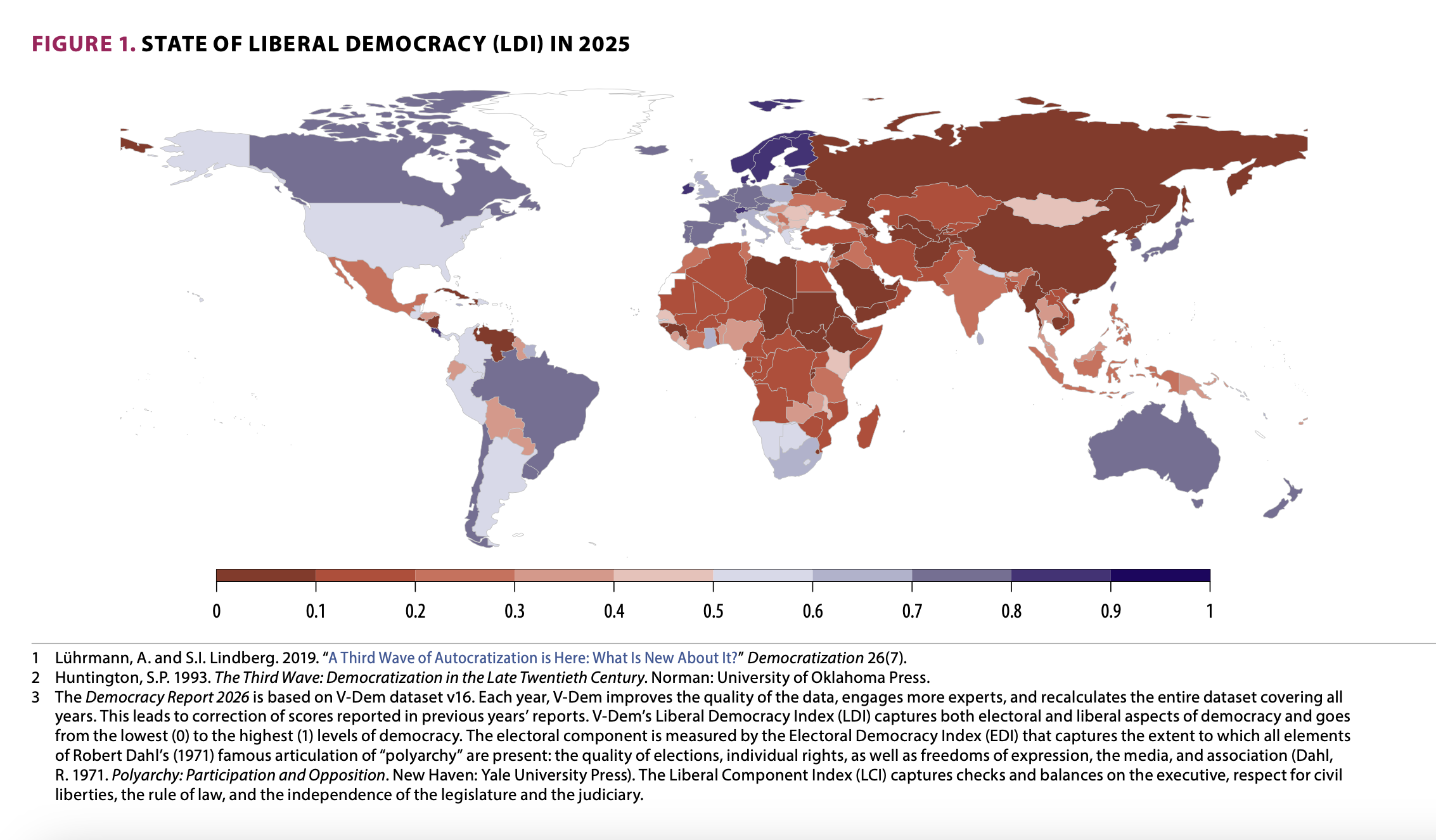
Source: V-Dem.
“Democracy in Eastern Europe was expanding drastically after the end of the Cold War, panning out by country averages at the turn of the century, and registering only marginal declines during the last decade. However, the level of democracy enjoyed by the average citizen was in decline since the mid-1990s, stabilising around its 1990 level more recently,” said the report from the independent research institute.
"There are many populous countries in the region undergoing autocratisation during the last two decades, such as Romania, Russia, Ukraine, and until recently Poland.”
According to the report, only 29% of Eastern Europe’s population live in democracies, including 5% in the liberal democracies of Czechia and the Baltic states, and a further 24% in electoral democracies, such as Bulgaria or Poland.
“A large majority – 65% – live in electoral autocracies, such as in Hungary, Russia, or Serbia,” the report notes. Belarus is identified as the only closed autocracy in the region, with “grey zone” regimes accounting for the remaining 3%, located in Albania, Bosnia & Herzegovina, Moldova and North Macedonia.
The report highlights the rise of what it calls the “third wave of autocratisation,” now extending into the European Union. “Among autocratising EU members in Eastern Europe, we find Croatia, Hungary, Romania, Slovakia, and Slovenia, while neighbours include Armenia, Belarus, Georgia, Moldova, Serbia, and Ukraine,” the study states.
Several countries are experiencing Bell-turns, or “failed democratisation”, with Armenia and Romania being the only two such countries from Eastern Europe to remain democratic, the report says.
Commenting on developments in Armenia, the report says: “Armenia’s initial period of democratisation in the early 2010s culminated with the 2018 Velvet Revolution and transition to an electoral democracy. The re-autocratization coincides with the Second Nagorno-Karabakh War in 2020. Nikol Pashinyan’s government resorted to personalistic style of governance, restricting freedom of expression, civic space, and civil liberties”.
In Romania, according to the report, re-autocratisation started in 2021, when “Intimidation of the opposition, suppression of civil society, attacks on the media, and interventions by external intelligence services became common”.
The report adds: “The other Eastern European country on the list – Georgia – is an electoral autocracy”, and notes that “democracy scores plummeted in 2023–2025”.
The V-Dem team warns that the decline is not limited to the region. “The USA loses its long-term status as a liberal democracy – for the first time in over 50 years,” Lindberg said. He added that the US has experienced an unprecedented deterioration in liberal democratic institutions: “The current US administration has been undercutting institutionalised checks and balances, politicising civil service and oversight bodies, and intimidating the judiciary, alongside attacks on the press, academia, civil liberties, and dissenting voices.”
Globally, autocratisation now touches 44 countries, affecting 41% of the world’s population. Nearly three-quarters of the world’s population – 6bn people – now live in autocracies, while only 7% reside in liberal democracies, a 50-year low. Freedom of expression is the most widely eroded democratic pillar, deteriorating in 44 countries, followed by rule of law and checks on executive power.
The report identifies three main trends: backsliding in traditionally stable democracies, breakdowns in countries that democratised after the Cold War, and deepening autocracy in already non-democratic states. Eastern Europe exemplifies all three. Montenegro and Poland are the only democratising countries in the region, while 11 countries are autocratising, up from eight the previous year. The report notes that this pattern reflects broader geopolitical and domestic pressures, including interference by external powers, internal polarisation, and weakening civic institutions.
Media censorship and repression of civil society are increasingly common, with 73% of autocratising countries restricting press freedom and 68% targeting civil society. “The fact that many populous and economically powerful countries are autocratising is especially worrying. Several of these countries have the economic and political weight to reshape international organisations, norms, and trade, effectively reshaping the global order. I think we are already seeing the effect of that,” Lindberg said.
The report highlights democratic gains in a minority of countries. Eighteen countries, including Brazil and Poland, are currently democratising, with improvements in media freedom and civil liberties. Botswana, Guatemala, and Mauritius are new entrants to the democratising group, showing that progress remains possible despite the global trend.
The V-Dem report paints a sobering picture of democracy in 2025: “Democracy is back to 1978 levels for the average global citizen. The gains of the ‘third wave of democratisation,’ starting 1974 in Portugal, are almost eradicated.” With 92 autocracies and 87 democracies worldwide, the study concludes that the world is increasingly governed by regimes where freedoms are curtailed, media is censored, and civil liberties are at risk. Eastern Europe’s experience, from partial liberalisation in the Baltics to growing autocratisation in Russia, Hungary, and Romania, mirrors a global trend in which even longstanding democracies are vulnerable.
Unlock premium news, Start your free trial today.


