
COMMENT: How Georgian Dream calculates its survival – and why Russia keeps South Ossetia on the table


Georgian Dream's steadily worsening relations with the West are often explained as either a matter of political self-preservation or geopolitical caution. In a recent analysis for the Central Asia-Caucasus Institute (CACI), Giorgi Gvalia and Ivane Lomidze argue these two explanations are not competing theories but the same calculation viewed from different angles — and that understanding this logic also explains why Moscow continues to treat breakaway Georgian territory South Ossetia as a useful bargaining chip rather than as a fully absorbed Russian territory.
Two kinds of risk, one government
Gvalia and Lomidze's central claim is that Western and Russian pressure represent fundamentally different categories of threat to Georgian Dream, and the ruling party has structured its foreign policy accordingly. Western tools, sanctions, diplomatic isolation, visa restrictions and support for civil society, are real but, in the authors' words, ultimately "containable, and potentially reversible". Sanctions can be endured, criticism reframed domestically as foreign interference and protests managed through administrative and coercive means. Georgian Dream can also simply wait out unfriendly European governments, expecting future elections in Brussels or Washington to soften the approach.
Russia is a different order of problem entirely. It already occupies Abkhazia and South Ossetia, keeps troops on Georgian soil and, as the authors put it, "can escalate pressure with little warning" through military force, economic coercion, or hybrid measures Georgia has limited capacity to counter. Crucially, the authors argue this isn't just a threat to the Georgian state — it's a direct threat to Georgian Dream's hold on power. A military crisis, even a contained one, risks territorial loss, economic disruption, and public panic that could be pinned squarely on the government that provoked it. "Political survival and state survival therefore become closely connected," Gvalia and Lomidze write, giving a government "principally concerned with remaining in office" every incentive to avoid confrontation with Moscow.
This is why, in their framing, Georgian Dream's expanding ties with China, Central Asia, Turkey and the Gulf matter: these relationships "cushion some of the costs of Western estrangement" without carrying democratic conditionality or provoking Russian retaliation, making resistance to Western pressure politically sustainable in a way that resistance to Russian pressure would not be. The authors call this "asymmetric threat management" — Tbilisi accommodates the actor it cannot counter and confronts the actors it believes it can survive.
Their conclusion carries a warning, though: the strategy's internal logic doesn't guarantee it works long-term. Even as it insulates Georgian Dream from immediate crises, "the erosion of Western support and the accumulation of Russian expectations could leave the country more isolated and vulnerable to the very coercion the government's policy seeks to manage."
Why Moscow doesn't just take South Ossetia
That last point connects directly to a separate recent CACI piece. Nicola Ilario examines South Ossetia's recent leadership transition, namely the resignation of Alan Gagloev in favour of Russian administrator Marat Kambolov, who went on to win a September 18 vote with over 80% of the ballot. Ilario says the resignation was the latest step in a Russo-Ossetian integration process dating back to the 1990s.
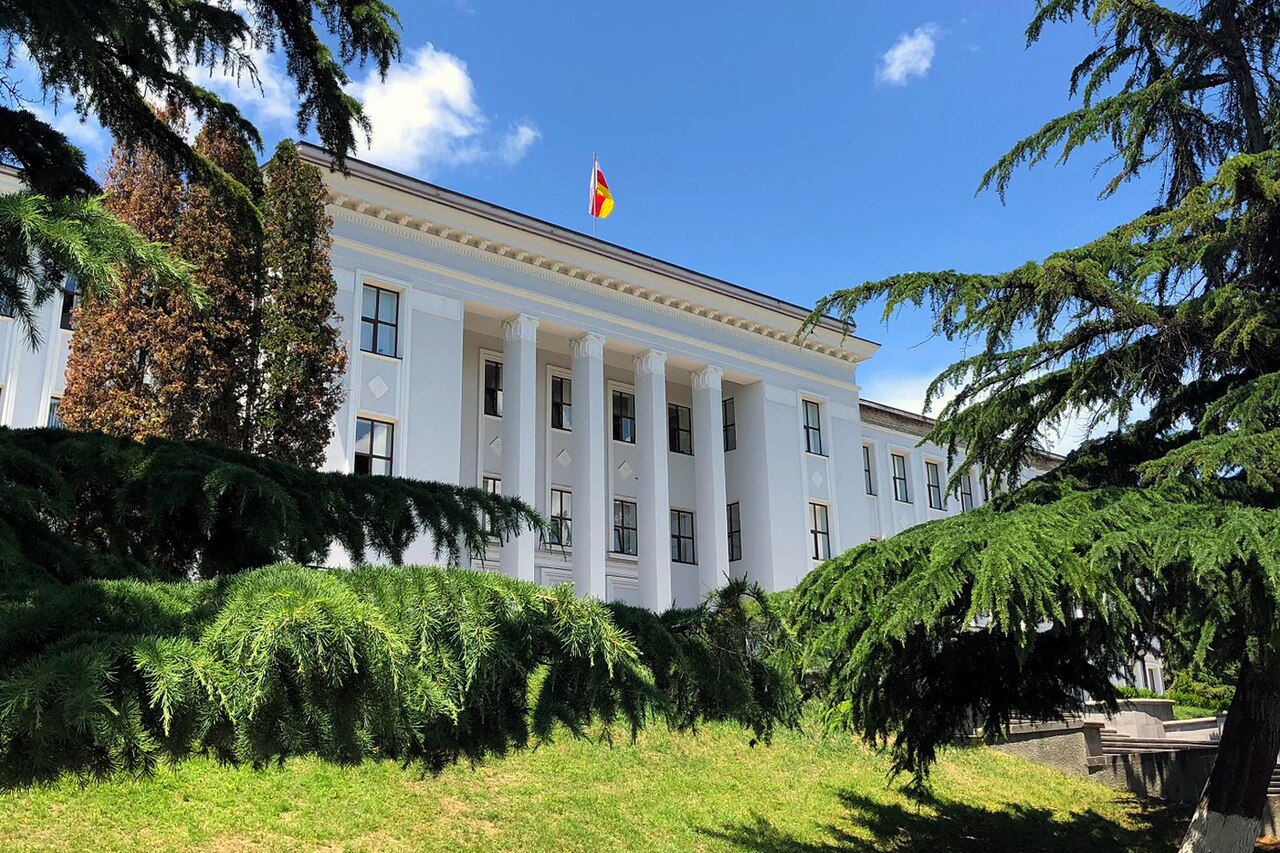
The de facto parliament building of South Ossetia in Tskhinvali (Credit: Labrang, cc-by-sa 4.0).
Kambolov, notably, is not from South Ossetia at all: a Russian national born in North Ossetia, he had no involvement in the territory's domestic affairs until 2025, when he was brought in as Gagloev's adviser before quickly becoming his successor. Ilario reads this as a sign that "Moscow is now installing administrators rather than cultivating local elites," a shift from indirect influence toward direct control.
The integration push has deep roots: a near-unanimous 1992 referendum backing "reunion" with Russia, the partial folding of South Ossetian forces into the Russian military, a 2016 union treaty, and finally the May 2026 "Treaty on Deepening Allied Interaction," which allows Russian citizens to hold office in South Ossetia and deepens energy, transport and telecoms integration, what Ilario calls a framework that "would bring de facto annexation" in all but name. Gagloev himself described it as "a step towards the reunification of the Ossetian people."
Yet Ilario argues Moscow has consistently stopped short of full, formal annexation — and that this restraint is deliberate rather than accidental. Plans for an annexation referendum were floated as far back as 2022 but were shelved by Gagloev after his election, with Gagloev later explaining the delay partly by pointing to Russia's war in Ukraine: "I believe that the current authorities of the Russian Federation... are still busy with other issues, I think with more serious ones."
More importantly, Ilario suggests Russia has found South Ossetia more valuable as unresolved leverage than as an incorporated territory. By keeping the region's final status open, Moscow can dangle the prospect of future talks on South Ossetia's fate to keep Tbilisi cooperative, even as it has no actual intention of relinquishing control. "This strategy continues to work," Ilario writes, "as GD continues its attempts at a multi-axis oriented foreign policy."
Reading the two together
Placed side by side, the twp pieces reinforce each other in a way that's more revealing than either alone. Gvalia and Lomidze describe a Tbilisi government that avoids confronting Russia because the consequences would be politically fatal at home. Ilario describes a Moscow that understands this dynamic perfectly — and has structured its own South Ossetia policy specifically to exploit it, using the unresolved territorial question as a standing incentive for Georgian restraint rather than settling it outright.
Neither piece frames this as coincidence so much as a stable, if uneasy, equilibrium: Georgian Dream avoids provoking Russia because occupation could deepen, while Russia keeps the occupation ambiguous enough that Georgian Dream still has something to hope for. Both analyses, however, end with the same caution — that equilibria built on short-term risk avoidance tend to erode the very leverage and alliances a state would need if the risk calculus ever changed.
Unlock premium news, Start your free trial today.


