
United Russia won only 35% in the Duma elections, not a constitutional majority
.jpg)

If the “real” result of Russia’s Duma elections this weekend were counted then the incumbent United Russia ruling party would have only won 35% of the vote, not the constitutional majority awarded to it by the Central Election Committee (CEC) and given it a simple majority, say statistician after studying the results.
United Russia was credited with 57.83% of the party-list vote and 355 of 450 seats in a preliminary account of Russia's September 18-20 State Duma election. But if only won 35.6% of the votes, as polls predicted before the elections, it would have ended up with a total of 219 seats – not enough to cross the threshold for a constitutional majority of 300 seats and not even enough for a simple majority of 226 seats.
To win just a simple majority, United Russia needed to garner at least 36.8% of the votes and all of the statistical studies estimating the real results of the election put the party’s support at below that percentage share. For the first time since the Yeltsin-era, Russia would have a real democratic parliament again.
The sweeping victor United Russia was awarded by the CEC raised eyebrows after the official results came in some 20 percentage points higher than even the Kremlin’s own pollsters were predicting - but even these results was not enough to win a clear victory. At the end of the day the Kremlin only needed to bump United Russia's share up by one or two percentage points to stay as the ruling party, but on the day it chose to give it a massive 20 point bump. This election's fix was not just about clearing important constitutional threshold; it was a political message on the war in Ukraine.
A poll taken before voting had United Russia on 35.6%. A forensic analysis of the Central Election Commission's own precinct protocols put it at about 35% of valid ballots. Liberal opposition publication Novaya Gazeta Europe, applying famous election statistician Sergey Shpilkin's method to the same protocols, arrived at 34%. The poll uses a separate dataset, but both statistical analyses apply variants of the Shpilkin method to election protocols. The official share is about 1.6 to 1.7 times these estimates.
Russian President Vladimir Putin has used the vote to endorse his increasingly unpopular war in Ukraine. In Russia's first parliamentary election since the full-scale invasion the result was designed to show that the “special military operation has made the ruling party more popular, not less.
Shpilkin, a physicist, has been analysing Russian election statistics since 2007, building on an approach developed by the American diplomat John Brady Kiesling; his home was searched in 2022, by which time he had already fled the country and now lives in self-imposed exile.
A pollster got there first
Taking Yabloko off the ballot made a big differnce, but not quite enough to ensure United Russia's victory even in a fair election. The research group ExtremeScan surveyed 800 people between September 4 and 10, before voting on September 18-20, with a margin of error of 3.5 points. Among decided voters it put United Russia on 31.8% when liberal opposition party Yabloko, which was banned before voting day, was offered on the ballot, and 35.6% when it was not. The image gives a base of 544 decided voters for the scenario without Yabloko.
Yabloko was struck off, so the second column is the one that matches the election actually held. It gave the Communists 23.9%, New People 16.2%, the Liberal Democrats 11.0% and A Just Russia 5.9%. That is a mixed Duma where United Russia doesn't even have a simple majority.
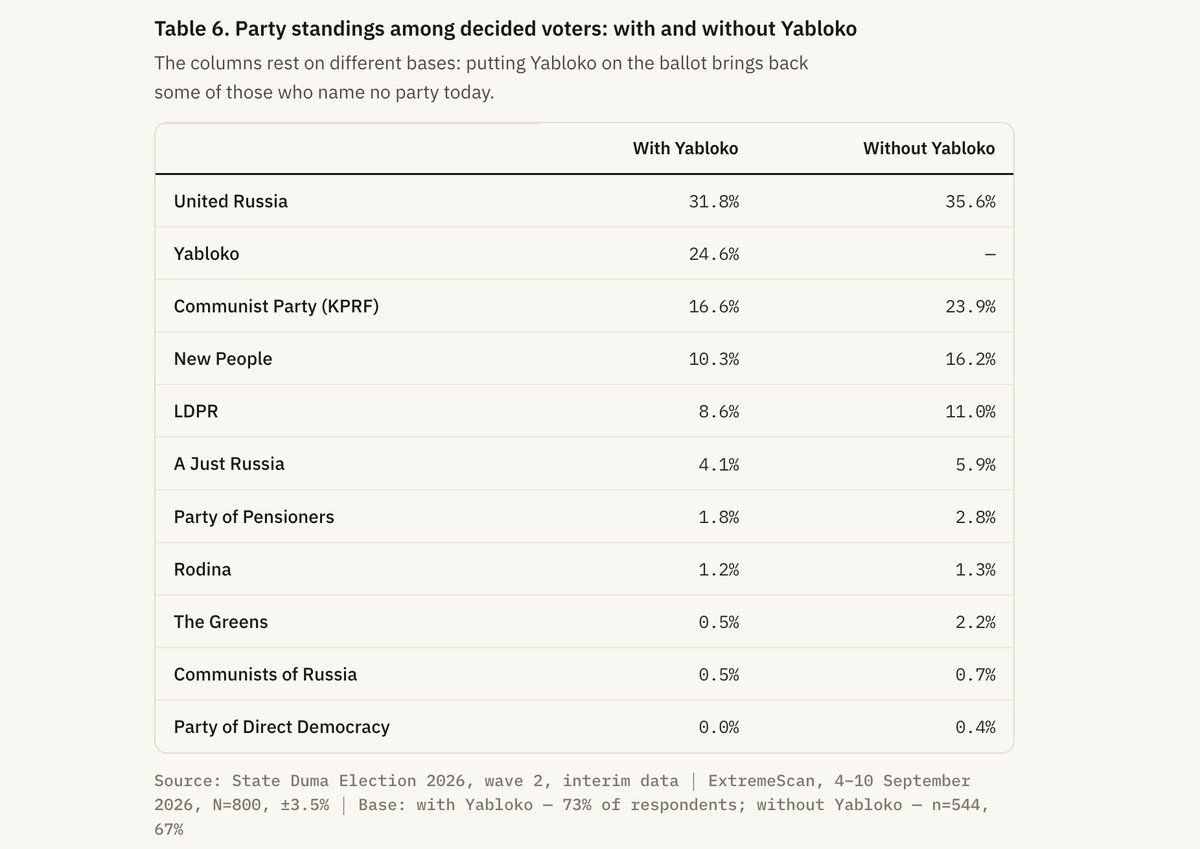
ExtremeScan, State Duma Election 2026 wave 2, interim data, September 4-10, 2026, N=800, margin of error 3.5 points. Party standings among decided voters, with and without Yabloko on the ballot.
What the statisticians found
The estimate of the actual results that has circulated most widely comes from Petr Zhizhin, who applies the Shpilkin method, which examines unusually strong relationships between turnout and a party's vote share as possible evidence of manipulation.
According to the liberal publication, Russian Election Monitor, Zhizhin puts actual turnout at about 40% against the official 57% to 59%, and United Russia's real share at about 35% of valid ballots against the official 58%.
That implies a turnout gap of some 17 to 19 percentage points and the party's vote inflated by about 23 points. His calculations were published in full but will not embarrass the Kremlin as statisticians have repeated show the elecitons to be a fraud in previous votes without effect.
Roman Udot, a veteran election analyst, notes that the use of administrative resource in Russian elections has historically been estimated at 15% to 20%, which places this election at the upper end of the normal range rather than outside it.
A second analyst, Boris Ovchinnikov, went further on a sample of more than 20,000 precinct protocols, about 23% of all precincts. Outside Moscow, he found turnout artificially inflated or fabricated at around 69% of offline polling stations, and about 31% of all offline paper votes fraudulent. His conclusion produced the sharpest figure in the bunch: roughly 55% of United Russia's total vote count is fabrication, produced by a mixture of stuffing ballots and reallocating other parties' votes at the count.
According to the analysts qouted by Russian Election Monitor, Moscow is a special case. Home to the most westernised and liberal Russian residents, offline turnout there was not pumped, but precinct data points to large-scale reallocation between candidates at the counting stage, the pattern last seen at that scale in 2011, when a communist victory in all districts in the capital was overturned after the electronic votes were included in the count. Remote electronic voting is unauditable by construction, and the occupied Ukrainian territories published no precinct-level breakdown at all.
Novaya Gazeta Europe ran the same method independently and also put the real result at about 34%.
"This year, the cluster of fraud-free polling stations is centered at 34% of the vote for United Russia. That is probably what the result would have been without fraud," it said, adding that two other election analysts agreed with its calculation.
The analyst Anatoly Karlin, reading the same scatter by eye, put the four main parties at United Russia 35% against an official 58%, the Communists 25% against 14%, the Liberal Democrats 15% against 9% and New People 15% against 8%. That is a rougher method than the others and is quoted as a cross-check, not as a finding.
The scatter chart gives it away
The fix is easily seen in a scatter diagram of voting treneds. One plot covers 10,114 precincts, excluding electronic voting, with turnout on one axis and the authorities' candidate share on the other. But this is not clearly a party-list measure. Turnout and voting preferences can also vary with geography and electorate composition.
Voting results should be a true random distribution of numbers and evenly spread but this election results produces two blobs - similar to the 2021 election results that produced a "coment effect" and a "Moscow blob." A truely random Gaussian distribution fitted to the data separates 73% of precincts into a cluster averaging 49.9% turnout and 41.9% for the authorities' candidate, and the remaining 27% into a second cluster averaging 90.4% turnout and 70.4% for the authorities' candidate. But the authors were careful to say that interpreting the clusters as honest and anomalous requires regional verification. The regression line through the whole cloud has the candidate's share rising 0.62 points for every point of turnout, with a correlation of 0.658 and a p-value below 0.0001.
The second chart in the same analysis makes the point without statistics. Plot votes for United Russia against votes for everyone else, binned by turnout, and below about 35% turnout the relationship is a straight line. Above it the line breaks into a saw-tooth: at every higher turnout band United Russia gains votes that the other parties do not. In other words, the higher the turnout, the more extra votes were reassinged to United Russia. The separate party chart shows the same trend: United Russia's share of the votes rises with turnout while other parties' shares decline.
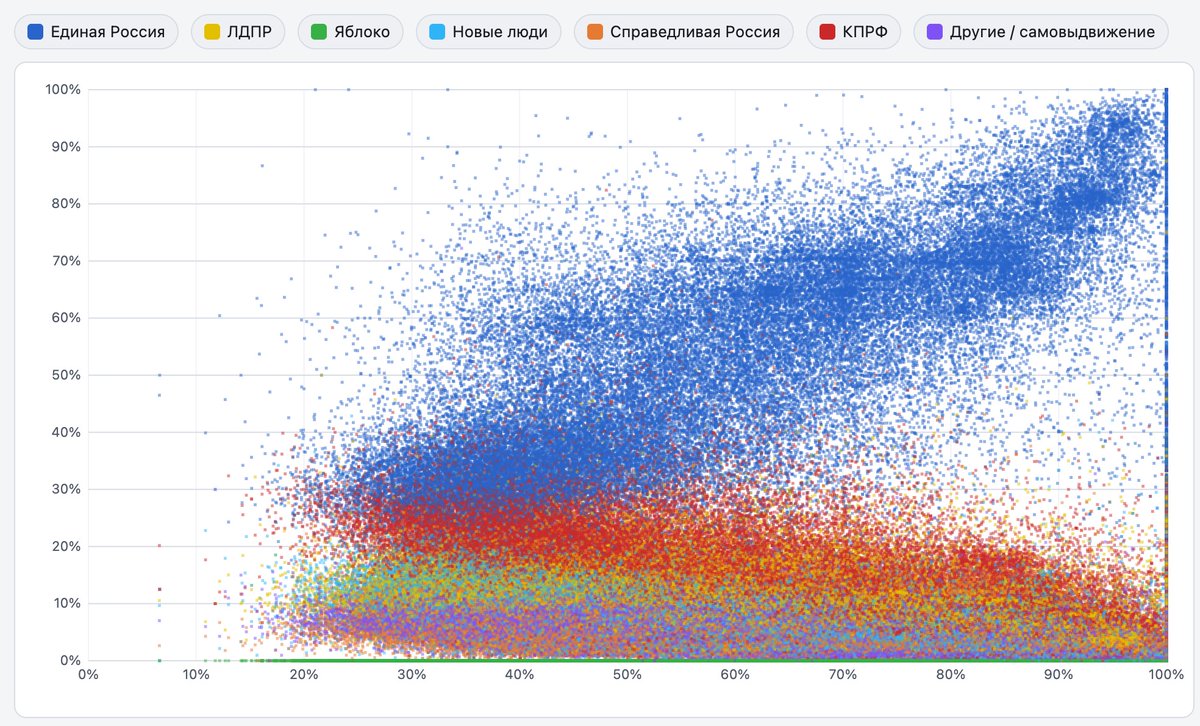
Precinct turnout against each party's share of the vote, 2026 State Duma election. United Russia in blue, the Communists in red, the Liberal Democrats in yellow, New People in cyan, A Just Russia in orange, Yabloko in green.
The official result, and what the vote implies
| Party | Official list vote | List seats | Constituency seats | Total seats | Implied real list vote | Implied real list seats |
| United Russia | 57.83% | 147 | 208 | 355 | ~35% | 87 |
| KPRF (Communists) | 13.81% | 35 | 5 | 40 | 21.3% | 53 |
| LDPR | 8.98% | 23 | 2 | 25 | 13.8% | 35 |
| New People | 7.96% | 20 | 0 | 20 | 12.3% | 31 |
| A Just Russia | 4.96% | 0 | 4 | 4 | 7.7% | 19 |
| Pensioners' Party | 2.00% | 0 | 0 | 0 | 3.1% | 0 |
| Greens | 1.15% | 0 | 0 | 0 | 1.8% | 0 |
| Communists of Russia | 0.85% | 0 | 0 | 0 | 1.3% | 0 |
| Rodina | 0.72% | 0 | 1 | 1 | 1.1% | 0 |
| Direct Democracy | 0.35% | 0 | 0 | 0 | 0.5% | 0 |
| Yabloko | barred | 0 | 0 | 0 | barred | 0 |
| Self-nominated | n/a | 0 | 4 | 4 | n/a | 0 |
Official figures are the Central Election Commission's preliminary result with 95.18% of precinct protocols processed. The implied column rescales the other parties' unchanged votes on Zhizhin's estimate that United Russia's real share was about 35%, and reallocates the 225 party-list seats among those clearing the 5% threshold. The 225 constituency seats cannot be recalculated from a national vote share and are left as reported.
Had the real results been effected that would have dramatically changed the balance of power in. the Duma. United Russia's party-list haul falls from 147 seats to 87, and liberal opposition party A Just Russia, which officially missed the 5% threshold and took no list seats at all, would have entered the Duma with a comfortable 7.7% and 19 seats.
The upshot is that if the unadultarated results stood, United Russia would have still won, but only with a simple majority, not the constitutional majority it was awarded by the CEC.
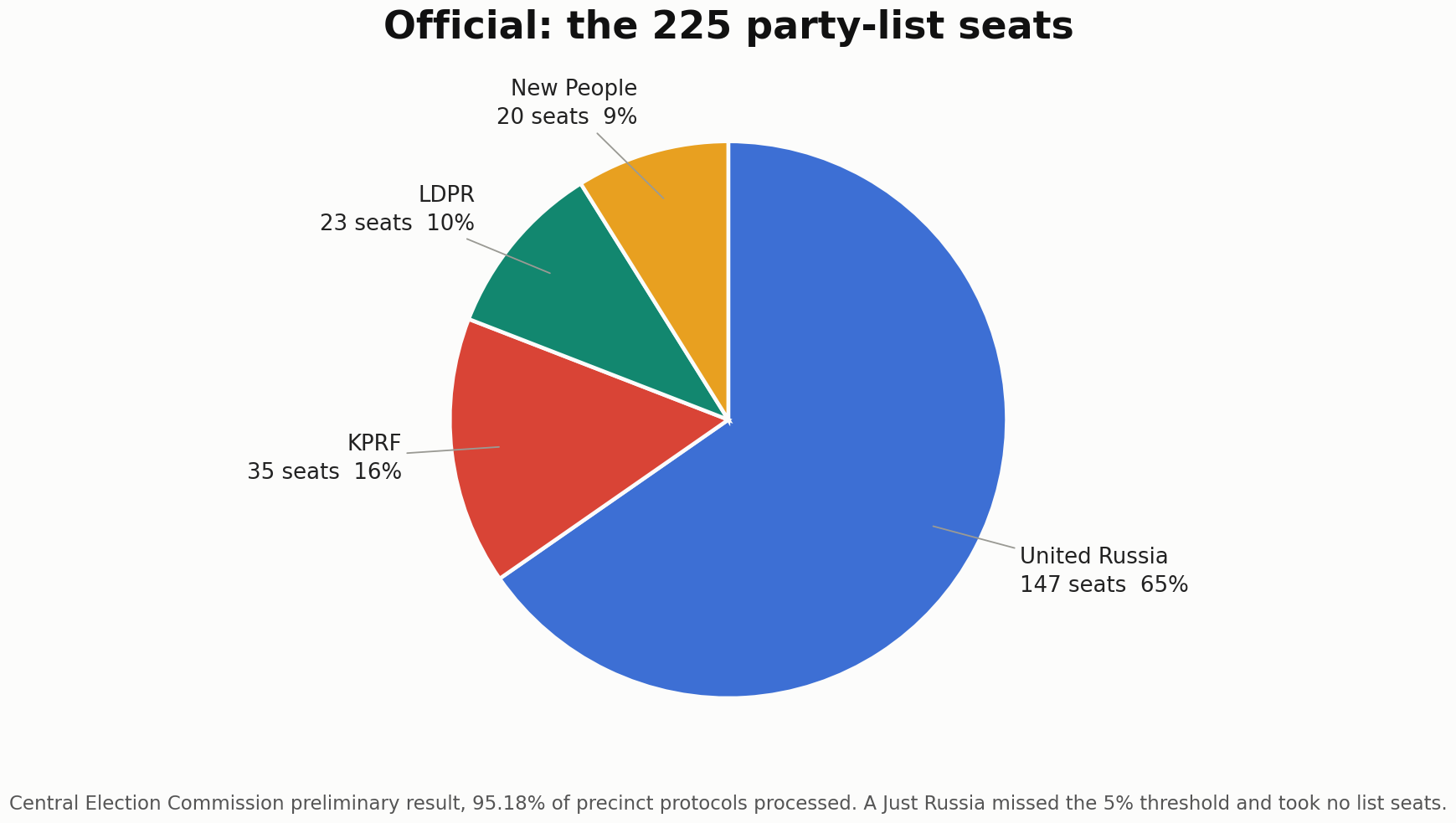
Official allocation of the 225 party-list seats. United Russia takes 147, and A Just Russia, on 4.96%, takes none.
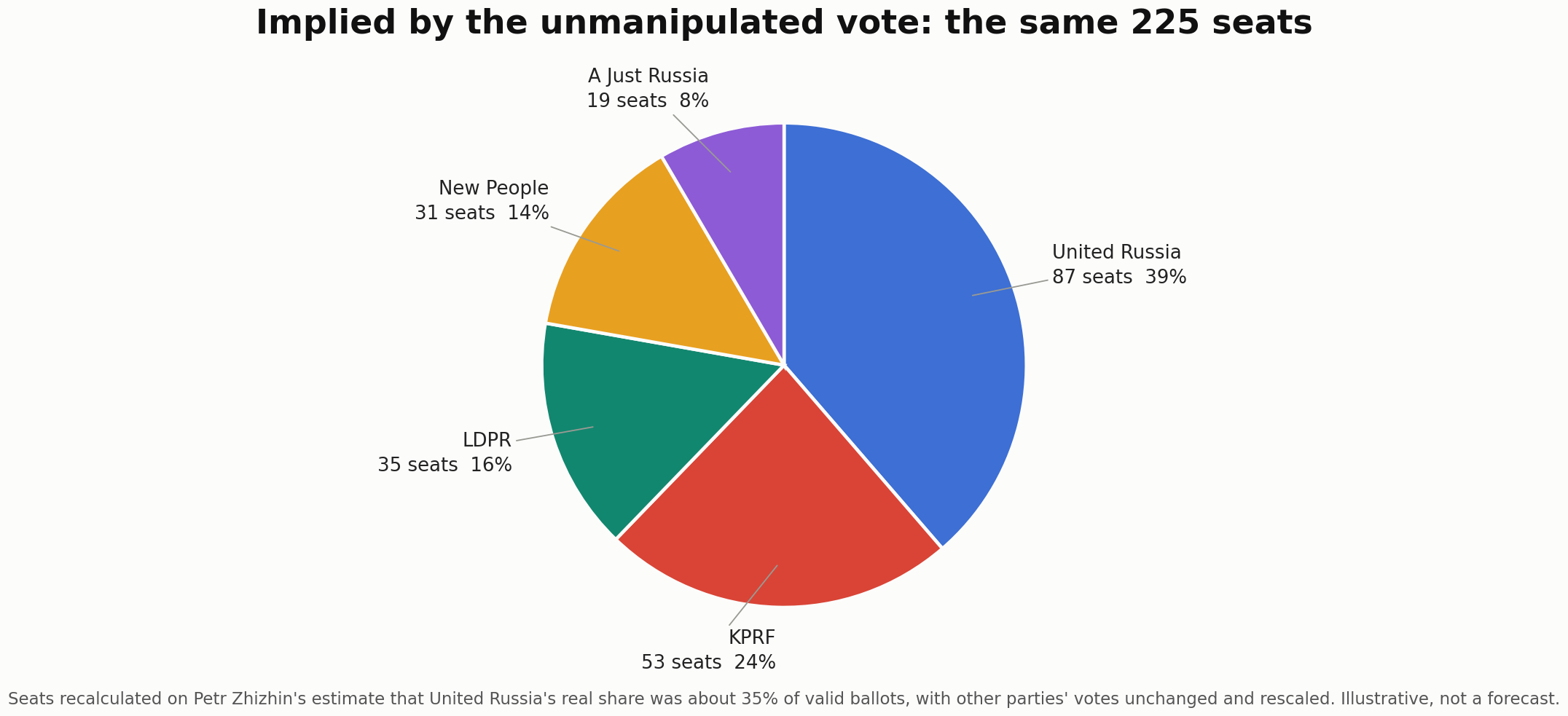
The same 225 seats, reallocated on the estimate that United Russia's real party-list share was about 35%. Illustrative: the 225 constituency seats are not included and cannot be recalculated this way.
The one electorate nobody could manage
Overseas polling stations give a rough control group, because the administrative machinery that operates inside Russia does not reach them. The independent outlet Agentstvo analysed Central Election Commission data from 27 foreign polling stations and the New People party beat United Russia in 18 of the total, taking first place. In Almaty, Barcelona, The Hague, Da Nang, Salzburg, Ljubljana, Prague and Tel Aviv it took more than half the vote. At many stations United Russia did not even come in second. It won nine cities, among them Baku, Bishkek, Riga, Istanbul, Sofia and Hanoi, and in Sydney it finished 31.66% to New People's 31.35%.
Across all overseas stations counted by the afternoon of September 21, United Russia had 39.58% against 58% at home, with New People on 24.49% and the Communists on 16.99%, Meduza reports. These are self-selected voters, disproportionately people who left after the war broke out in February 2022, and anti-Putin by default after voting against the Kremlin's decision to invade Ukaine with their feet.
Why the Kremlin wanted this number
United Russia scored 49.82% in 2021 on an official turnout of 51%. Independent assessments at the time put its organic support somewhere between 25% and 40%, depending on method. This year the official figure rose to 57.76% while pre-election polling had it on 33% to 37%.
The political analyst Anton Barbashin reads the target as deliberate: a result large enough to be accepted by the other parties and abroad, which lets Putin say support for the ruling party has risen because of the war, not fallen, and Russian society backs the war.
But the Kremlin was forced to put in some heavy handed fixes before the polling began. Yabloko was struck off the party lists before voting opened, non-systemic candidates were purged, independent observation was all but eliminated by legal amendment and administrative pressure, and voting took place amid digital blackouts and documented coercion of public-sector workers and military personnel. The Russian Election Monitor's assessment is that the elections were neither free nor fair, and that they functioned as an administrative ritual to demonstrate regime durability rather than as a measure of opinion.
The four parties that remain in the chamber alongside United Russia were not competing for power in any case. The Communists, the Liberal Democrats, A Just Russia and New People form the systemic opposition that are nominally in opposition to the ruling Uniter Russia, but in practice always vote with the government when needed by the Kremlin. Ejecting Yabloko whch has been in the Duma since the first elections were held following the fall of the USSR, marks the end of even token democracy in Russia.
Unlock premium news, Start your free trial today.


