
Indonesia's processed nickel output grew more than 60-fold by 2023


Indonesia produced 41% of the world's processed nickel in 2023, up from 1% in 2014, according to Our World in Data.
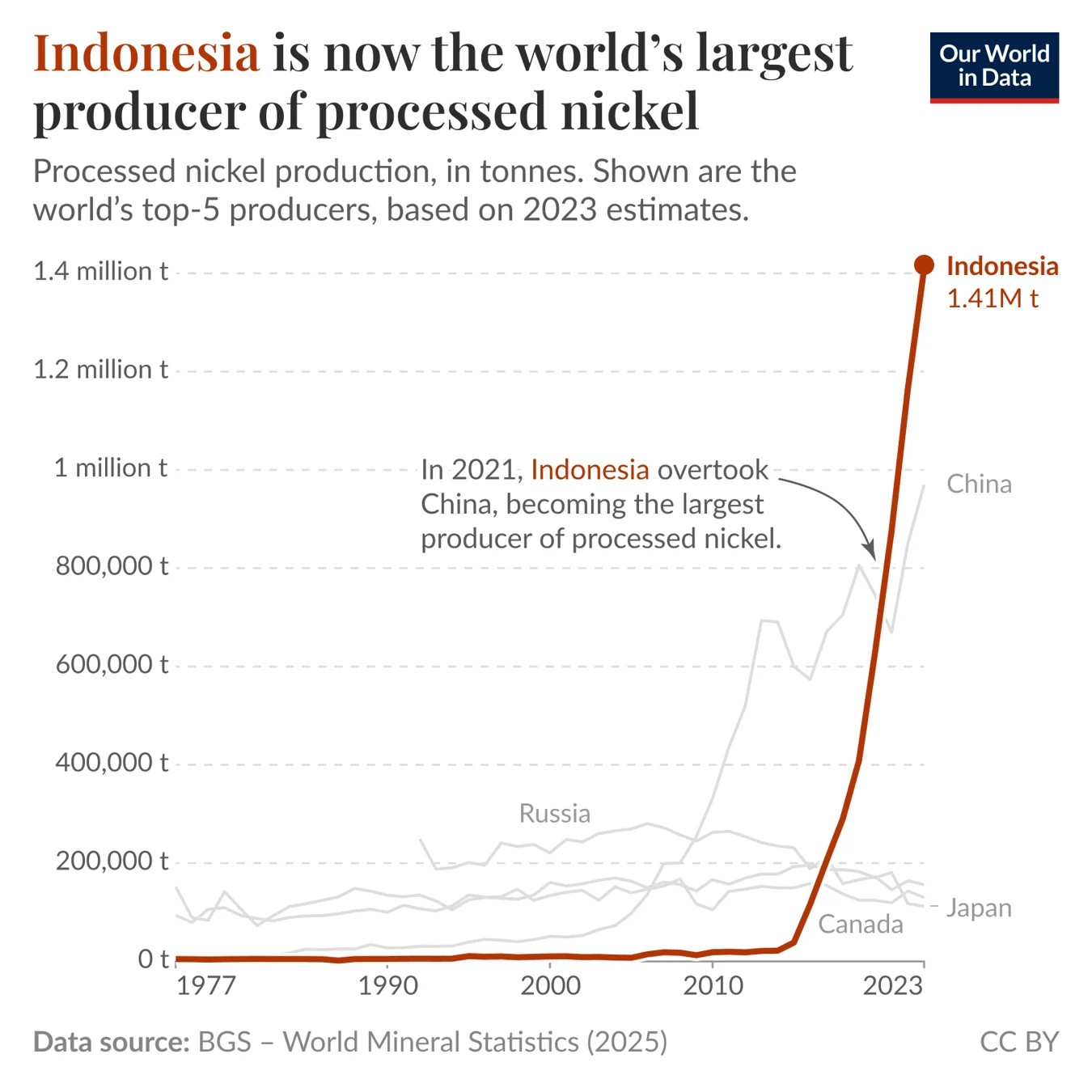
Indonesia overtook China as the world's largest producer of processed nickel in 2021. Source: Our World in Data, based on BGS World Mineral Statistics (2025), CC BY.
Production rose from around 22,000 tonnes in 2014 to more than 1.4mn tonnes in 2023, according to a data insight published by Our World in Data, based on British Geological Survey figures. Indonesia overtook China as the largest producer in 2021 and was well ahead by 2023.
Jakarta encouraged domestic processing by banning exports of unprocessed nickel ore, betting that miners would build smelters at home rather than lose access to the world's largest reserves of a metal used in stainless steel and electric-vehicle batteries.
Indonesia first banned ore exports in 2014 under its 2009 mining law, relaxed the ban in 2017 and reinstated it in full from January 1, 2020, according to a US International Trade Commission working paper. Export bans, along with planned windfall taxes and export levies on nickel and coal, remain at the core of the government's resource nationalism as it hunts for new revenue.
Chinese investment helped finance the expansion. Chinese companies own the vast majority of Indonesia's nickel refining assets, the International Energy Agency (IEA) said in its Global Critical Minerals Outlook 2025. The report said Indonesia hosted almost 45% of global refined nickel production but Indonesian companies accounted for only 10% of global production by ownership, while Chinese firms controlled 65% of global output by ownership against 30% by location, the agency calculated.
The Indonesia Morowali Industrial Park on Sulawesi, heavily financed by China's Tsingshan Holding Group, is the centre of the industry, though its growth has been marred by pollution and unsafe labour conditions, as well as clashes between Chinese and Indonesian workers.
The reciprocal trade agreement Indonesia signed with the US in February has raised questions about access to battery materials, given China's dominant position in Indonesian nickel refining.
Jakarta is now pushing state companies further down the chain. State-owned miner Aneka Tambang (IDX: ANTM) is developing $3.3bn of nickel processing plants in East Halmahera, according to a September 10 presentation cited in the linked report. Its partners include battery maker CATL (SZSE: 300750), while a separate project involves Zhejiang Huayou Cobalt (SHA: 603799).
An August 24 report put Indonesia's share at more than 60% of global nickel output, alongside efforts by Western-backed investors to secure alternative supplies in countries such as Tanzania. The measure is distinct from the processed-nickel series above.
Unlock premium news, Start your free trial today.


