
Trump strikes Russian diesel deal with Putin as Zelenskiy says Ukraine's negotiators were used as a "smokescreen"


US President Donald Trump said on October 9 that Russia will release 300,000 tonnes of diesel "immediately" to the US and global markets, followed by 500,000 tonnes in November and 1mn tonnes after that, after a phone call with Russian President Vladimir Putin.
Trump added on Truth Social that Russia would then deliver a further 3mn tonnes "within a short period of time", depending on the condition of its refineries, which Ukrainian drones have been hitting for months. The US Treasury is suspending sanctions on Russian diesel exports until April 7 and issued a temporary licence allowing the fuel into the market shortly after the announcement, the BBC reported. Other restrictions, including on Russian assets frozen in US banks, stay in place.
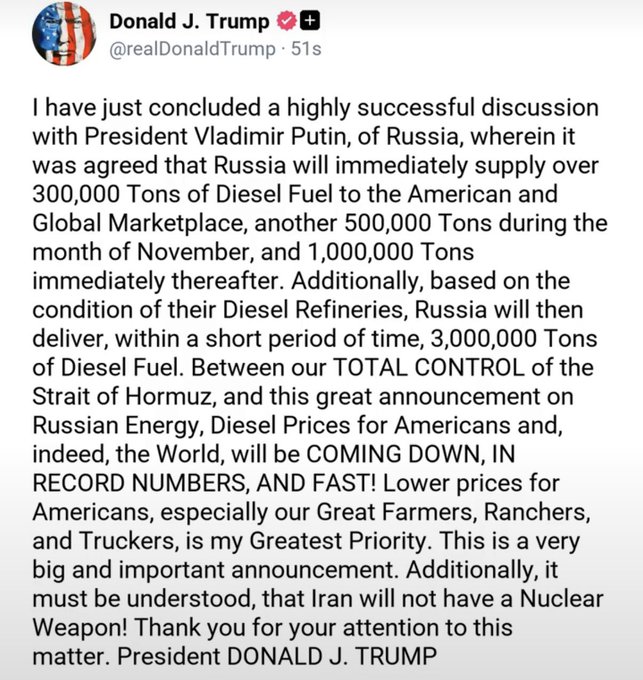
Donald Trump's Truth Social post announcing the Russian diesel deal, October 9, 2026. Source: Truth Social / @realDonaldTrump
"Between our TOTAL CONTROL of the Strait of Hormuz, and this great announcement on Russian Energy, Diesel Prices for Americans and, indeed, the World, will be COMING DOWN, IN RECORD NUMBERS, AND FAST!" Trump wrote. US diesel averaged $6.28 a gallon, according to the AAA motoring association, just off a record $6.53 set at the end of September, as the Iran war that began in February keeps fuel prices high ahead of the US midterm elections.
The Kremlin's readout was more guarded and gave no volumes. "During discussions of the global energy market, Russia reaffirmed its readiness to supply oil and petroleum products to the US and global markets. I am confident that this will have a positive effect on the global economy as a whole," Putin said in a statement. Kremlin envoy Kirill Dmitriev said on social media that "Russia-US co-operation on diesel and energy will benefit the world."
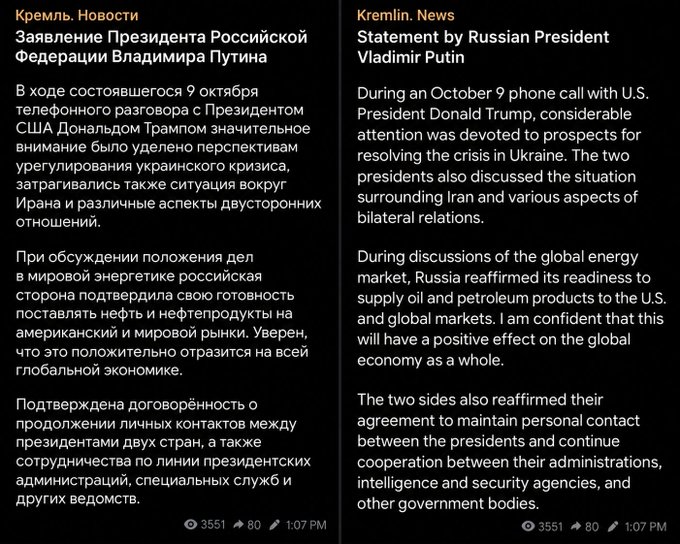
Vladimir Putin's statement on his October 9 call with Donald Trump, in Russian and English. Source: Kremlin
The call did nothing to move the war itself. Putin aide Yuri Ushakov said the Russian leader ruled out resuming peace talks and told Trump Russia would fight on until it had achieved "all its objectives", Ukrainska Pravda reported. Ushakov said the two men talked for an hour and a half and discussed a possible meeting on the sidelines of the Asia-Pacific Economic Cooperation summit.
Moscow has set a price for the energy truce Washington is pushing. Russia has asked for sanctions relief in return for halting strikes on Ukraine's power system, and wants the deal linked to a Black Sea ceasefire, the Kyiv Independent reported on October 9, citing US and Ukrainian officials. None of them knew which sanctions Moscow wants lifted. US and Russian officials are expected to keep talking over the weekend.
Zelenskiy furious
The timing of the deal infuriated Kyiv. Russia is currently pounding all of Ukraine causing blackouts Kyiv as the temeratures start to fall. A Ukrainian delegation was in Florida meeting Trump's envoys about an energy ceasefire when the call took place.
"At this very moment - while our team is speaking with the American team in Florida - the President of the United States is talking to the Kremlin leader, the leader behind this war and this aggression, and is reaching an agreement allowing Russia to export diesel," President Volodymyr Zelenskiy said in a voice memo sent to reporters, reported by the Financial Times' Christopher Miller.
"This means millions, billions. Ultimately, it all goes towards the war against people, against Ukraine - against all of us. I believe our team is simply being used as a smokescreen. This is certainly dishonest; it is certainly not how partners should act. And, in my view, it is a weak decision - sadly, a weak decision made by strong partners," Zelenskiy said.
In a separate post he called the deal "an investment in a war that must be ended, not prolonged" and said Russia would repay the diesel with "further terror". He defended Ukraine's strikes on Russian refineries as a response to Russia's campaign against Ukraine's energy system. "Ukraine will not set Russian oil refineries on fire if Russia does not destroy our energy infrastructure," he said.
The volumes are small. The first 300,000-tonne tranche is about 2.25mn barrels, against US consumption of about 3.8mn barrels a day, "so it won't make a material difference to pump prices in the US", Tim Armitage, investment strategist at Quilter Cheviot, told the BBC. All three tranches together, 1.8mn tonnes, would cover about three and a half days of US diesel demand. "It does appear to be a slightly desperate move by President Trump to try to lower inflation ahead of the midterms," Armitage said.
Nor is Putin giving much away. Before Moscow restricted fuel exports this year, Russia shipped 3.3mn-3.4mn tonnes of diesel and gasoil a month, so the 1.8mn tonnes on offer is about half of one month's normal exports. Production recovered to around 170,000 tonnes a day in August, or about 5.3mn tonnes over the month, against 4.7mn tonnes delivered to the domestic market, leaving a surplus to sell.
Moscow had already planned to let producers resume diesel exports from September, before twice pushing the date back; the current ban on exports by producers runs to October 31. A US waiver lets Russia sell barrels it was preparing to put back on the market anyway, and at today's prices: the global diesel market is unusually tight, with Brent above $103 a barrel against about $73 before the Iran war, and Europe has been leaning on US cargoes to fill the gap left by Russian supply.
The deal is also a reversal for Washington. The US Congress recently passed legislation, signed by Trump, authorising sanctions and tariffs on countries that import Russian oil and gas. The UK said it would keep up "the toughest sanctions regime ever imposed by the UK" on Russia.
Unlock premium news, Start your free trial today.

_2.jpg)
