
Trump's Russian diesel deal splits Washington from Kyiv as he calls for a new Ukrainian president


Donald Trump's phone call with Vladimir Putin on October 9 went so well that neither man wanted to be the first to hang up, the Kremlin said, and the diesel deal that came out of it has opened the deepest rift between Washington and Kyiv in months.
"Neither wanted to be the first to hang up. They hung up simultaneously, literally at the same time," Kremlin foreign policy aide Yuri Ushakov said on October 10, calling the 90-minute conversation "very substantive and friendly", Interfax reported. Most of the call was about the war, the Kremlin said, though Putin played down the chances of three-way peace talks resuming soon.
Out of it came the deal Trump announced the same evening: Russia will release 300,000 tonnes of diesel immediately, 500,000 tonnes in November and 1mn tonnes after that, and the US Treasury issued a temporary general licence suspending sanctions on Russian diesel until April 7.
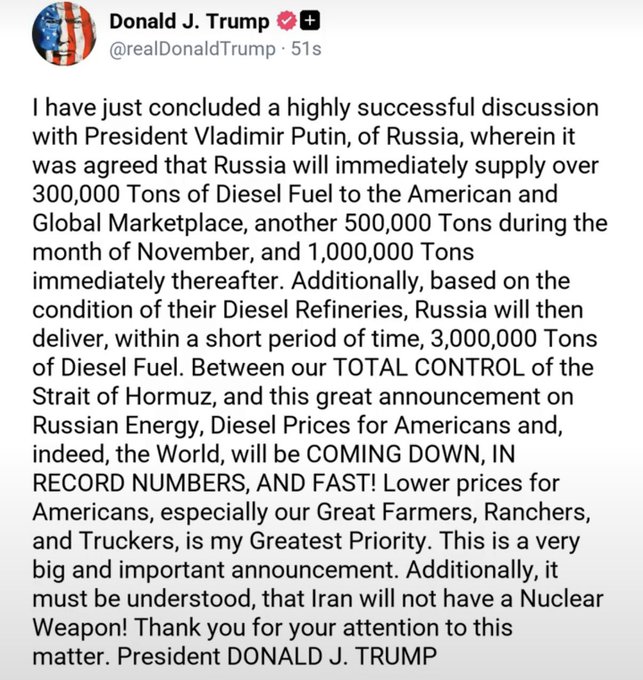
Donald Trump's Truth Social post announcing the Russian diesel deal, October 9, 2026. Source: Truth Social
Trump has made no secret that he wants to do business with Moscow. Kremlin envoy Kirill Dmitriev has pitched Washington a package of economic deals that Ukrainian President Volodymyr Zelenskiy has said is worth $12 trillion, and Trump has backed a plan to trade sanctions relief for prisoners. Cheaper diesel ahead of the US midterm elections is the first concrete return on that courtship, and Moscow is reported to want sanctions relief in exchange for any energy truce. No details of a wider package have been made public.
The deal may have been settled well before it was announced. The tanker Minerva Zen loaded at St Petersburg on September 22 and is due at Wilmington, North Carolina, on October 11 carrying around 275,000-280,000 barrels of fuel, according to ship-tracking data posted by the Russian Market account on X, which said the timing suggests the two sides reached an understanding weeks earlier.
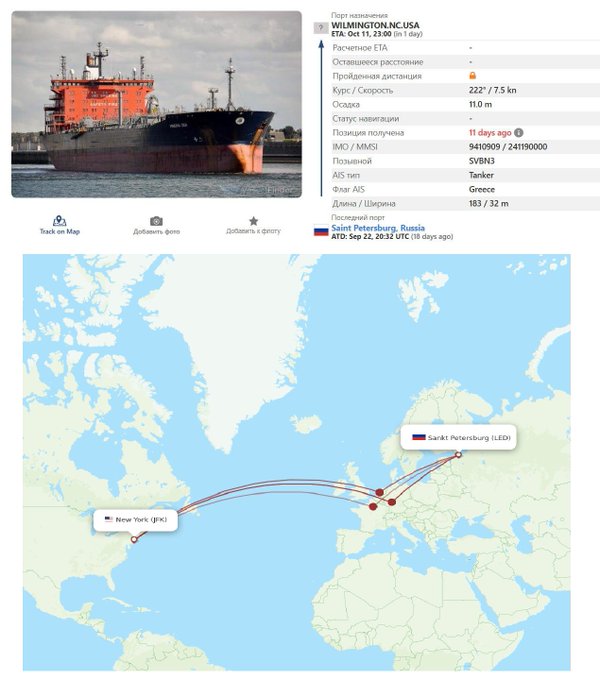
Ship-tracking data for the tanker Minerva Zen, which left St Petersburg on September 22 bound for Wilmington, North Carolina. Source: Russian Market (@runews) on X
Russia was preparing to sell more diesel anyway. Moscow banned exports late in this year's fuel crisis and had already been discussing a partial lifting of the ban, because it is "now producing more than it can consume" with the harvest over, Janis Kluge of the German Institute for International and Security Affairs (SWP) wrote on X. "Most likely, someone in Moscow had the idea that Putin could sell the decision to Trump as a deal," he added.
Ukraine found out in the middle of negotiations. Its delegation was in Miami for talks with Trump's envoys Steve Witkoff and Jared Kushner on an energy ceasefire and a Black Sea arrangement when the two Americans told them Washington was about to lift sanctions on Russian diesel, the Kyiv Independent reported in an exclusive on October 10.
"It felt like a trap," a senior Ukrainian official told the paper. "It was not just our delegation there, but a European one as well. It's just that everyone was sitting there like fools." Another official read the April 7 expiry of the waiver as evidence the move had been timed around Putin's birthday on October 7: "It's a birthday present for Putin. They're counting the six months."
The envoys also raised the possibility of cutting off the US intelligence sharing that Ukraine uses to find targets inside Russia if Kyiv did not heed Washington's warning to stop hitting Russian refineries, according to people familiar with the matter cited by the Financial Times' Christopher Miller. One senior Ukrainian official told the Kyiv Independent he hoped "the Americans don't give them Patriot (air defense systems) to protect their oil refineries."
Kyiv's answer was defiance. "We will burn [Russian] refineries," a senior Ukrainian official told the Financial Times, and hours later Ukrainian drones struck the Yug Rusi oil terminal in Rostov-on-Don, Russian authorities said. The delegation cut its trip short instead of holding a second round of talks on October 10, and one official said the move had "ruin[ed] the trust completely". On the US side, a person familiar with the talks said Kyiv's resistance to halting the strikes had left a bad taste in Trump's mouth, though the negotiators had still worked on a peace proposal that could go to Russia before winter.
Zelenskiy said his team had been "simply used as a smokescreen" and called the waiver "a weak decision by our strong partners."
Trump hit back on October 10. "I think it's time for Ukraine to get a new president," he told reporters at the White House, saying Zelenskiy had failed to end the war, the Associated Press reported. "I suggest they get a new leader who can make a deal." He blamed Kyiv's refinery strikes for the price of fuel: "He wants to make problems for the world, for our farmers with diesel," Trump said, according to the Kyiv Post. "Zelensky could have settled this war many, many times, but he chooses not to."
The call was quickly echoed by Ukraine's pro-Russian fringe. Vadim Novinsky, a former pro-Russian member of parliament, wrote on Facebook that the Trump-Putin agreements and the failure of the Miami talks meant Zelenskiy should resign immediately and hand his powers to the Verkhovna Rada, which should form a working group to negotiate with Moscow.
The row squanders much of the goodwill Kyiv had rebuilt with the White House since the Oval Office clash between the two presidents in February 2025. In September, Trump had told Zelenskiy directly: "Mr. Zelensky has to do one thing. He has to stop knocking out diesel fuel in Russia," the Kyiv Independent reported.
Meanwhile Russia kept pounding Ukraine's cities and power grid. Russia launched a drone attack followed by a missile strike on Kyiv on October 10, also targeting energy facilities. Days of blackouts have halted the capital's metro and cut water pressure, and Mayor Vitali Klitschko has told residents with friends or family outside the city to leave, though he has not ordered an evacuation. Russian attacks killed at least 41 people across Ukraine in the day to October 9, according to regional authorities, and early on October 10 a guided bomb hit a five-storey apartment block in Zaporizhzhia, killing five people including two children, regional official Ivan Fedorov said.
In Washington, Democrats and some Republicans lined up against the deal. Senate Democratic leader Chuck Schumer called it "a deal with the devil", Senator Richard Blumenthal called it "a disgrace", Senator Jeanne Shaheen called it a betrayal of Ukraine, Europe and US national security, and Republican Congressman Don Bacon said supporting Russia's war economy was "morally wrong", according to a round-up by the Ukrainian news account Blyskavka. Democratic Congressman Don Beyer said giving Trump expanded sanctions powers in the hope he would use them to help Ukraine had been a mistake.
That was the point of the Graham sanctions bill, the so-called "sanctions from hell", which cleared the House by 262 votes to 159 on September 16 and was signed into law by Trump. It was meant to tighten the screws on Moscow, but it left the president broad waiver powers, and less than a month later the first big move under Trump's sanctions regime has been to loosen it.
The EU has been caught out too. "Suspending sanctions on Russian diesel provides Moscow with more revenues. This is not the time to ease pressure on Russia, and Europe won't," EU foreign policy chief Kaja Kallas wrote on X, TASS reported. EU foreign ministers intend to approve "the biggest set of sanctions listings" on October 12 as part of a 22nd sanctions package, she said, after EU ambassadors on October 8 agreed to blacklist more than 1,500 companies and individuals linked to military and dual-use production.
Washington is moving the other way. Witkoff and Kushner may visit Moscow within the next two weeks, TASS reported, citing a source, and Putin has already been invited to the G20 summit in Miami in December.
Unlock premium news, Start your free trial today.


