
Ten things Putin told Russia's Valdai Club


Russian President Vladimir Putin used his annual appearance at the Valdai Discussion Club on October 1 to restate the Kremlin's case that “the West started the war in Ukraine,” that Western dominance is ending and that Russia will take the rest of the Donetsk region sooner than its enemies expect.
It was a belligerent speech as Putin seems to have given up all pretence of being prepared to enter into peace talks with Bankova, Ukraine’s presidential administration. The onstage conversation that followed, moderated by the club's research director Fyodor Lukyanov, ran to three hours and 20 minutes and were a long list of the Kremlin’s gripes, according to a transcript published by the Kremlin. The 23rd annual meeting was titled "Responsibility for the Future: Limits of the Possible, or Limitless Possibilities?"
Little in the speech was new. Set up as an international think tank to encourage dialogue with Western partners, the Valdai meeting has decended into a soapbox for a Kremlin rant on foreign policy. This year it came in the midst of an escalating brutal tit-for-tat missile war as Russia's refinery losses mount and Europe debates whether Moscow is preparing a wider war. The war has cost Russia about 1% of GDP, Putin said of Ukraine's refinery campaign, and continues to downplay the attacks, while promising to upscale Russia’s retaliation after Ukrainian President Volodymyr Zelenskiy opened “Pandora’s box” by attacking Russia’s retail system. These are the main points he made.
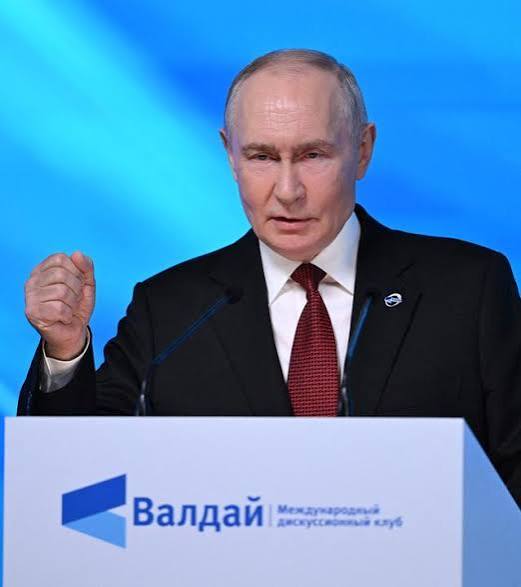
Vladimir Putin at the plenary session of the 23rd annual meeting of the Valdai Discussion Club, October 1, 2026.
1. The world is at a turning point
Putin opened with a sweeping account of technological, social and political upheaval, from artificial intelligence to genetics, that he said leaves every country exposed.
"The world has reached a decisive turning point in its development," he said. "We are entering a completely new and unprecedented reality."
2. Western dominance is ending
In a long standing trope, Putin ran down the old world system where the West is predominant and stress a new world worder is emerging, a multipolar world where China and Russia are playing leading roles via the BRICS+, G20 and other non-western institutions. He predicted more conflict on the way to this new order but said the end of Western supremacy would leave the world better off. He attacked the West's weight in the UN, which he said should give Asia, Africa, Latin America and the Middle East a bigger role and called again for the reform of the United Nations Security Council (UNSC) that should take account of the new realities.
"As the world moves away from Western hegemony, the international situation will gradually improve leading to a more stable, democratic, and free multipolar international order," Putin said. A "narrow grouping of Western countries" still has a disproportionate say in the UN, he added, though "it constitutes a global minority by all accounts."
3. Russia did not start the war
Putin broke off from his main theme to address what he called the question: why Russia started a war while talking about peace. He blamed Nato's eastward expansion, Ukrainian nationalism and the 2014 change of government in Kyiv.
"The truth is that we did not want and were not the ones who started to fight. In fact, they started to fight against us," he said. "They pushed us to this brink knowingly and intentionally," he said referring to the failed round of diplomacy in January 2022 with the US where Russia was demanding an “ironclad legal guarantees” that Ukraine would never join Nato, a demand rebuffed by the US.
4. Donetsk will fall soon
Asked about the front, Putin said Ukraine now holds only 11% of the Donetsk region and questioned why Kyiv was still defending it, UAWire reported.
"Ukrainian leaders say they will hold on to those 11% for a year and a half. In Europe, they say two years. We believe it will happen sooner. The question is: if the loss of these territories is inevitable, does it make sense to cling to them?" he said.
Putin has set 15 deadlines for taking the whole region since the full-scale invasion began and Russian forces have missed every one of them, according to the same report. The Institute for the Study of War estimated that Russia controlled 79.89% of the region at the end of August, with its troops about 15 km from Sloviansk and Kramatorsk.
5. The Minsk agreements were a deception
Putin returned to a favourite grievance, the 2014-2015 Minsk peace deals for eastern Ukraine, saying Kyiv and its Western backers "never intended to implement" them. He specifically highlighted former German Chancellor Angela Merkel admission that the Minsk agreements were an attempt by the West to play for time to give Kyiv a chance to prepare for war. He also claimed that provisions in the agreements would have given Ukraine's southeast the right to secede if the country joined Nato.
6. Refinery strikes hurt, and Russia hit back
In an unusual admission, Putin said Ukraine's drone campaign against Russian refineries had partly achieved its aim. "By our estimates, we lost about 1 percent of GDP," he said, adding that Russia had responded by striking Ukraine's energy system in return. Other experts say that Russia’s oil product through put has reduced production by as much as 45%. While Russia has always run a 30% excess of diesel production, which it usually exports, the gasoline production excess margin was closer to 15% and through put has now been reduced to below the level where the refineries can fully meet domestic demand, causing a fresh fuel crisis.
He said Russia has enough diesel for its own needs but that sanctions keep it off world markets, days after Moscow extended its diesel export ban to the end of October.
7. Nuclear weapons cannot be ruled out
Putin warned that a cycle of retaliation could reach "a point of fatal irreversibility" and that the leading powers hold weapons that could destroy all life on Earth. "Can we guarantee that these weapons will never be used? We cannot, of course," he said. "We all remember the saying that if you have a rifle hanging on the wall in the first act, it will eventually be fired," he said referring to a famous quote by the playwriter Anton Chekhov, well known to all Russians.
He was more explicit on Kaliningrad, Russia's exclave between Poland and Lithuania. A direct attack on Russian territory would put the use of "all the weapons at its disposal" on the agenda, he said.
8. The Soviet Union trusted the West and paid for it
Putin said the late Soviet leadership had been naive in believing Western promises, citing West German Social Democrat Egon Bahr's 1990 proposal for a pan-European security council that included both the US and the USSR. Putin has also repeatedly referred to the verbal promises made to Gorbachev in 1990 that Nato would not expand “one inch” east if there was a detent between the USSR and the West, a promise that was quickly ignored after Nato’s western expansion got underway in the mid1990s.
"Blind trust in Western partners and confidence in 'gentlemen's agreements,' when they thought they could simply take someone at their word and come to terms also played a cruel joke on the Soviet Union," he said. "They said that Nato would not expand eastwards - and immediately they broke that promise."
9. Trump is sincere, Washington is not
Putin praised US President Donald Trump personally. "I am grateful to him for his efforts to resolve the Ukrainian crisis," he said, adding that he was convinced Trump was sincere. The Trump administration has made it clear from the start that he wants to do business with Russia and continues to suggest a so-called “Dmitriev package” of deals worth a reported $12 trillion could be done, but little progress has been made.
Putin blamed the US, not Russia, for the collapse of arms control after the initial attempt to restart Cold War-era missile agreements came to naught: "It was not we who withdrew from all the international agreements. It was the United States that did so," referring to President George W Bush decision to unilaterally withdraw from the ABM treaty (Anti-Ballistic Missile Treaty) in 2002 that put Russia and the US on a collision course and effectively restarted an arms race that led up to the Ukraine conflict.
10. AI must not become a new totalitarianism
Putin called for limits on artificial intelligence in areas that shape human moral development and warned against algorithms "configured by others" stripping people of their individuality.
"Such digital totalitarianism would be just as much of a dead end, and just as bleak and inhumane, as the totalitarian societies of the past," he said.
What he left out
German security analyst Nico Lange, writing on X the next day, said the speech recast every Russian move as defence and treated the economy as a weapon rather than a source of living standards. Putin said nothing about the human losses, the demographic crisis or the emigration of skilled workers caused by the war, Lange noted.
"Putin speaks of the economy as a power resource of the Russian state, not as a livelihood for Russian people," he wrote.
Unlock premium news, Start your free trial today.

_1.jpg)
