
Russia's state-owned giants buckle under war costs and high rates


Russia's biggest state-owned companies, led by Rosneft, AvtoVAZ and Aeroflot, are buckling under Ukrainian drone strikes, vanishing subsidies and high interest rates, The Bell reported on October 23.
Industrial output has not grown at all this year, overdue loans at the big road builders have more than doubled since March and the government is cutting civilian spending to make room for a record defence bill in 2027.
Russia's economy grew by 4.1% in 2023 and 4.9% in 2024 on a flood of military spending, but the war boom has faded: growth fell to 1% in 2025 and the economy ministry expects only 0.6% this year. The Central Bank of Russia (CBR) has cut its key rate from a record 21% to 14%, but paused its easing in September after inflation picked up again and was widely expected to hold at its October 23 meeting. Real borrowing costs for business remain crushing, and President Vladimir Putin has twice this year publicly called for cheaper money.
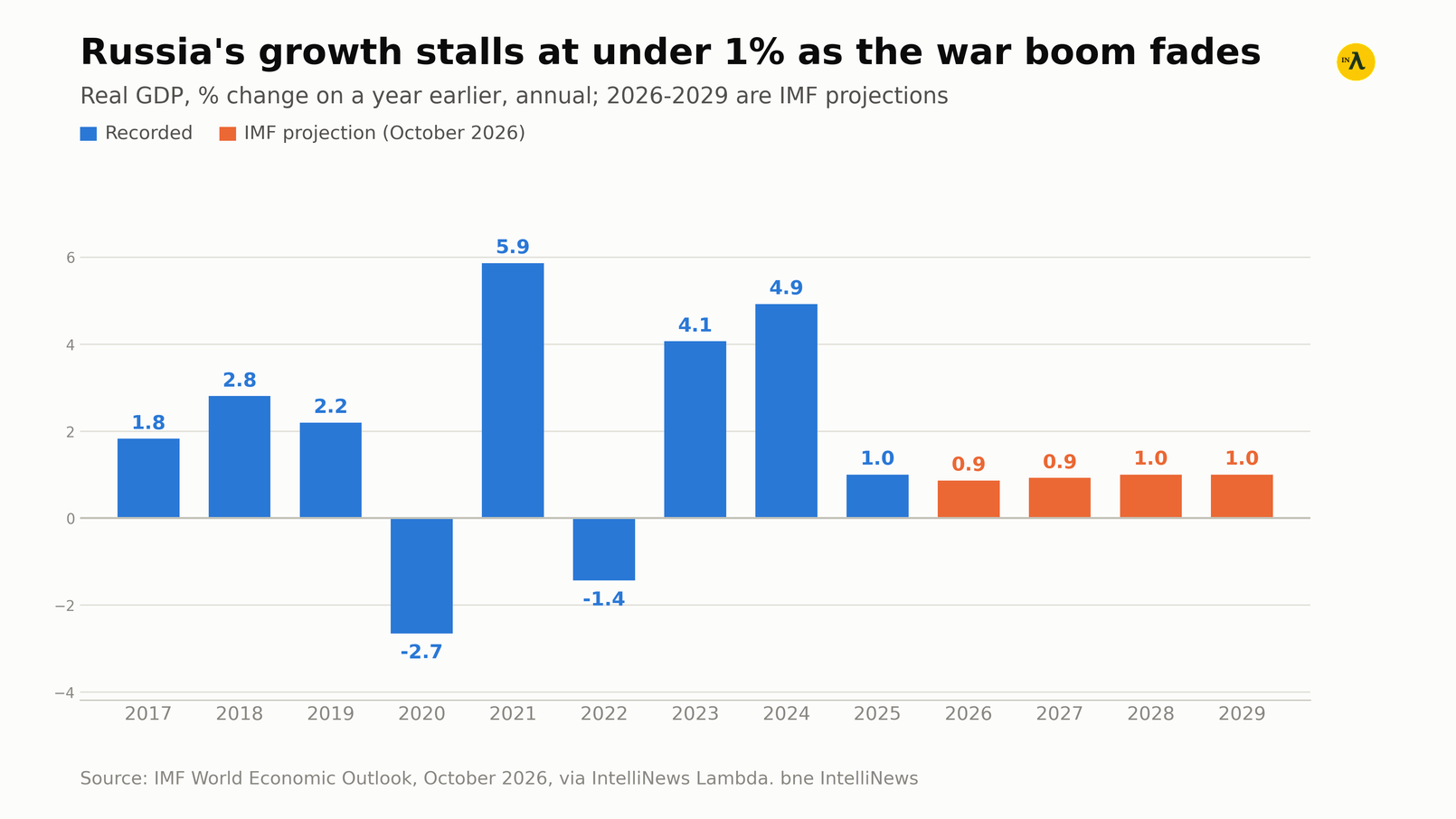
Russia's GDP growth has collapsed from nearly 5% in 2024 to under 1%, and the IMF does not see it recovering before the end of the decade. Source: IMF World Economic Outlook, October 2026, via IntelliNews Lambda.
The bankruptcy wave that has not broken
Two years ago, analysts were warning that Russia faced a wave of bankruptcies as borrowing costs skyrocketed, and Rostec CEO Sergei Chemezov warned in October 2024 that "most of our businesses will go bankrupt" if rates stayed above 20%. Others warned of a credit crisis building up in the state-directed soft loans the Kremlin pushed banks to extend to the defence sector.
Neither has happened yet: corporate bankruptcies actually fell in 2025 as companies leaned on loan restructurings: Fedresurs counted 3,208 liquidation proceedings in the first half of 2025, down 26.5% y/y, and the second quarter was the lowest since the registry began publishing the data in 2011, Rossiyskaya Gazeta reported.
Bankruptcies are now rising again. Russian courts declared 3,547 companies bankrupt in the first half of 2026, up 10.8% y/y, with the second-quarter count up 21%, Interfax reported on July 16.
Bond defaults are rising faster: the number of default events nearly tripled to 157 in the first quarter of 2026 from 54 a year earlier, and the number of issuers affected rose to 29 from 16. Rating agency ACRA counted 13 defaulting companies in the first half against eight a year earlier, though first-time defaulters still made up only about 0.1% of the debt market.
So far the distress has been absorbed by banks rolling over loans and by deep cuts in dividends: listed companies cut their payouts for 2025 by a quarter to about RUB2 trillion ($24.7bn) to service their debt. A wave of failures has started among the most exposed, and the infrastructure builders' association told Kommersant that the failures it expected within one to two years had begun to arrive within six months.
Thirteen drowning men, and counting
In September 2025 The Bell ran the CBR's own debt-stress test on public accounts and named the 13 "drowning men" among Russia's largest borrowers, with combined net debt of almost RUB3.5 trillion ($37bn at the time), or 1.7% of GDP.
The list was: United Aircraft Corporation (UAC), Mechel, Globaltruck, Transmashholding, Kurganmashzavod, Rusal, Acron, En+ Group, Sollers, OVK (United Wagon Company), TMK, Polymetal Russia and Petropavlovsk. Several are state-owned or Rostec subsidiaries. UAC alone had net debt of RUB2.18 trillion and a net debt to Ebitda ratio of 29.5x.
The list has grown since: by November 2025 the CBR had raised its own count of distressed companies to 17 of the 89 largest firms it surveys, which together account for 39% of GDP, and said companies with excessive interest burdens held 58.5% of corporate debt. In its best-case scenario of a 14% average key rate in 2026, that share would rise to 63.8%. The key rate has averaged close to that level this year.
The CBR has not named names, but a list drawn up today would almost certainly be longer still. Housebuilder Samolet, food retailer Magnit, electronics chain M.Video, developers LSR Group and Etalon, Aeroflot and Russian Railways have all since swung into losses, missed payments or sought state help, and Rosneft's debt ratio is at a five-year high. On those numbers the list would run to at least 20 large companies.
Who is hurting
Rosneft: Rosneft's managers have privately warned that the company cannot keep paying for the endless repair of refineries hit by Ukrainian drones, Bloomberg reported on October 22, citing people familiar with the matter.
Plants are frequently struck again just as repairs are completed, and some have deliberately slowed repairs, stretching work that should take days into weeks. Company officials fear that even a few more months of war could leave lasting damage across the business.
Rosneft runs 12 refineries with about a third of Russia's refining capacity. Its Ryazan refinery, which supplies Moscow, has been shut for more than half the time since it was first attacked in May, Syzran has spent much of the past six months shut or running at under a third of capacity and the Tuapse plant on the Black Sea has been offline since April.
Ukraine has carried out at least 114 strikes on Russian refineries so far this year, more than double the same period of 2025, according to Bloomberg's count, and Russia lost three refineries in five days in August. Sanctions mean replacement parts for crackers and reformers must come from Russian copies or Chinese imports that can take months to arrive. Most of the repair bill falls on the companies, not the state.
Rosneft refined 35.5mn tonnes of crude in the first half, down from 38.7mn tonnes a year earlier, and its net profit fell by 18.4% to RUB200bn ($2.5bn). Its net debt to Ebitda ratio rose to 1.8x at the end of June, the highest in more than five years.
AvtoVAZ: The Rostec-controlled carmaker, which became state-owned again after Renault's exit, faces a different problem: the state is pulling its support. AvtoVAZ's production and sales could fall by 20-25% before the end of the year because the money for subsidised car loans has run out, Dmitry Klementyev, a deputy department director at the Industry and Trade Ministry, said on October 23. State schemes financed 123,000 car loans and 54,800 leases in the first nine months, out of 968,000 new car sales, and the draft budget cuts car-loan subsidies from RUB20bn ($247mn) this year to RUB7bn a year in 2027-2028.
New car sales fell by 6.2% y/y in September, after the first monthly fall of the year in August, and dealers said about 70% of car loan applications were rejected over the summer. Lada sales were down 0.4% y/y in the first nine months at 236,806 units. Car production rose by 26.4% in the first eight months, but only against a weak 2025, when AvtoVAZ put its workers on a four-day week to clear unsold stock.
Aeroflot: The state carrier slipped into a net loss of RUB0.6bn ($7.4mn) under Russian accounting standards in the first half, against a profit of RUB107.8bn a year earlier that was inflated by currency gains and an insurance payout, as jet fuel costs rose 16% y/y. Renaissance Capital said the airline's second-quarter IFRS results were held up mainly by a 10-fold rise in payments under the state's jet fuel damper, which it expects to contribute around RUB90bn ($1.1bn) to profit this year.
Drones have closed Moscow's airports repeatedly; more than 200 flights were cancelled there on October 17 alone. Ukrainian President Volodymyr Zelenskiy warned airlines and insurers on September 2 that "Russian airspace is becoming completely unsafe", after which Turkey's Pegasus Airlines cancelled dozens of flights to Russia. Compensation for the losses is "not currently on the agenda", said Dmitry Yadrov, head of the Federal Air Transport Agency, who was appointed transport minister on October 23.
Infrastructure contractors: Companies working on civilian state contracts are in the worst shape. Overdue bank debt at 22 large infrastructure builders more than doubled between March and August to almost RUB9bn ($111mn), Kommersant reported on October 23, citing the National Association of Infrastructure Companies. Clients have unilaterally terminated 18 contracts worth RUB80.5bn ($992mn), banks are refusing loans and guarantees even to borrowers with clean records, and two members are already in bankruptcy proceedings. Regional spending on infrastructure fell by 19% in the first nine months.
Russian Railways: The state rail monopoly is struggling to service about RUB4 trillion ($49.3bn) of debt and the government has been discussing a rescue since last December, when its profits had already collapsed. It has cut its investment programme by 40% in 2025 and a further 20% in 2026, put 49% of its Federal Freight Company up for sale and is trying to shift costs onto shippers. Freight tariffs have been raised three times in the past year by about 20% in total, a bill paid by the same civilian industries that are shrinking. Loadings fell 0.7% in the first nine months and 1.2% in September, led by ferrous metals (-8.5%), oil and oil products (-7.9%), chemicals (-6.7%) and construction materials (-3.7%).
Coal: The coal industry is in outright crisis. Output fell 6.1% y/y to 105mn tonnes in the first quarter, the sector lost RUB55bn ($678mn) in January and February alone and 59% of coal companies were loss-making. Mechel, one of the original 13, produced its least coal in a decade last year, and a Carnegie paper argued in April that the sector is running out of political cover. The government has refused broad support to steelmakers and prefers targeted help only for companies in proven distress.
Banking: The banks are the one sector doing well out of high rates. The sector earned RUB3.2 trillion ($39.4bn) in the first eight months, up 40% y/y, with a return on equity of 22%, as net interest margins widened to 5.5% in the second quarter. The CBR raised its 2026 forecast for sector profits to RUB3.9-4.4 trillion. Overdue corporate loans are steady at 3.5%, but retail arrears have crept up to 5.9%.
Retail: Supermarkets are being squeezed between soaring wage, rent and power bills and shoppers who are spending less. Magnit, the second-largest food retailer, swung to a net loss of RUB2bn ($24.7mn) in the first half as net financial expenses rose 65% to RUB48bn and personnel costs rose 16%. Market leader X5 missed its sales growth targets in the first quarter but still paid out 158% of its net profit in dividends, by Renaissance Capital's estimate. Electronics chain M.Video has dropped out of the country's top 10 retailers after its quarterly revenue fell 40%.
Real estate: Developers have been in trouble since the mass subsidised mortgage programme ended in mid-2024. Samolet, Russia's largest housebuilder by construction volume, slipped into a technical default on a RUB2.5bn ($31mn) bond in September, its second payment slip in five months, after the government refused it a RUB50bn concessional loan. It lost RUB22.3bn ($275mn) in the first half on revenue down 31%, carries more than RUB1.1 trillion of debt, has lost its CEO and only on October 23 won back project financing from Gazprombank for one of its biggest Moscow projects. Renaissance Capital calculates that Samolet's operating earnings covered only 0.7x its net interest bill.
PIK, long the market leader, is in better shape. It still holds net cash, but its first-half revenue fell 12% y/y to RUB290bn ($3.6bn), Renaissance Capital's own measure of its Ebitda fell 64%, and its owner is preparing to delist the company. LSR Group and Etalon both widened their losses.
Mortgages: Market mortgage rates remain out of reach for most buyers, leaving demand dependent on the subsidised Family Mortgage. Issuance jumped 63% m/m in September as buyers rushed to borrow before the programme was tightened on October 1, after which the subsidised rate depends on the number of children. Each previous rule change has produced a similar spike followed by a slump.
SMEs: Conditions for small business have deteriorated rapidly this year. About 209,000 small and medium-sized enterprises shut down in the first quarter, up almost 9% y/y, with retailers, beauty salons and restaurants hit hardest after the VAT rate rose two percentage points to 22% in January. In an Opora Russia survey, 53.5% of small businesses said they could no longer pass on higher costs to customers.
Behind most of these problems is a squeeze on consumers. Real disposable incomes rose by 5.8% in 2023 and 7.3% in 2024 as war spending and labour shortages pushed up wages, creating a new war middle class and a consumer boom. That boom is over: real wage growth slowed from 8.6% in January-February to 3.3% in July, retail and services turnover growth slowed to 2.9% in August and inflation has climbed back above 7%.
Only the war is growing
Industrial production fell 0.6% y/y in August and was flat over the first eight months of the year. The fastest-growing sector was fabricated metal products, where Rosstat also books weapons and ammunition, up 11.4%. Oil refining fell 17.8% in August, chemicals 4.7% and textiles 8%. Renaissance Capital estimates that output in the manufacturing segments dominated by state orders rose 10.8% in the first eight months, while the rest of manufacturing fell 1.7%. Over four years of war manufacturing output has risen by 18.3%, but defence-related industries account for all of that growth and more, so civilian manufacturing has shrunk.
Guns before roads
Investment is the key complaint of government and economists alike: companies are not investing enough, and affordable capital is hard to come by. Fixed capital investment fell by 9.9% in the first half, according to Rosstat data cited by The Bell, and Economic Development Minister Maxim Reshetnikov expects it to return to growth only "sometime around 2028". Since April his ministry has cut its forecast for investment in 2026 from a 1.5% fall to a 5.4% contraction, but still predicts GDP growth of 0.6% this year and 1.4% next year. The IMF is gloomier, seeing growth below 1% in both years.
Defence keeps taking a bigger share of the budget. The draft budget puts defence spending at a record RUB17.1 trillion ($210.8bn) in 2027, about 35% of total federal spending, and 27% more than had been pencilled in for 2027 a year ago. Military spending will approach RUB17 trillion this year against an original allocation of RUB12.1 trillion, according to Bloomberg's sources. Add national security and law enforcement and the security apparatus gets 44% of all spending in 2027, more than twice the 21% going on social policy, health and education, Carnegie's Alexandra Prokopenko calculated.
To pay for it the government is raising taxes again and cutting everything else. Planned spending in 2027 compared with the 2026 budget plan:
| Budget category | Planned change in 2027 vs 2026 plan |
| National economy, incl. roads, infrastructure and farm subsidies | -7.4% |
| Social policy | -7.0% |
| Healthcare | -6.8% |
| Education | -6.0% |
Source: draft 2027 federal budget, via The Bell.
The cuts land on the same roads, subsidies and loan programmes that kept civilian companies afloat. Drone strikes are hitting refineries and logistics directly, the budget is diverting money to the military, and falling investment means the new capacity that would power growth once military spending stops rising is not being built.
Unlock premium news, Start your free trial today.


